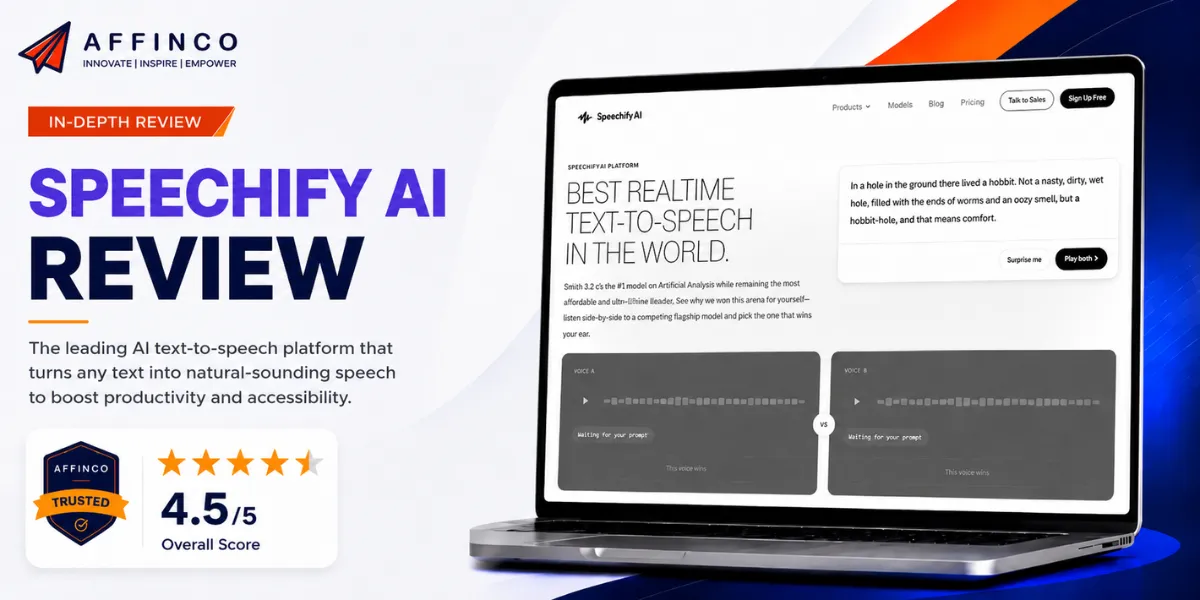
Let us start with a confession. Our team did not go looking for a new voice platform. We were happy. For over a year, ElevenLabs ran our entire audio stack. Our founder's voice is cloned there. It is wired into n8n. It narrates our YouTube channel. We were not shopping.
Then two things happened. The ElevenLabs bill kept climbing. And Speechify's new model, Simba 3.2, quietly took the number one spot on the Artificial Analysis text-to-speech leaderboard.
So we tested it. Then we moved a large part of our voice workload over. This is the honest, hands-on report on what we found, what it costs, where it beats ElevenLabs, and the places where ElevenLabs is still the better tool. No hype. Just what happened when a working agency put real traffic through it.

Speechify AI is the best value voice API we have tested in 2026. Simba 3.2 genuinely sounds top tier, the pricing is a fraction of the competition, and the built in voice agents replaced a separate tool for us. It is not perfect.
The flagship model is English only and the voice library is small. But for agencies and ecommerce teams that need cheap, high quality speech plus real phone agents, it is a very easy recommendation.
50,000 characters a month, no card needed
First, Clear Up What Speechify AI Actually Is
There is a naming trap here, so let us kill the confusion early.
Most people know Speechify as the reading app. The one that reads your PDFs and articles aloud on your phone. That is speechify.com, and it has around 50 million users.
This review is not about that.
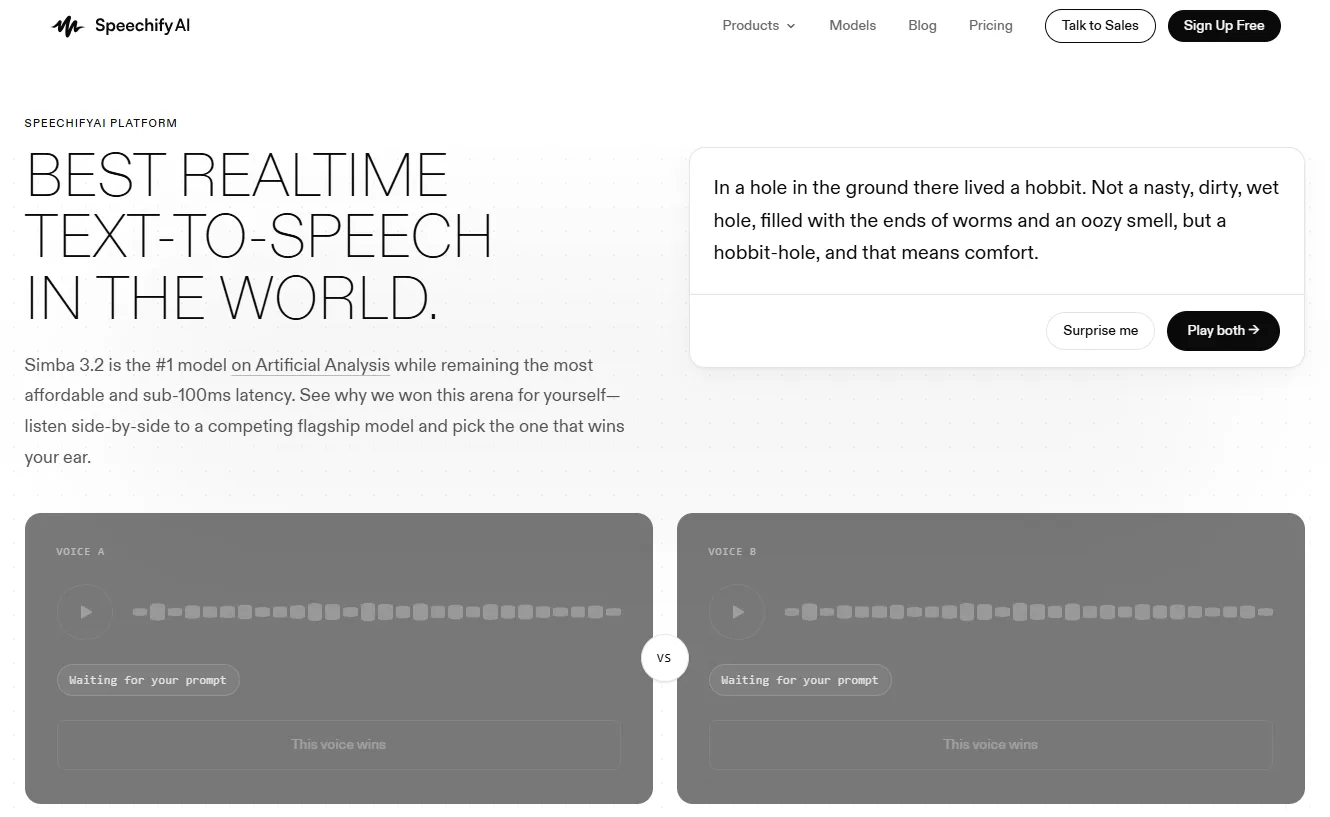
This is about speechify.ai, the developer platform. It is a completely different product aimed at builders. You get raw text-to-speech models, zero-shot voice cloning, and real-time voice agents, all through one API. Think of it as the engine, not the app.
If you build anything that needs a voice, this is the side that matters. And it is the side almost nobody is reviewing properly yet.
Why This Market Is Moving So Fast
Before the review proper, a bit of context, because it explains why a tool like this matters now.
Voice AI is in the middle of a boom. The narrow text-to-speech market sat around $4 billion in 2024 and is tracking toward $7.6 billion by 2029, growing about 14% a year.
The generative slice, the AI voice generators specifically, is growing far faster, close to 30% a year toward roughly $22 billion by 2030. Zoom out to the whole conversational and voice AI category and the forecasts run from $14 billion today to somewhere between $79 billion and $145 billion within a decade.
Two shifts are driving it. First, quality crossed a line. Modern models no longer sound synthetic, so businesses are comfortable putting them in front of customers.
Second, and this is the big one, the category moved from reading text aloud to holding a conversation. The money is no longer just in narration. It is in real-time voice agents that answer phones, qualify leads, and follow up with customers.
That is the exact wave Speechify is riding, and it is why we cared enough to test it. A platform that leads on benchmark quality and bundles real phone agents is aimed squarely at where this market is heading, not where it was.
The Backstory: A Year on ElevenLabs
To judge Speechify fairly, you need to know where we came from.
ElevenLabs was, and still is, brilliant for content creation. We cloned our founder‘s voice there in 2025. The likeness is excellent. We use it for long form YouTube narration, and we automated the whole pipeline through n8n, so a script goes in and finished audio comes out.
We are not knocking it. For that job, it earns its keep.
The problem was everything else. As we started adding voice to client systems, follow up calls, internal reminders for our own staff, and simple text-to-speech inside apps we build, the cost model started to bite. Character heavy work on premium voices adds up fast. And stitching together a separate tool for phone agents made the stack messy.
We wanted one cheaper engine that could do the boring, high volume voice work at scale, so we could keep ElevenLabs for the premium creative jobs. That is the exact gap Speechify walked into.
The Simba Models, Explained Simply
Speechify runs its own in house model family called Simba. There are two you need to care about, and they do different jobs.
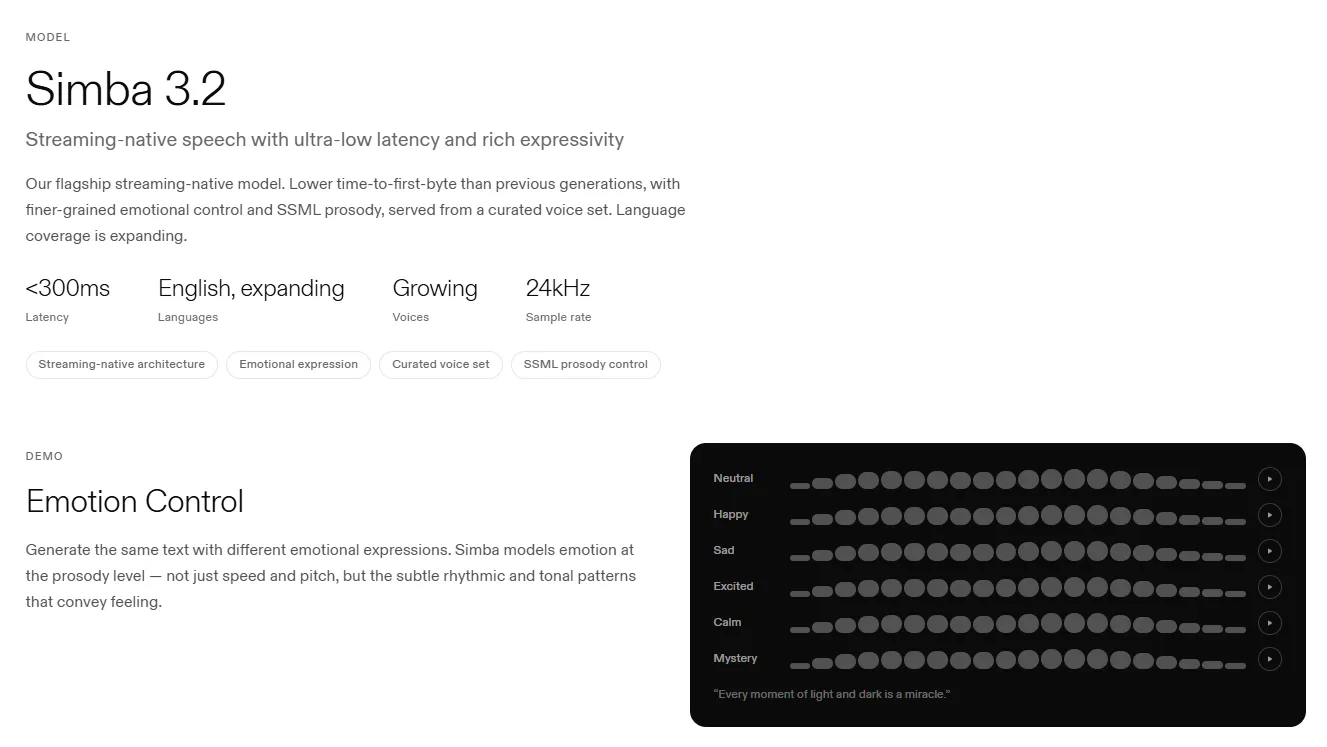
Simba 3.2 is the flagship. It is a streaming native model built for real-time speech, which is a fancy way of saying it starts talking almost immediately. Speechify quotes a sub-100ms headline, though the technical pages put the real time-to-first-byte at around 300 milliseconds.
Either way, it is fast enough for live phone calls. The catch is that Simba 3.2 is English only for now, with a small set of API voices. Speechify says more languages are coming.
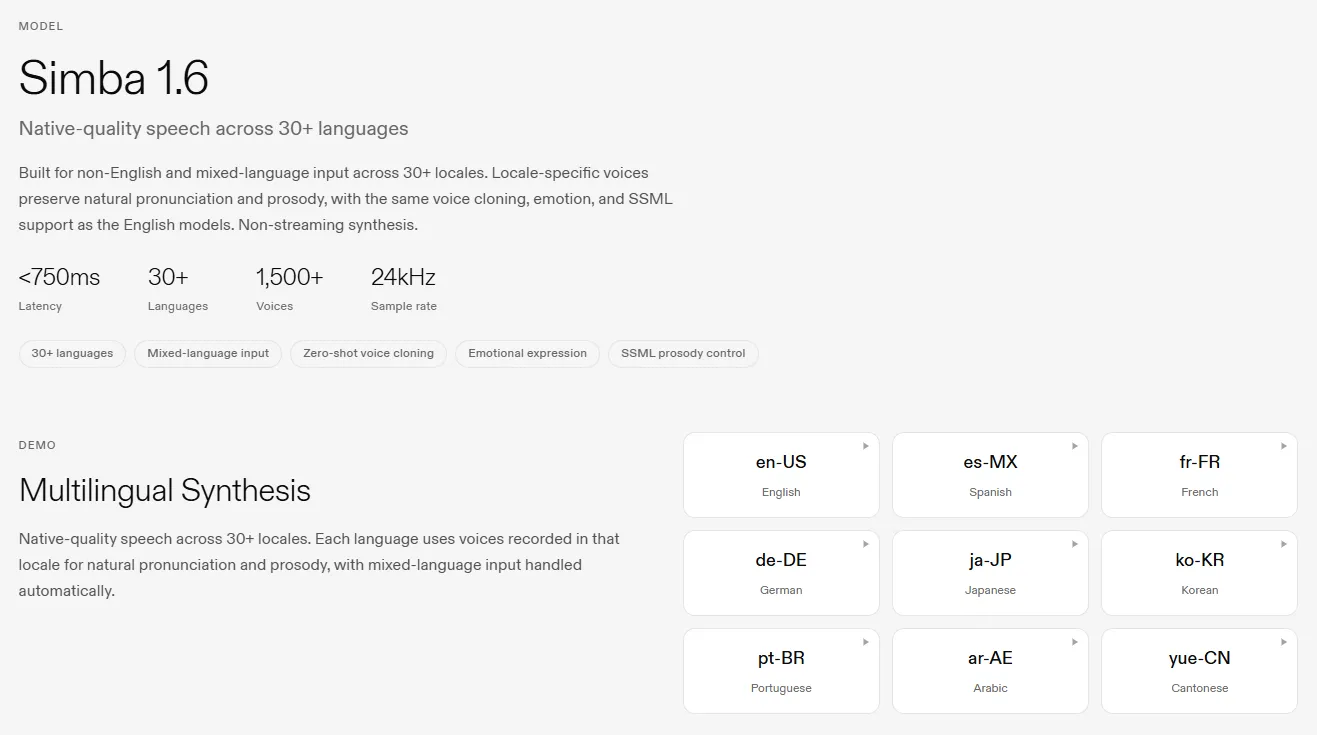
Simba 1.6 is the multilingual workhorse. This is the one with real range: over 30 languages and more than 1,500 voices. It is not as instant as 3.2, but it is where you go for localisation and scale.
Here is the side by side.
| Simba 3.2 | Simba 1.6 | |
|---|---|---|
| Role | Flagship real-time model | Multilingual workhorse |
| Languages | English (expanding) | 30 plus |
| Voices | Small, growing set | 1,500 plus |
| Time to first byte | Around 300ms | Under 750ms |
| Streaming | Yes, streaming native | Standard synthesis |
| Emotion control | Prosody level, 13 styles | Supported |
| Best for | Voice agents, live calls | Voiceover, dubbing, localisation |
You switch between them with a single parameter in the same API call. That detail matters more than it sounds, and we will come back to it.
The Benchmark That Made Us Look Twice
We are naturally sceptical of vendor claims. So the thing that actually got our attention was independent.
In July 2026, Simba 3.2 took the number one position on the Artificial Analysis Speech Arena. That is the closest thing this industry has to a neutral scoreboard, scored by blind human preference. Simba 3.2 landed at an Elo of around 1,230, ahead of Cartesia Sonic 3.5, Google Gemini 3.1 Flash TTS, and every evaluated model from ElevenLabs and OpenAI.
Read that again. A tool most people think of as a phone reading app is currently beating the giants on raw voice quality.
We will add the honest caveat. The exact Elo figure is quoted by Speechify, and leaderboard positions move week to week as new models drop. But the number one placement itself was confirmed by Artificial Analysis directly, not just by Speechify's marketing. That was enough to make us open our wallet and test.
Zero-Shot Voice Cloning That Needs Ten Seconds
This is where Simba earns its reputation.
Reference – Original speaker
Clone – Simba output
Speechify does zero-shot voice cloning. You give it a short reference clip, and it produces a usable clone with no training run and no waiting. The docs accept a sample as short as 10 seconds, and the model captures more than just the tone. It picks up identity, timbre, cadence, and the small micro-expressions that make a voice sound like a person rather than a robot.
We tested it against our existing ElevenLabs clone. Honest result? ElevenLabs still has the edge on a deeply fine tuned professional clone, because it has a dedicated high fidelity cloning tier we had already invested time in. But Speechify's ten second zero-shot clone was shockingly close for the effort involved, which was almost none.
For fast, disposable, or multi voice work, zero-shot from ten seconds is a genuine unlock.
Emotion and Multilingual Control
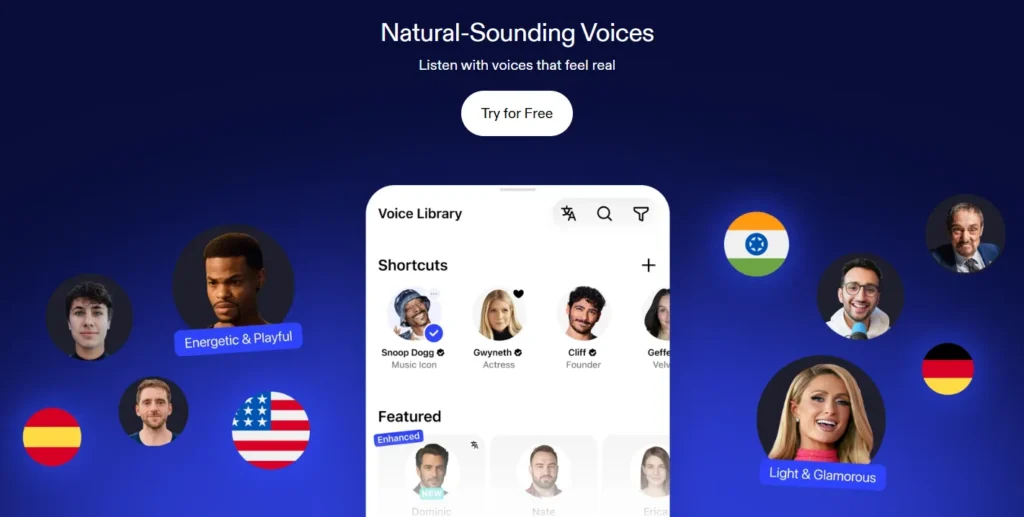
A flat voice kills a phone call. Speechify handles this at the prosody level, not with crude speed and pitch sliders.
You get emotional control through style tags in the API, with 13 distinct registers available and a handful demoed openly, including neutral, happy, sad, excited and calm. It reads rhythm and tone, not just words.
For languages, Simba 1.6 covers over 30, with mixed language input supported, so a single line can switch tongues mid sentence. For an ecommerce brand running stores across regions, that is the localisation lever.
The One API That Changed Our Workflow
from speechify import Speechifyclient = Speechify( token="YOUR_TOKEN_HERE",)client.audio.speech( input="Hello! This is the Speechify text-to-speech API.", voice_id="geffen_32", audio_format="mp3",)Here is the part that sold our developers.
Everything runs through a single unified API. Text-to-speech, voice cloning, and the voice agents all sit behind one key and one bill. There is a good mental model for this. If you have used Firecrawl, where one clean API handles all your web scraping, Speechify is that same idea for voice. One endpoint, one integration, anything you need.
Practically, that means one call to generate speech, one to clone a voice, one to spin up an agent. It streams audio in chunks for real-time playback. It supports SSML for fine control. It returns word level timestamps for caption syncing. And it outputs telephony ready formats like u-law, which is exactly what you need to pipe a voice down a phone line.
Because it is a straightforward REST API with a bearer token, you can call it from anything. Your own app, your backend, an automation in n8n or Make, or an agent framework. It slots into a modern AI stack without drama.
Two honest limits to note. There is a cap of 20,000 characters per request, and concurrency is capped per plan rather than being truly unlimited. So the popular claim that there is no rate limit at all is a stretch. In practice the limits are generous, but they exist.
The Real Reason We Switched: Voice Agents
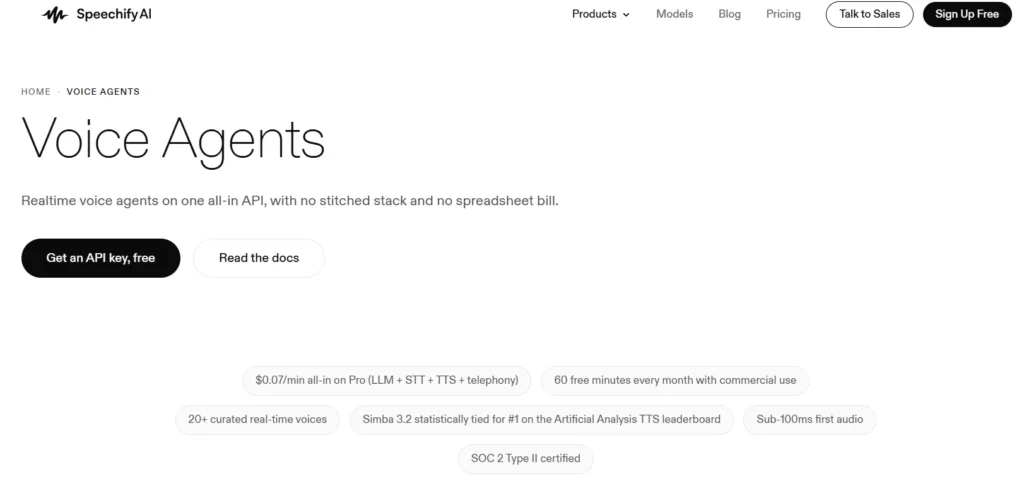
Text-to-speech got our attention. The voice agents got our money.
Speechify AI Agents are full real-time conversational agents that listen, think, and speak on a live call. This is not a recording. It is a voice that holds a two way phone conversation, and it is baked into the same platform.
What they can do is genuinely useful for an agency:
They handle inbound and outbound calls over SIP, so you can provision a real phone number and connect it to the phone network. They support tools and function calling, which means the agent can hit your CRM or booking system in the middle of a call.
They take a knowledge base, so you upload your documents or a sitemap and the agent answers from it. They keep memory across a conversation. They stream webhook events. And the whole thing is SOC 2 Type II certified, with tuning presets for regulated industries like healthcare, insurance and real estate.
The pricing model is the kicker. It is one all-in rate of about $0.07 per minute that covers the language model, the speech to text, the text-to-speech, and the telephony. One line item. No token maths. No stitching three vendors together.
Here is where our own use case comes in. For our client work and our internal operations, we needed voice for follow up calls, appointment reminders, simple cold outreach, and staff follow ups. On the $99 Pro plan we get 1,200 agent minutes a month included. That is roughly 40 minutes of calls every single day before we pay a cent extra, and after that it is just seven cents a minute. For that job, nothing we tested came close on price.
Real use cases we are running or testing
Pricing, Decoded
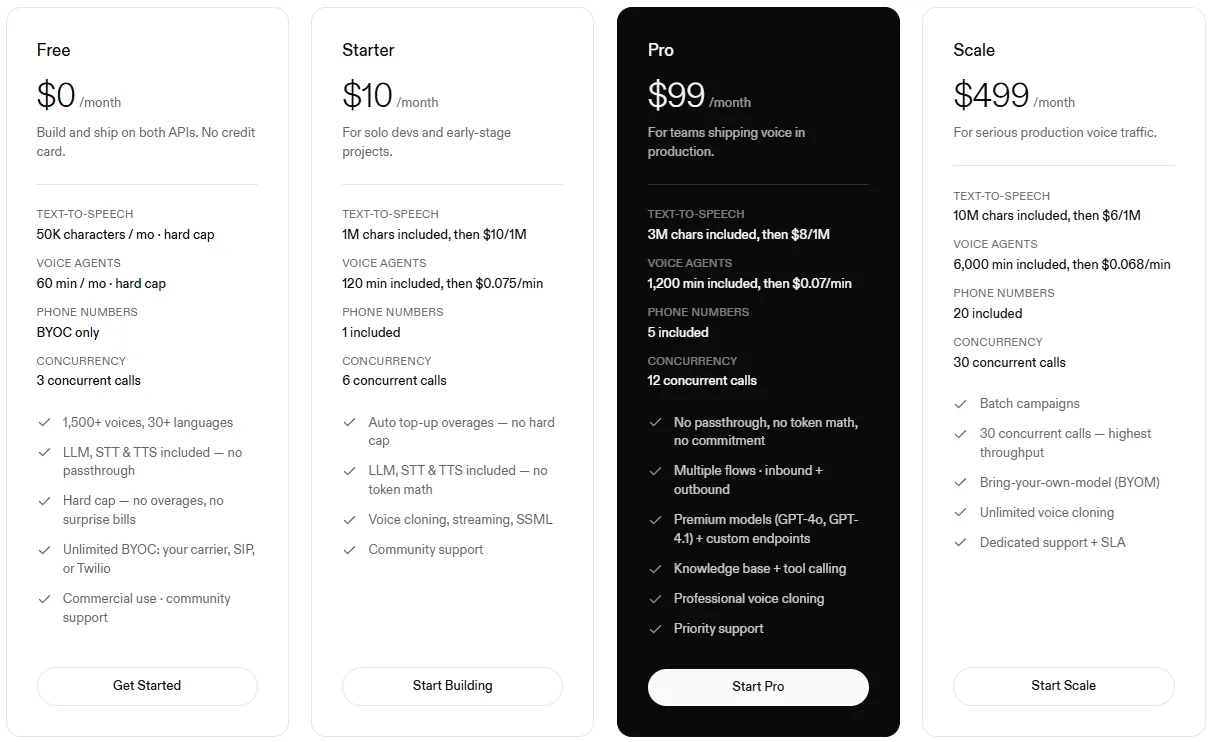
Speechify's pricing is refreshingly blunt. Here is the full picture, verified on their pricing page.
| Plan | Price | TTS characters | Extra characters | Agent minutes | Extra minutes | Phone numbers | Concurrent calls |
|---|---|---|---|---|---|---|---|
| Free | $0 | 50,000 | none | 60 | none | Bring your own | 3 |
| Starter | $10 | 1 million | $10 per 1M | 120 | $0.075 | 1 | 6 |
| Pro | $99 | 3 million | $8 per 1M | 1,200 | $0.07 | 5 | 12 |
| Scale | $499 | 10 million | $6 per 1M | 6,000 | $0.068 | 20 | 30 |
| Enterprise | Custom | Volume | Custom | Custom | from $0.06 | Custom | Custom |
Look at the free plan for a second. Fifty thousand characters a month, free, plus 60 agent minutes. For context, that is five times the free character allowance of ElevenLabs. You can build and test a real prototype without paying anything.
The Starter plan at $10 is almost a joke in a good way. One million characters, 120 agent minutes, and a real provisioned phone number, all for the price of two coffees.
For most agencies and ecommerce teams, the $99 Pro plan is the sweet spot. Three million characters, 1,200 agent minutes, five phone numbers, and twelve concurrent calls. That is a serious amount of voice for under a hundred dollars, with no annual lock in. You pay month to month, and you can leave whenever.
What we actually pay: We run Pro at $99. Our call volume sits comfortably inside the 1,200 included minutes, and our TTS work rarely touches the 3 million character ceiling. Compared with what we were spending before, it is not close.
Speechify vs ElevenLabs: The Honest Head to Head
This is the comparison everyone wants, so let us do it properly, with the good and the bad.
| Factor | Speechify AI | ElevenLabs |
|---|---|---|
| Benchmark quality | Number 1 on Artificial Analysis | Ranks below Simba 3.2 |
| Flagship languages | English only on Simba 3.2 | 70 plus on Eleven v3 |
| Voice library | Small on the API, 1,500 plus on Simba 1.6 | 10,000 plus community voices |
| Free tier | 50,000 characters | 10,000 characters |
| Cost per 1M characters | $6 to $10 | Effectively far higher at scale |
| Professional cloning | Zero-shot, very good | Dedicated pro tier, best in class |
| Creative suite | TTS and agents | Studio, Dubbing, Music, Sound Effects |
| Voice agents | Built in, $0.07 per minute | Built in, $0.08 per minute |
| Commitment | Month to month | Month to month |
One correction worth making, because we have seen it repeated. ElevenLabs does not actually start at $50 or $100. It has a free tier and a $6 Starter plan. So it is not expensive to begin with.
The real difference is what happens at volume. On heavy, character rich workloads and premium voices, ElevenLabs gets expensive quickly, while Speechify's $6 to $10 per million characters stays cheap as you scale. That, plus the five times larger free tier, is the honest cost story.
Where ElevenLabs Still Beats Speechify
We promised a real review, not a sales page. So here is where we are keeping ElevenLabs, and where you should too.
So our real world split is simple. Premium creative and multilingual content stays on ElevenLabs. High volume TTS and all our phone agents moved to Speechify.
The Other Alternatives Worth Knowing
Speechify and ElevenLabs are not the only players. Here is who else matters, and who each one is for.
Hume AI is the empathy specialist. Its Octave and EVI models read the emotion in a caller's voice and respond in kind.
If your use case lives or dies on sounding genuinely warm and human, Hume is worth a look. It covers fewer languages, around 11, and real world call latency runs a little higher.
Deepgram is the low latency and enterprise pick. We have used it ourselves. Its speech to text is fast and accurate, its Voice Agent API is solid at about $0.075 a minute, and it deploys on premise or in your own cloud for HIPAA sensitive work.
The trade off is that its voices are business plain rather than expressive, and it clones nothing by default.
OpenAI is the convenient option if you already live in its ecosystem. The gpt-4o-mini-tts model is cheap and steerable, and the Realtime API can run voice agents. But there is no self serve voice cloning, and the realtime audio pricing gets expensive.
Cartesia is the speed king. Its Sonic model hits first audio around 90 milliseconds and runs on device, which is superb for latency critical agents at scale. It sits just behind Simba on the quality benchmark.
For most agencies, the shortlist that matters is Speechify, ElevenLabs, and one of Deepgram or Hume depending on whether you optimise for cost or for empathy.
How Speechify Fits an Agency or Ecommerce Stack
Here is the practical part. You do not have to pick one tool for everything. We do not.
Use Speechify as your default voice engine. Route all your high volume, cost sensitive text-to-speech through it, and run every phone agent on it. The price and the benchmark quality make it the sensible base layer.
Keep ElevenLabs for premium creative. Long form narration, your signature cloned brand voice, dubbing, and anything multilingual and high stakes.
Wire both into your automations. Because Speechify is a clean REST API, it drops straight into n8n, Make, or your own app, the same way you already connect other tools.
That combination gave us lower costs, one phone agent platform instead of a bolted together mess, and no loss of quality where quality actually mattered.
Who Should Switch, and Who Should Not
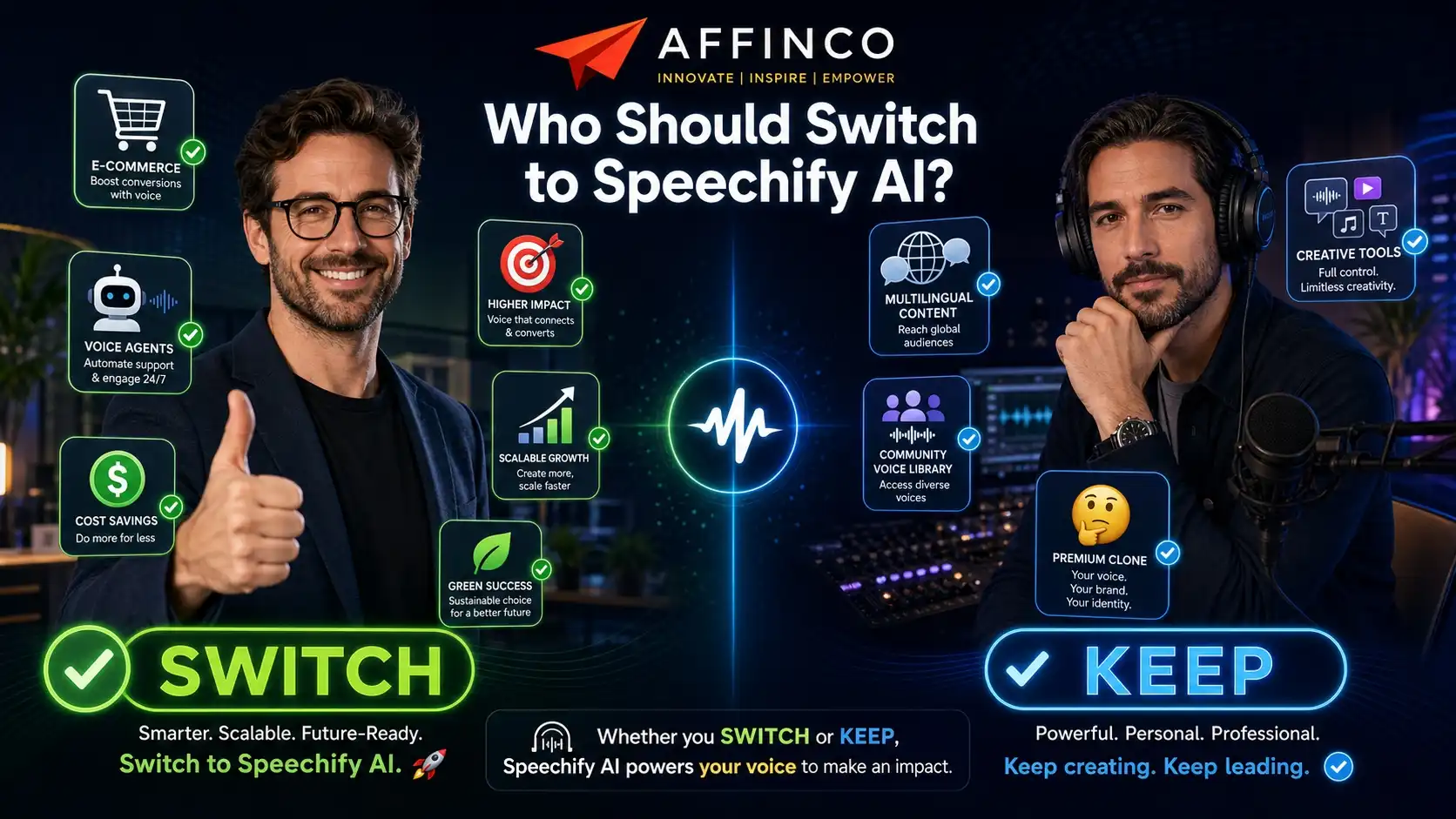
Switch to Speechify if you are an agency, an ecommerce brand, a media buyer, or a developer who needs cheap high quality voice at scale, and especially if you want real phone agents without paying for a separate platform. The free tier means there is no reason not to test it today.
Do not switch your whole stack if your work is mostly premium multilingual content, if you rely on a large community voice library, or if you have a deeply tuned professional clone already living happily somewhere else. In that case, add Speechify for agents and volume, but keep your creative tool.
Frequently Asked Questions
Is Speechify AI the same as the Speechify reading app?
No. The reading app lives at speechify.com and reads documents aloud. This review covers speechify.ai, the developer platform that gives you text-to-speech models, voice cloning, and voice agents through an API. They share a brand, not a product.
Is Simba 3.2 really the best text-to-speech model?
As of July 2026, Simba 3.2 ranks number one on the Artificial Analysis Speech Arena, which is scored by blind human preference. That places it above ElevenLabs, OpenAI, Cartesia and Google on raw quality. Rankings do shift as new models launch, so treat it as current, not permanent.
How much does Speechify AI cost?
There is a free plan with 50,000 characters and 60 agent minutes a month. Paid plans are $10 Starter, $99 Pro, and $499 Scale, with Enterprise custom. Extra characters run from $6 to $10 per million, and voice agent minutes run from about $0.06 to $0.075 depending on tier.
Can Speechify make real phone calls?
Yes. Speechify AI Agents make and receive live calls over SIP, provision phone numbers, follow a knowledge base, and call your other systems through function calling, all at roughly $0.07 a minute all inclusive. This is what sets it apart from pure text-to-speech tools.
How does Speechify compare to ElevenLabs?
Speechify wins on benchmark quality, price, and free tier size, and it matches ElevenLabs on built in agents. ElevenLabs wins on language breadth, voice library size, professional cloning, and its wider creative suite. Many teams use both.
How good is the voice cloning?
Speechify does zero-shot cloning from as little as 10 seconds of audio, capturing timbre, cadence and micro-expressions. It is very good for fast work, though a dedicated professional clone on ElevenLabs still edges it for broadcast grade fidelity.
Does Speechify have a free API tier?
Yes. The free plan includes 50,000 characters and 60 voice agent minutes each month with no card required, which is enough to build and test a working prototype before you pay anything.
The Affinco Verdict
Speechify AI surprised us, and we do not say that often. It is the rare tool where the marketing undersells the substance.
The Simba 3.2 model is objectively excellent, sitting at number one on the only independent benchmark that counts. The pricing is the most aggressive in the category, with a free tier five times bigger than ElevenLabs and a Pro plan that bundles serious voice agent minutes for $99. The single unified API made it painless to adopt. And the built in voice agents let us delete a separate tool from our stack entirely.
It is not flawless. The flagship model is English only, the API voice selection is thin, and the wider ecosystem is younger than ElevenLabs. We were honest about those.
But for the specific job most agencies and ecommerce teams actually have, cheap reliable speech plus real phone agents, it is now our default. We moved real work onto it and we are not moving back.
 AFFINCO Verdict
Speechify AI Voice API
The best-value voice API and AI agent platform in 2026, backed by genuinely benchmark-leading voice quality.
Docked half a point for its English-only flagship model and relatively young ecosystem.
- Benchmark-leading voice quality
- Voice API and AI agent tools
- No payment required to start

Ali
Ali is a digital marketing expert with 7+ years of experience in SEO-optimized blogging. Skilled in reviewing SaaS tools, social media marketing, and email campaigns, we craft content that ranks well and engages audiences. Known for providing genuine information, Ali is a reliable source for businesses seeking to boost their online presence effectively.