
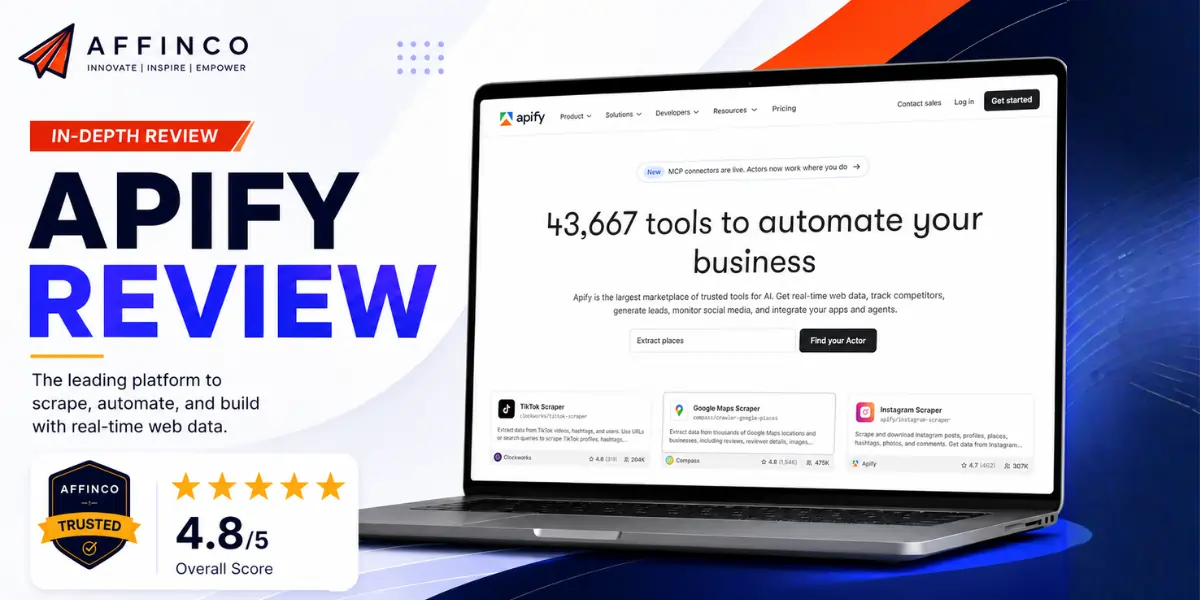
I'll be blunt: Apify is the single most useful tool we've added to our stack in the last two years — and we've tested a lot of tools. It's marketed as a web scraper, but that undersells it.
Apify is a full web scraping and automation platform that can pull data from almost anywhere on the internet — Google Ads, competitor sites, Product Hunt, Trustpilot, Instagram, you name it — and hand it to you as clean JSON in minutes.
This isn't a theory-based review. Our team at AFFiNCO has run Apify hard across client and in-house projects for 3+ months of heavy use, and we've documented every bit of it.

In one 25-day sprint alone we scraped eSIM plans, thousands of Google Ads, competitor sites, Product Hunt launches, and over 16,000 links — and the whole thing cost us about $140. That number still surprises people. Below is our honest, hands-on Apify review, including a step-by-step tutorial, the AI workflow that changes everything, real pricing, and the drawbacks nobody mentions.

⚡ Quick Verdict (TL;DR)
Apify is the best all-round web scraping and automation platform in 2026 for marketers, affiliates, and founders. It gives you 8,000+ ready-made “Actors” (pre-built scrapers) plus the ability to run anything in plain language through Claude, ChatGPT, or Codex via its MCP server.
You can start free with $5/month in credits (no credit card), and paid plans begin at $29/month. It's astonishingly cheap for the volume of data it produces.
The catch: Usage-based pricing and per-result Actor fees can stack up at scale, so you need to watch your spend.
What Is Apify?

Apify is a cloud platform for web scraping, data extraction, and browser automation. The core concept is the Actor — a serverless cloud program that performs one job, like scraping Google search results, extracting Instagram profiles, or pulling reviews from Trustpilot.
You don't have to build these yourself: the Apify Store has thousands of ready-made Actors (8,000+ and growing), published by both Apify and a large developer community.
Around those Actors, Apify gives you everything a serious data operation needs:
In short, it's not “a scraper.” It's the infrastructure layer for any project that needs live web data — which, for an affiliate and marketing business like ours, is basically everything.

Start Scraping Data for Free with Apify
Get $5/month in free platform credits with no credit card required and full access to the Apify Store. Test real-world scrapes from Google Maps, Amazon, and Instagram before spending a single dollar. Scale only when you need to.
👉 Get Your Free Apify CreditsPowered by AFFINCO.com
Why We Use Apify (Our Real Experience)
We've been doing affiliate marketing and running data-heavy projects for over 15 years, so we don't get excited easily. Apify earned its spot.
Here's the honest cost story. We started with a $150 top-up and put it through a brutal 25-day sprint — and even after all that work, we'd only spent about $140. In that time we pulled:

The work that used to take us months — manually collecting coupons from companies, building affiliate-program databases, gathering ad data points — now takes a single day.
That's not marketing fluff; it's our documented reality, and it's the reason Apify is woven into how we operate. If you want to move fast, this is the tool.
What You Can Scrape With Apify (Real Use Cases)
The possibilities really are close to unlimited, because anyone can publish an Actor. Here are the use cases we (and the marketers we know) actually run:
Search & SEO data
Ads & competitor intelligence

There's even a whole ecosystem of tools built on Apify scrapers — for example, many creator-economy analytics tools (including for platforms like Fanvue and OnlyFans) are powered under the hood by Apify. The point: if data exists publicly on a page, there's almost certainly an Actor (or a way) to extract it.
For our agency clients, this feeds directly into SEO services and paid search — competitor intelligence and market data are the foundation of both.
How We Built a 16,000-Link Dataset in One Sprint (Mini Case Study)
To make this concrete, here's one real workflow from that 25-day sprint. The goal: build two assets at once — a directory of AI tools and a database of affiliate programs with their promo codes — for our network.

Here's how it ran:
- Discovery. We used the Google Search Results Scraper and a few directory crawlers to find seed URLs — AI-tool listings, network catalogs, and niche directories worth harvesting.
- Harvest. We pointed the Website Content Crawler (and sitemap-based scraping) at each source. Feed it a sitemap, get back every post and URL — no manual clicking.
- Structure. A general web scraper pulled the fields we cared about: tool name, category, pricing, outbound links, and any visible coupon or offer text.
- Dedupe & export. We exported everything to JSON, deduplicated, and ended up with 16,000+ clean links plus program and coupon data.
- Enrich with AI. We then ran the dataset through Claude to categorize, summarize, and flag the highest-value programs.
Months of manual collection, done in a sprint — and it was a fraction of our $140. That's the workflow that turned us from occasional users into daily ones.
3 Affiliate Plays We Run on Apify
If you're in affiliate marketing, these three are worth copying:
Coupon & deal extraction
Scrape brand offer pages and network dashboards (Impact, Awin, Rakuten) to pull promo codes and terms, then publish them straight to your deal pages — exactly the engine behind a coupon site.
Affiliate-program discovery
Scrape directories and networks to surface every program in a niche (VPN, eSIM, travel, SaaS), then build an outreach list. You find programs competitors haven't touched.
Competitor ad & angle intel
Pull live creatives from the Facebook Ads Library and Google Ads Transparency, see which offers and angles are actually running, and model the winners instead of guessing.
Apify + AI: Claude, ChatGPT, Codex & MCP (The Game-Changer)
Here's where Apify went from “great tool” to “unfair advantage.” Apify connects directly to AI tools — Claude, ChatGPT, Codex, Cursor, and Perplexity — through its official MCP server. That means you can scrape in plain language, without touching the Apify dashboard.
Want hundreds of this week's Product Hunt launches? You just ask Claude. With the Apify MCP connected, Claude searches for the right Actor, runs it, and returns the data — all inside your chat. We use it the same way you'd use a tool like Firecrawl inside Claude or Codex, except Apify has thousands of specialized Actors behind it.

A few things that make this powerful:
- No-code, plain-language scraping. Even on a basic ChatGPT plan or Claude Pro, you describe the task and get a complete JSON result back.
- An API key for builders. If you're building a dashboard or web app in Claude Code or Codex, drop in your Apify API token and it pulls data automatically — perfect for live, self-updating dashboards.
- OpenRouter and utility Actors. There are Actors for everything, including an OpenRouter Actor (use LLM models without separate provider accounts) and a Cloudflare bypass Actor you can route requests through.
- MCP everywhere. Once connected, the same Apify connector works across Claude, ChatGPT, VS Code, and Cursor.
This is exactly the kind of AI-plus-automation workflow we build for clients through our AI Agent & Workflow Automation service — Apify is one of the engines behind it.
Tutorial: How to Start Scraping With Apify (Step by Step)
You do not need to be technical. Here's the exact path, from zero to data.

That's it. A non-technical founder — or honestly, a 10th-grader with Claude — can get real data out of Apify in an afternoon.
How to Choose a Good Actor (So You Don't Waste Credits)

The Store is huge, and the quality of community Actors varies, so a little vetting saves money and headaches:
Integrations & Exports (Including Dropbox)

Apify is built to plug into the rest of your stack:
Between native options, Zapier/Make, and webhooks, there's effectively no tool Apify can't feed.
Apify Pricing (2026)

Apify runs on a monthly platform fee plus pay-as-you-go usage. Here's the current structure (verified 2026):
| Plan | Price | Included Usage | Compute Rate | Best For |
|---|---|---|---|---|
| Free | $0/mo | $5/mo credits (no card) | $0.30/CU | Testing & light, recurring scrapes |
| Starter | $29/mo (~$26 annual) | $29 usage | $0.30/CU | Solo marketers & small teams |
| Scale | $199/mo (~$179 annual) | $199 usage | $0.25/CU | Scheduled pipelines at volume |
| Business | $999/mo (~$899 annual) | $999 usage | $0.20/CU | High-concurrency, heavy proxy use |
| Enterprise | Custom | Custom | Lowest | Large orgs, SLAs, support |
A few things to understand so you're not surprised:
For context, our real spend lines up with this: light personal research stays free, lead-gen and competitor scrapes run a few dollars to a few tens of dollars, and our heavy 25-day sprint came to ~$35.
Compared to enterprise data tools that charge far more for a fraction of the output, Apify is a bargain. Check out our broader tool deals for more savings.
👉 Try Apify Free — Upgrade Only When You Need To5 Ways to Keep Your Apify Bill Low

Because pricing is usage-based, a few habits keep costs predictable:
- Cap every run. Set a max results/pages limit so a runaway scrape can't drain your credits.
- Use lightweight Actors when you can. Simple HTML scrapers cost a fraction of heavy, headless-Chrome (JavaScript-rendered) ones — only pay for the heavy ones when you truly need them.
- Watch your proxy usage. Residential proxy bandwidth (~$8/GB) is usually the biggest line item. Use datacenter proxies where the target allows it.
- Read the Actor's pricing tab before scaling. Per-result and rental fees are where first-timers overspend — check them, then run big.
- Time big jobs and set alerts. Test on the free $5/month, run large jobs near your billing reset, set usage alerts, and bill annually (~10% off). Paid plans also unlock Bronze/Silver/Gold Store discounts.
Apify Pros & Cons
We promised honesty, so here's the balanced view.
What We Love (Pros)
The Drawbacks (Cons)
None of these are dealbreakers for us — they're just the realities of a powerful, pay-as-you-go platform. Go in with a plan and you'll be fine.
Apify vs Firecrawl, Bright Data & Octoparse
Apify isn't the only player, and the honest answer is that the “best” tool depends on the job. Here's how we'd frame it after using several:
| Scaper | Best For | How It Works | Marketplace | Starting Price |
|---|---|---|---|---|
| Apify | All-round scraping + automation for marketers | 8,000+ ready Actors + API + AI/MCP | ✅ Huge | Free ($5/mo credits) · $29/mo |
| Firecrawl | LLM-ready content for AI/RAG apps | Crawl/scrape API → clean markdown | ❌ | Free + paid API plans |
| Bright Data | Enterprise scale, proxy-heavy ops | Largest proxy network + scraper APIs/datasets | Partial (datasets) | Usage-based (enterprise) |
| Octoparse | Non-coders who want a visual builder | Point-and-click desktop/cloud scraper | ❌ | Subscription tiers |
| ScrapingBee | Developers who want a simple API | Scraping API (handles proxies + JS) | ❌ | From ~$49/mo |
Our read:
Where Apify wins is breadth plus AI: thousands of ready-made Actors for specific targets, a real API and SDK for builders, the MCP connection to Claude/ChatGPT, and a price that starts free.
For an affiliate or marketing operation that needs many kinds of data — and wants to drive it with AI — it's the most versatile single platform. The smart move is often to pair Apify with Firecrawl: Apify for structured data from specific sites, Firecrawl for LLM-ready content from arbitrary ones.
Who Should Use Apify?
FAQs Related to Apify
Is Apify free?
Yes — Apify has a permanent free plan with $5/month in platform credits and no credit card required, including full access to the Apify Store. It's enough to run hundreds of small scrapes. Paid plans start at $29/month.
How much does Apify cost?
Free ($0, $5/mo credits), Starter $29/mo, Scale $199/mo, and Business $999/mo, with custom Enterprise. You also pay usage (compute units), residential proxy bandwidth, and any per-result fees on specific Store Actors.
Is Apify good for beginners and non-technical users?
Yes. You can run Actors with a few clicks, and by connecting Apify to Claude or ChatGPT via MCP, you can scrape in plain language with no code at all.
Can Apify connect to Claude and ChatGPT?
Yes. Apify has an official MCP server that exposes Actors as tools inside Claude, ChatGPT, Codex, Cursor, and VS Code. Once connected, the AI can search, run, and return scraped data in your chat.
Is web scraping with Apify legal?
Scraping publicly available data is generally permissible, but legality depends on the site's terms, the data type, and your jurisdiction. You're responsible for complying with each site's terms of service, robots rules, and privacy laws like GDPR and CCPA. Scrape ethically.
What can you scrape with Apify?
Almost anything public: Google and Bing results, Google/Facebook ads, Instagram, TikTok, LinkedIn, Amazon, Trustpilot, G2, Product Hunt, Reddit, job boards, and full affiliate-program catalogs from Impact, Rakuten, Awin, and Shopify.

Final Verdict
After three months and tens of thousands of scraped data points, our take is simple: Apify is the best web scraping and automation platform for marketers and affiliates in 2026.
It replaced expensive data tools, compressed months of manual collection into single days, and — paired with Claude via MCP — turned scraping into something anyone on our team can do in plain English. The pricing is usage-based, so watch your spend on heavy jobs, but the value is extraordinary. We started with $150 and got more data than tools costing ten times that would have given us.
Need Real Web Data? Start with Apify Free
Whether you build affiliate websites, run an agency, or simply need real web data, start on Apify's free plan today and see what you can build.
👉 Start Scraping with Apify Free
Ali
Ali is a digital marketing expert with 7+ years of experience in SEO-optimized blogging. Skilled in reviewing SaaS tools, social media marketing, and email campaigns, we craft content that ranks well and engages audiences. Known for providing genuine information, Ali is a reliable source for businesses seeking to boost their online presence effectively.