
Search engines have quietly closed their front doors to developers. Google stopped accepting new customers for its Custom Search JSON API and has scheduled it for shutdown in 2027, and Microsoft retired the Bing Search API in August 2025.
Yet the appetite for live search data has never been higher, because rank trackers, market-research dashboards, affiliate research tools, and AI agents all run on fresh search engine results page (SERP) data.
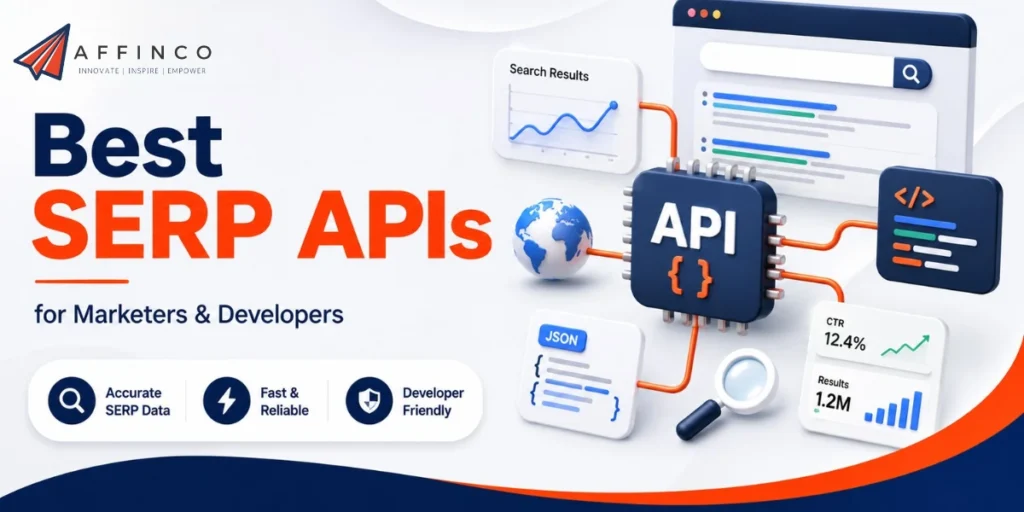
A SERP API closes that gap. It sends your query through real browsers and rotating residential proxies, solves CAPTCHAs, renders JavaScript, and returns clean, structured JSON without you ever touching a proxy pool or a parser. The best SERP APIs in 2026 differ mainly in coverage, speed, output format, and price.
For raw breadth across search engines and verticals, SerpApi leads. For the lowest cost at scale, DataForSEO wins. For feeding real-time data to an LLM, Firecrawl and Oxylabs' Fast API are purpose-built. For an all-round managed scraper, Oxylabs and ScraperAPI are the safe defaults, while Decodo offers the friendliest entry price.
This guide compares ten providers in depth, explains how a SERP API actually works, what to weigh when choosing one, and how to wire search data into AI applications built on Claude.
What Is a SERP API, and Why Not Just Scrape Google Yourself?

A SERP API is a managed service that fetches search engine results on your behalf and returns them as structured data, typically JSON, with fields like position, title, URL, snippet, and rich SERP features. You send a query and a few parameters; the provider handles the infrastructure and hands back parsed results.
The reason this market exists is that scraping Google directly has become impractical at any real scale. Since 2017, Google has required JavaScript rendering to display results, so a plain HTTP request returns an empty shell. It aggressively blocks datacenter IPs, throws press-and-hold and image CAPTCHAs, rate-limits by IP, and reshapes its HTML often enough to break a hand-built parser every few weeks.
The OWASP project even classifies automated SERP collection (OAT-011) as a recognized scraping pattern that search engines actively defend against. Building your own scraper means maintaining proxy rotation across thousands of IPs, a CAPTCHA-solving layer, a headless browser kept current with Chrome, and a parser you patch continuously. A SERP API absorbs all of that, which is why total cost of ownership almost always favors buying over building.
The timing matters too. With Google's Custom Search JSON API winding down and Bing's API already gone, the official routes that once served light use cases are disappearing, pushing teams toward the third-party tools below.
How a SERP API Works
Every SERP API follows the same four-stage path, and understanding it helps you read pricing and parameters correctly.
First, you send a request defining the query, target search engine, and parameters such as location or UULE, device, language, number of results, and result type (organic, news, shopping, maps). Second, the provider routes that request through its proxy network, picks an appropriate IP, renders the page in a real browser, and solves any CAPTCHA so the response mirrors what a genuine user in that location sees.
Third, a parser converts the rendered page into structured fields, isolating organic listings, paid ads, the featured snippet, People Also Ask, the knowledge graph, local packs, and increasingly the AI Overview. Fourth, the result returns to you, usually as JSON, sometimes as raw HTML, Markdown, or CSV.
Integration happens in one of several ways, and the right one depends on scale. A direct REST call over an open connection suits low volume. Webhooks let you fire thousands of asynchronous requests and receive results as they complete, which is how large operations conserve resources.
A proxy-style endpoint lets you point existing tools at the API with minimal code. Software development kits and, more recently, MCP servers expose the API as a callable tool for AI agents.
Full API Versus Fast API: The Distinction That Decides Your Choice
A real fork has opened in the SERP market, and naming it upfront saves you money. A full SERP API scrapes and parses every element on the page: organic results, ads, snippets, People Also Ask, knowledge panels, and AI Overviews.
That richness is what SEO teams, rank trackers, and competitive-intelligence tools need.
A fast search API does the opposite on purpose. It returns only the organic results, optimized for the lowest possible latency, often using proxies hand-picked for speed. Oxylabs reports about a second for 95 percent of Fast API requests; ScrapingBee's Fast API returns half of calls in under a second. This category exists because AI applications and retrieval-augmented generation pipelines rarely need ad placements or knowledge panels. They need a clean list of relevant links and content, delivered quickly enough to sit inside a live model response.
If you are grounding an LLM, a fast API is usually cheaper and snappier; if you are tracking rankings, you want the full version.
What to Consider When Choosing a SERP API

Match the tool to your workload across these dimensions rather than chasing the lowest sticker price.
Search engine and vertical coverage comes first: confirm the API serves not just Google but the specific properties you need, whether that is Maps, Shopping, News, Images, Trends, or Bing and Baidu for international work. Geo-targeting granularity is next; country level is fine for broad research, but local SEO demands city, coordinate, or UULE precision.
Parser quality and SERP-feature coverage separate good tools from average ones, since the value is in clean, complete fields, including modern elements like AI Overview and AI Mode. Output format should fit your pipeline (JSON for apps, CSV for analysts, Markdown for LLMs). Integration method matters at scale, where webhooks and MCP support pay off.
Finally, scrutinize the pricing model: subscription versus pay-as-you-go, whether you are billed per search or per result (a common source of confusion, since one search can return many results), whether only successful requests are charged, and whether unused credits roll over. Layer in response time, success rate, concurrency limits, and, for regulated work, compliance certifications and any legal indemnity the provider offers.
SERP APIs for AI: Real-Time Data, RAG, and Building With Claude

The fastest-growing reason to buy a SERP API in 2026 is not SEO reporting; it is feeding live search data to AI systems. Large language models are frozen at their training cutoff, so any agent that needs current facts, prices, news, or rankings has to retrieve them. A SERP API is the cleanest source of that grounding.
Three patterns dominate. In retrieval-augmented generation, you run a search, pull the top results (often as Markdown via a tool like Firecrawl), and pass that context into the model so its answer reflects today's web rather than last year's training data.
In agentic workflows, search becomes a tool the model calls on demand: an agent researching a competitor or assembling a market brief issues queries and reasons over the structured results. In answer-engine and generative-engine optimization, marketers use SERP and AI Overview data to track how models and Google's AI surfaces cite brands, a discipline now central to visibility work.
What makes this practical is the Model Context Protocol. DataForSEO, ScraperAPI, Apify, and Firecrawl all ship MCP servers, which means you can connect a Claude-powered assistant to live search and let it query SERP data in natural language, no glue code required.
For developers building on the Claude API, the same endpoints plug into function calling, so the model can request fresh results mid-conversation and incorporate them into its response. If you are building anything that answers questions about the current world, pairing Claude with a fast SERP or search API is the most direct way to make it accurate.
The 11 Best SERP APIs in 2026 (Reviewed)
| Provider | Type | Search Engines | Geo-Targeting | Output | Entry Price |
|---|---|---|---|---|---|
| Apify | Actor marketplace | Google, Bing, Baidu, Yandex, DuckDuckGo | Up to 195 (varies) | JSON, CSV, Excel | $39/mo (free $5 credits) |
| Cloro | Search + AI engine API | Google, News, AI Overview, AI Mode, ChatGPT, Perplexity, Gemini, Copilot | All countries + US state | JSON, Markdown, HTML, text | $30/mo (free 500 credits) |
| Firecrawl | AI search + scrape API | Web search (engine-agnostic) | Country | Markdown, JSON | $16/mo (free 500 credits) |
| Oxylabs | Web Scraper API + Fast API | Google, Bing, Baidu, Yandex | City + coordinate | JSON, CSV, HTML | $49 / 49K results |
| ScraperAPI | Google SERP API | Google (Search, News, Jobs, Shopping, Maps) | 50+ countries | JSON, CSV | $49 / 100K credits |
| Decodo | Web Scraping API | Google, Bing | City + coordinate (Google) | JSON, HTML, Markdown, PNG | $19/mo (~38K) |
| Zyte API | Unified scraping API | 150+ countries | Parsed JSON | PAYG (custom) | |
| SerpApi | Dedicated SERP API | 100+ engines and verticals | City-level (Google geo) | JSON | Free 100; $25 / 1K |
| DataForSEO | PAYG SERP API + SEO stack | Google, Bing, Yahoo, Baidu, YouTube, more | 170+ countries, coordinate | JSON, HTML | $0.60 to $2 / 1K ($50 min) |
| NodeMaven | Proxies + cloud browser | Build-your-own (any) | City + ASN | Your parser | $2.20/GB |
| ScrapingBee | Google API + generic | Google (generic for others) | Country | JSON, HTML | $49/mo (250K credits) |
1. Apify

Apify is less a single SERP API than a marketplace of more than 19,000 cloud scrapers, called Actors, several of which target Google, Bing, Baidu, Yandex, and DuckDuckGo. Instead of one rigid endpoint, you choose the Actor that matches your engine and use case, or build your own with their SDK. Every Actor runs on Apify's managed cloud with residential proxies, automatic scaling, scheduling, and dataset storage, so you never provision servers.
The platform shines for AI builders: Actors expose REST endpoints and plug into MCP, LangChain, and Google ADK, letting an agent call live search as a tool. Pricing is usage-based and set per Actor, so costs vary, but the free plan includes $5 in monthly platform credits.
| Parameter | Detail |
|---|---|
| Type | Marketplace of cloud Actors (build or rent) |
| Search engines | Google, Bing, Baidu, Yandex, DuckDuckGo, and others |
| Geo-targeting | Up to 195 locations, depending on the Actor |
| Output formats | JSON, CSV, Excel, XML, via API |
| Integration | REST API, MCP, LangChain, Google ADK, webhooks, Make, Zapier |
| Free trial | Free plan with $5 monthly platform credits |
| Pricing / minimum | From $39/mo; per-Actor usage pricing (pay-per-result or compute) |
Pros
Cons
2. Cloro
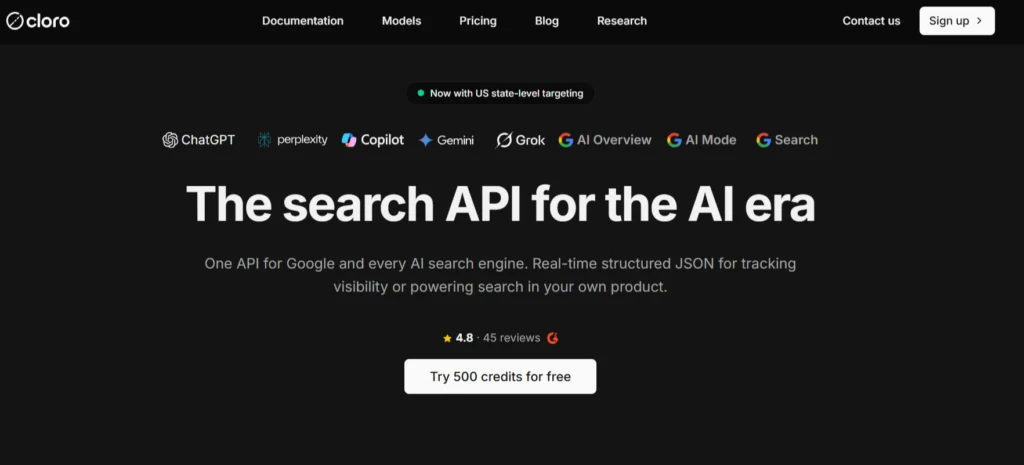
Cloro treats Google and the AI answer engines as one surface instead of two problems. A single endpoint returns structured JSON from Google Search, Google News, AI Overview, and AI Mode, alongside ChatGPT (including web search and ChatGPT Ads), Perplexity, Gemini, and Copilot, all sharing the same response shape.
Adding an engine becomes a config change rather than another integration to build and maintain, which is the practical argument for it over stitching together provider APIs.
The Google parser is thorough where it counts: organic listings, sponsored ads with sitelinks and top or bottom block position, the People Also Ask tree, People Also Search For, featured snippets, the knowledge panel, related searches, the local pack, shopping blocks, and AI Overviews with their sources and any injected ads.
What sets it apart from a classic SERP API is citation data. Model providers return answer text and nothing about its provenance, while Cloro parses sources and citations out of every AI response, which is the raw material for AI visibility tracking and answer-engine work. You can see the output shape before signing up through its public leaderboard, republished weekly across twelve software categories.
Python and TypeScript SDKs, an async endpoint with webhooks, and an official MCP server handle integration, and that MCP connection lets a Claude assistant query live search and AI answers in plain language. Credits are deducted only on successful extraction, with automatic retries up to ten times inside a five-minute window.
USP: One API for Google plus every major AI answer engine, with parsed sources and citations you cannot get from the model providers directly.
| Parameter | Detail |
|---|---|
| Type | Unified search and AI answer engine API |
| Search engines | Google Search, Google News, AI Overview, AI Mode, ChatGPT (web search and Ads), Perplexity, Gemini, Copilot |
| Geo-targeting | All countries, city level via location name or UULE, US state level on AI engines |
| Output formats | Structured JSON, Markdown, plain text, raw HTML via include.html |
| Integration | REST API, Python and TypeScript SDKs, async endpoint with webhooks, MCP server, LangChain, n8n, Zapier, OpenClaw |
| Free trial | Free plan with 500 credits per month, no card |
| Pricing / minimum | From $30/mo (37,500 credits at $0.80 per 1K), down to $0.31 per 1K across 11 tiers |
Pros
Cons
3. Firecrawl
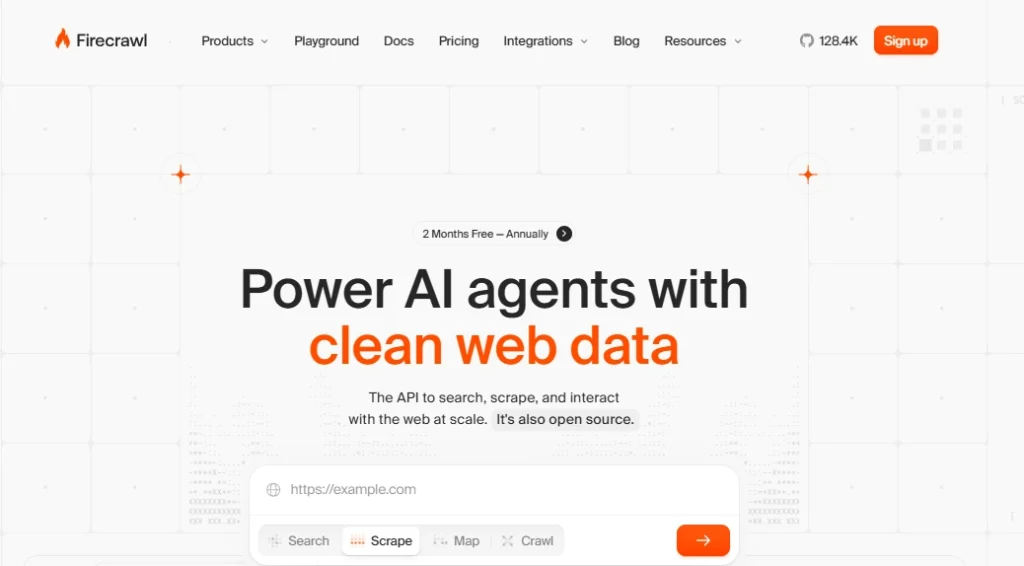
Firecrawl has become the default web-data layer for AI developers, and its search endpoint doubles as a SERP tool with a twist: it runs a web search and returns the full page content of each result as clean, LLM-ready Markdown in a single call. That combined search-and-scrape behavior is built for retrieval-augmented generation and agents that need grounded, real-time context rather than raw HTML.
Open source under AGPL-3.0 and built by Mendable, it handles JavaScript rendering, proxy rotation, and anti-bot defenses behind the endpoints scrape, crawl, map, search, and extract. Native MCP, LangChain, LlamaIndex, and CrewAI support make it trivial to wire into a Claude stack. The free tier grants 500 credits monthly, with search billed at two credits per ten results.
| Parameter | Detail |
|---|---|
| Type | AI search and scrape API (LLM-ready output) |
| Search engines | Engine-agnostic web search via the search endpoint |
| Geo-targeting | Country level |
| Output formats | Markdown, structured JSON, HTML, screenshot |
| Integration | REST API, MCP, LangChain, LlamaIndex, CrewAI, Python and Node SDKs |
| Free trial | 500 credits per month, no card |
| Pricing / minimum | Hobby $16/mo (3K credits) to Growth $333/mo (500K); search 2 credits per 10 results |
Pros
Cons
4. Oxylabs

Oxylabs offers the most feature-complete SERP tooling here, built on one of the largest and best-performing proxy networks in the industry. Its Web Scraper API covers Google, Bing, Baidu, and Yandex with targeting down to the city and exact coordinate, and it is the only option that also exports CSV alongside JSON and HTML.
A separate Fast API strips responses to organic results and returns 95 percent of requests in about a second, ideal for AI pipelines, while the Web Unblocker handles the hardest anti-bot walls. In Proxyway's 2026 benchmark it posted a 100 percent Google success rate at 4.79 seconds. You also get OxyCopilot, an AI assistant that writes query parameters, a testing playground, and webhook delivery.
| Parameter | Detail |
|---|---|
| Type | Web Scraper API, Fast API, Web Unblocker |
| Search engines | Google, Bing, Baidu, Yandex |
| Geo-targeting | 150+ locations, city and coordinate level |
| Output formats | JSON, CSV, HTML |
| Integration | REST API, webhook, proxy endpoint, OxyCopilot assistant |
| Free trial | 7-day free trial |
| Pricing / minimum | Web Scraper API from $49 for 49K results (about $1 per 1K); Fast API custo |
Pros
Cons
5. ScraperAPI

ScraperAPI pairs a dedicated Google endpoint with the fastest response time in independent testing, returning 99.97 percent of requests in an average of 3.72 seconds. Its structured data endpoints cover Google Search, News, Jobs, Shopping, and Maps, delivering parsed JSON or CSV so you skip parsing entirely.
A pool of more than 40 million datacenter, residential, and mobile IPs across 50-plus countries, paired with machine-learning proxy selection, drives that success rate. You can integrate as a REST API, an SDK, a proxy endpoint, or through an MCP server for AI agents, and target by country, domain, device, or UULE with a time-frame filter that mirrors Google's own. A request costs between one and 75 credits depending on rendering and proxy type.
| Parameter | Detail |
|---|---|
| Type | Google SERP API (structured data endpoints) |
| Search engines | Google: Search, News, Jobs, Shopping, Maps |
| Geo-targeting | 50+ countries, plus UULE |
| Output formats | JSON, CSV (HTML, Markdown, text for generic scrapes) |
| Integration | REST API, SDK, proxy, MCP server |
| Free trial | 5,000 credits for 7 days |
| Pricing / minimum | $49 for 100K credits and 20 concurrent threads (1 to 75 credits per request) |
Pros
Cons
6. Decodo

Decodo, the proxy provider formerly known as Smartproxy, delivers the friendliest entry point without sacrificing performance, matching Oxylabs with a 100 percent Google success rate at 3.76 seconds in Proxyway's test. Its Web Scraping API ships ready-made SERP templates for Google Search, AI Overview, AI Mode, Maps, Lens, Travel and Hotels, and Ads, plus Bing Search and raw Bing URLs.
Targeting reaches city and coordinate level for Google, with parameters for language, device type, and a session ID, and optional JavaScript rendering. Few rivals match its output flexibility: HTML, JSON, Markdown, XHR, and PNG screenshots. Entry pricing is among the lowest in the market.
| Parameter | Detail |
|---|---|
| Type | Web Scraping API with SERP templates |
| Search engines | Google (multiple templates), Bing |
| Geo-targeting | 150+ countries, city and coordinate for Google |
| Output formats | HTML, JSON, Markdown, XHR, PNG |
| Integration | REST API, proxy endpoint, session control |
| Free trial | $1 credit, plus a 14-day money-back guarantee |
| Pricing / minimum | From $19/mo for roughly 38K requests ($0.50 CPM); no pay-as-you-go |
Pros
Cons
7. Zyte API
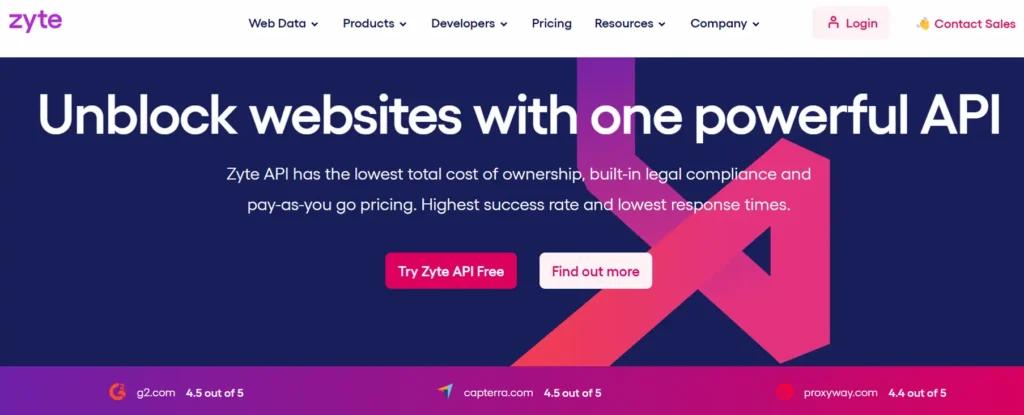
Zyte API takes a different philosophy. Instead of a rigid SERP product, it exposes a single intelligent endpoint that decides, per request, which proxy type, headers, and rendering each target needs, with a built-in parser for Google results. It automatically selects a location from the URL or lets you choose from 150-plus countries, manages cookies, and can automate clicks, scrolls, and typing for JavaScript-heavy pages.
For enterprise teams, a TypeScript browser-scripting layer allows fine-grained actions like hovering or entering individual characters in a cloud development environment. Pricing has no fixed rate; you pay per successful request based on each page's difficulty and the features it requires, with a price estimator to forecast spend.
| Parameter | Detail |
|---|---|
| Type | Unified scraping API with automatic configuration |
| Search engines | Google (built-in SERP parsing) |
| Geo-targeting | 150+ countries, auto-selected by URL |
| Output formats | Parsed JSON |
| Integration | REST API, proxy mode, TypeScript browser scripting |
| Free trial | $5 in credits for 30 days |
| Pricing / minimum | Custom, pay-per-success based on difficulty (price estimator provided) |
Pros
Cons
8. SerpApi

SerpApi is the breadth champion, exposing more than 100 search-engine APIs from one polished interface: Google and its verticals (Maps, Shopping, Images, News, Scholar, Trends, Jobs, Flights, Hotels, Lens), plus Bing, Baidu, Yahoo, YouTube, Amazon, Walmart, eBay, the Apple App Store, Naver, and Yandex.
Each request runs in a full browser with CAPTCHA solving, so you receive exactly what a human would see, and only successful searches are billed regardless of how many results return.
Its signature feature is the U.S. Legal Shield, which assumes liability for lawful scraping and parsing with up to $2 million in coverage on Production plans, backed by SOC 2, SOC 3, and ISO 27001 certification and a privacy-first ZeroTrace mode.
| Parameter | Detail |
|---|---|
| Type | Dedicated real-time SERP API |
| Search engines | 100+ engines and verticals (Google, Bing, Baidu, Yahoo, YouTube, Amazon, and more) |
| Geo-targeting | City-level via Google geolocated parameters |
| Output formats | Structured JSON |
| Integration | REST API, client libraries, locations endpoint |
| Free trial | Forever-free 100 searches per month |
| Pricing / minimum | $25 (1K), $75 (5K), $150 (15K, Legal Shield), $275 (30K), up to enterprise |
Pros
Cons
9. DataForSEO

DataForSEO is the cost leader and the quiet data layer behind many commercial SEO platforms, delivering the same caliber of search data without a dashboard markup. Its SERP API spans Google, Bing, Yahoo, Baidu, DuckDuckGo, Yandex, Naver, YouTube, and more, with three speed tiers that let you trade latency for price: Standard queue at $0.0006 per result (around five minutes), Priority at $0.0012, and Live mode at $0.002 for sub-two-second responses.
That works out to between $0.60 and $2.00 per thousand SERPs, a fraction of subscription rivals at scale. You pay only for usage with a $50 minimum deposit, no monthly fee, and credits that never expire, plus a free sandbox. Critically for AI work, it ships an official MCP server.
| Parameter | Detail |
|---|---|
| Type | Pay-as-you-go SERP API within a wider SEO data platform |
| Search engines | Google, Bing, Yahoo, Baidu, DuckDuckGo, Yandex, Naver, YouTube, more |
| Geo-targeting | 170+ countries, down to coordinate for supported engines |
| Output formats | JSON, HTML (Regular and Advanced functions) |
| Integration | REST API, MCP server, LangChain, n8n, Node SDK |
| Free trial | Free sandbox plus $1 in starter credit |
| Pricing / minimum | $0.0006 to $0.002 per SERP ($0.60 to $2 per 1K); $50 minimum deposit |
Pros
Cons
10. NodeMaven

NodeMaven approaches search data from the infrastructure side. Rather than a turnkey parser, it gives you the cleanest possible proxy network to build your own SERP scraper, which is exactly what some teams want for full control.
Its two-step IP filter screens every residential, ISP, and mobile address and guarantees a fraud score below 70, yielding a 95 percent clean-IP rate and a 99.54 percent success rate, with sticky sessions up to seven days and city plus ASN targeting at no premium.
The included cloud Scraping Browser runs Puppeteer, Playwright, or Selenium through a Chrome DevTools Protocol URL, rotating fingerprints and solving CAPTCHAs automatically, so your Google and Bing scrapes stay unblocked without local headless setup.
| Parameter | Detail |
|---|---|
| Type | Premium proxies plus cloud Scraping Browser (bring your own parser) |
| Search engines | Any (you build the scraper); strong on Google and Bing |
| Geo-targeting | 190+ countries, city and ASN, no premium fee |
| Output formats | Whatever your parser produces (JSON, CSV, and so on) |
| Integration | Proxy gateway, CDP browser (Puppeteer, Playwright, Selenium), REST API |
| Free trial | $3.50 trial with 750 MB of bandwidth |
| Pricing / minimum | From $2.20/GB, with cashback and a quality guarantee |
Pros
Cons
11. ScrapingBee
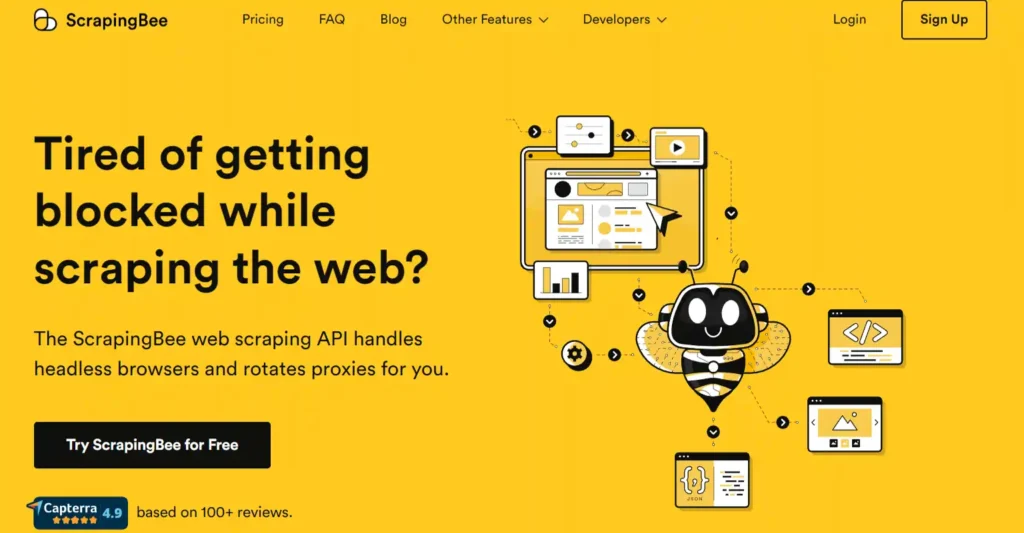
ScrapingBee rounds out the list as a developer-favourite generalist that also ships a dedicated Google API. From one endpoint you can pull Google Search, News, Images, Maps, Lens, or AI Mode results, set the country and page count, and append any unsupported parameter as long as it is URL-encoded.
A simpler Fast API returns organic results with half of requests under a second for ten credits, while a standard Google SERP call costs ten credits, or fifteen with browser rendering. For Bing, Yandex, and other engines, its highly configurable generic scraper accepts custom JavaScript scenarios, which beats writing a scraper from scratch. It managed a 99.45 percent Google success rate in Proxyway's benchmark.
| Parameter | Detail |
|---|---|
| Type | Google API, Fast API, plus a configurable generic scraper |
| Search engines | Google (generic scraper for Bing, Yandex, and others) |
| Geo-targeting | 195+ locations, country level |
| Output formats | JSON, HTML |
| Integration | REST API, custom JavaScript scenarios |
| Free trial | 1,000 free API calls |
| Pricing / minimum | $49/mo for 250K credits (Google SERP 10 credits, 15 with rendering) |
Pros
Cons
No-Code and Hybrid Options: Octoparse and Beyond

Not every team wants to write code, and SERP data can be gathered through visual tools too. Octoparse is a point-and-click scraper with a friendly interface, a free plan capped at 10,000 records per export, and paid tiers from roughly $83 to $299 that add automatic IP rotation, scheduling, and unlimited exports.
It is well suited to small and mid-size projects where you would rather configure a workflow than maintain a script, though it does not guarantee a 100 percent success rate against Google, so pairing it with quality residential proxies is wise.
ScrapeBox, a one-time $97 desktop product, remains popular with SEO agencies for keyword and metadata harvesting, backlink checks, and bulk search collection, but you supply your own proxies.
The practical reality is that these tools and the APIs above increasingly work together. Most SERP APIs slot into automation platforms like n8n, Make, Zapier, and Google Sheets through native connectors or webhooks, so a marketer can trigger a search, route the JSON into a spreadsheet or a dashboard, and schedule the whole thing without engineering help. The right architecture is usually a managed API for reliability at the core, with a no-code layer on top for orchestration.
How to Choose: Quick Recommendations by Use Case
Whatever you choose, run a small paid test against your real queries and locations, measure success rate and field completeness, and only then commit to volume.

Final Word
The closure of Google's and Microsoft's official search APIs has turned SERP APIs from a convenience into core infrastructure for anyone who depends on live search data.
The right pick comes down to your job: choose DataForSEO for the lowest cost at scale and native Claude integration, SerpApi for the widest engine coverage and a legal shield, Oxylabs for the most complete managed tooling, Firecrawl for AI-ready search and scrape in one call, Decodo for the friendliest entry price, and NodeMaven when you want to own the stack on the cleanest possible proxies.
Test against your real queries first, watch how each tool bills, and build on the one whose data, speed, and price fit what you are actually shipping.
For more on the infrastructure behind data collection, see our guides to the best rotating proxies and the best antidetect browsers, and for the search-visibility side, our breakdown of the Q1 2026 Google quality update.

Ali
Ali is a digital marketing expert with 7+ years of experience in SEO-optimized blogging. Skilled in reviewing SaaS tools, social media marketing, and email campaigns, we craft content that ranks well and engages audiences. Known for providing genuine information, Ali is a reliable source for businesses seeking to boost their online presence effectively.