


Your shell loop fires 30 cURL requests, the first few return clean JSON, then request eight comes back as 429 Too Many Requests. That is the target rate-limiting your single IP address, and it is the fastest way to kill a command-line scrape.
The best proxies for cURL route every request through a fresh IP, drop cleanly into the -x flag, support SOCKS5 with remote DNS when you need it, and never make you fight the authentication. cURL is the sharpest tool for scripting a scrape or testing an endpoint, but raw cURL egresses from your own address, so a proxy is what separates a working pipeline from a wall of blocks.
For a free start, Webshare wins; for balanced rotating scrapes, Decodo; for the cleanest IPs, NodeMaven; for premium SOCKS5 at scale, Oxylabs; and for unlimited-bandwidth loops, Shifter. This guide ranks nine providers, then goes deep on exactly how proxies work with cURL, including every flag and parameter that matters.
Quick tip: cURL takes a proxy in one flag.
HTTP: curl -x "http://user:pass@host:port" https://httpbin.org/ip. SOCKS5 with remote DNS: curl -x "socks5h://user:pass@host:port" https://httpbin.org/ip.To proxy every request in a session, run export https_proxy="http://user:pass@host:port", or add a proxy = line to ~/.curlrc to make it permanent. Always confirm the IP changed against httpbin.org/ip first.
How Do Proxies Work With cURL?

cURL routes a request through a proxy with a single flag, -x (or its long form –proxy), which takes a full proxy URL in the form protocol://user:pass@host:port. The protocol you choose changes how the request travels. This is the mechanic behind every command below.
For a standard HTTP or HTTPS proxy, the syntax is direct:
curl -x "http://user:[email protected]:8080" https://httpbin.org/ipFor a SOCKS5 proxy, always prefer the socks5h:// scheme rather than socks5://. The trailing h tells cURL to resolve DNS through the proxy instead of on your machine, which prevents your real location from leaking through a DNS request:
curl -x "socks5h://user:[email protected]:1080" https://httpbin.org/ipAuthentication: credentials or IP whitelist
Proxies accept one of two authentication methods, and every provider on this list supports at least one. The first is username and password, embedded in the proxy URL or passed with -U (–proxy-user). The second is IP whitelisting, where you register your machine's IP in the dashboard and the proxy trusts it without credentials, which keeps your commands shorter in a controlled environment:
curl -x "http://gateway.provider.com:8080" -U "user:pass" https://httpbin.org/ipProxying every request in a session
To send all requests from a terminal through a proxy without repeating the flag, export environment variables. cURL reads http_proxy, https_proxy, and all_proxy, and respects no_proxy for exceptions:
export http_proxy="http://user:pass@host:port"
export https_proxy="http://user:pass@host:port"
export no_proxy="localhost,127.0.0.1"

To make the setting permanent across every session, add a line to the cURL configuration file at ~/.curlrc:
proxy = "http://user:pass@host:port"
proxy-user = "user:pass"
Rotation and sticky sessions
Rotation is where a proxy network earns its value for cURL. Point a request at a rotating residential gateway and each call egresses from a fresh IP automatically, so a simple for loop spreads a scrape across the pool with no IP list to manage:
for i in $(seq 1 20); do
curl -s -x "http://user:[email protected]:7000" https://httpbin.org/ipdone
When a script must hold one IP across a multi-step flow, such as a login followed by several authenticated requests, you use a sticky session. Most providers control this through the username string: DataImpulse and Decodo append a session token, while Shifter uses a session ID (sid) or a timed ttl value. The same username pattern also carries geo-targeting, so you can request a country, city, or ASN inline:
curl -x "http://user-country-us-city-newyork-sessid-abc123:pass@gateway:7000" https://httpbin.org/ipThe cURL proxy flags worth knowing
| Flag or Variable | Purpose | Example |
|---|---|---|
| -x, –proxy | Set the proxy (protocol, host, port) | curl -x http://host:8080 URL |
| -U, –proxy-user | Supply proxy credentials | curl -x host:8080 -U user:pass URL |
| –socks5-hostname | SOCKS5 with DNS resolved by the proxy | curl –socks5-hostname host:1080 URL |
| -p, –proxytunnel | Tunnel a non-HTTP request through an HTTP proxy | curl -p -x host:8080 URL |
| –proxy-header | Send a header to the proxy only | curl –proxy-header “X-Key: v” -x host URL |
| –noproxy | Comma-separated hosts to bypass | curl –noproxy .internal.com URL |
| –proxy-insecure | Skip proxy TLS verification | curl –proxy-insecure -x https://host URL |
| http_proxy / https_proxy / all_proxy | Env vars applied to every request | export https_proxy=http://user:pass@host:port |
| ~/.curlrc | Persistent config file | proxy = “http://user:pass@host:port” |
| -v, –verbose | Show the full connect and header exchange | curl -v -x host:8080 URL |
The 9 Best Proxies for cURL in 2026 (Reviewed)
| cURL Proxy Provider | Best cURL Edge | Protocols | Ideal Workflow | Entry Price |
|---|---|---|---|---|
| Webshare | Free forever plan, one-click list export | HTTP, HTTPS, SOCKS5 | Quick tests and light shell scraping | Free / ~$1.40/GB |
| Decodo | Copy-paste cURL docs, 24h sticky | HTTP(S), SOCKS5 | Mid-scale rotating scrapes | ~$2/GB at scale |
| NodeMaven | Cleanest IPs, fewest blocks | HTTP(S), SOCKS5 | Low-block scripted scraping | ~$2.20/GB |
| Oxylabs | Premium SOCKS5 + GitHub examples | HTTP(S), SOCKS5 | SLA-grade large jobs | ~$2.50/GB at 1TB |
| Shifter | Unlimited-bandwidth backconnect ports | HTTP(S), SOCKS | High-volume unmetered loops | Port-based |
| Rayobyte | Unlimited-bandwidth datacenter | HTTP(S), SOCKS5 | Fast scraping of unprotected targets | $1/IP datacenter |
| IPRoyal | Sticky sessions up to 7 days | HTTP(S), SOCKS5 | Long multi-step scripts | ~$1.75/GB (bulk) |
| DataImpulse | $1/GB, targeting in the username | HTTP, HTTPS, SOCKS5 | High-volume shell loops on a budget | $1/GB |
| Proxy-Seller | All 5 proxy types, IPv6 from $0.08/IP | HTTP(S), SOCKS5 | Mixed workflows and cheap IPv6 bulk | $0.08/IP (IPv6) |
1. Webshare (Best Free Start for cURL)
Webshare is the fastest way to get a working -x command for free. Its permanent free plan hands you 10 proxies and 1 GB a month with no card, and the dashboard exports a ready-to-paste host:port:user:pass list that drops straight into cURL. Every connection supports HTTP, HTTPS, and SOCKS5 across 80 million residential and 500,000 datacenter and ISP IPs, so you can prove a shell script works in minutes before paying a cent.
| Parameter | Detail |
|---|---|
| Proxy types | Datacenter, ISP, residential |
| Protocols | HTTP, HTTPS, SOCKS5 |
| Authentication | Username/password and IP whitelist |
| Geo-targeting | 195 countries; city on residential |
| Pricing | Datacenter from $0.0299/IP; residential ~$1.40 to $3.50/GB |
| Coupon | No code needed (permanent free tier) |
| Free trial | Free forever: 10 proxies + 1 GB/mo |
Pros
Cons
2. Decodo (Best Balanced Pick for cURL)

Decodo is the balanced step up once you outgrow free proxies, and its documentation ships copy-paste cURL snippets that get you running quickly. The 115 million residential pool plus datacenter options cover most command-line scraping, with HTTP(S) and SOCKS5 support and sticky sessions you can hold up to 24 hours when a script needs one stable IP across steps. A 3-day trial and 14-day money-back guarantee let you validate it against your own targets risk-free.
| Parameter | Detail |
|---|---|
| Proxy types | Residential, datacenter |
| Protocols | HTTP(S), SOCKS5 |
| Authentication | Username/password and IP whitelist |
| Geo-targeting | 195+ locations, city and coordinate |
| Pricing | Residential $2 to $3.75/GB; datacenter from $0.60/GB |
| Coupon | No code needed (3-day trial + 14-day money-back) |
| Free trial | 3-day free trial, 14-day refund |
Pros
Cons
3. NodeMaven (Best for Low Block Rates)

NodeMaven suits cURL work where getting blocked is the enemy, because its two-step filter screens every IP and keeps roughly 95 percent clean, producing a 99.54 percent success rate. You get HTTP(S) and SOCKS5 across 30 million residential and 250,000 mobile IPs, city and ASN targeting at no premium, and sticky sessions up to seven days for long scripted flows. A cloud Scraping Browser is included when a request needs JavaScript, and the $3.50 trial unlocks full access before you commit.

| Parameter | Detail |
|---|---|
| Proxy types | Residential, mobile, ISP |
| Protocols | HTTP(S), SOCKS5 |
| Authentication | Username/password |
| Geo-targeting | 190+ countries, city and ASN, no premium |
| Pricing | From ~$2.20/GB, cashback on used traffic |
| Coupon | AFFMAVEN35 (35% off) |
| Free trial | $3.50 trial with 750 MB |
Pros
Cons
4. Oxylabs (Best Premium SOCKS5 for cURL)
Oxylabs is the premium SOCKS5 choice, supporting the protocol across residential, ISP, datacenter, and mobile proxies at no surcharge, backed by a dedicated cURL tutorial and a public GitHub example repo. With 175 million residential IPs it is built for SLA-grade, high-volume shell jobs, and adds a Web Unblocker and Scraper API you can call in one line. Note the default port limit: only 80 and 443 work out of the box, and non-standard ports require verification.

| Parameter | Detail |
|---|---|
| Proxy types | Residential, ISP, datacenter, mobile |
| Protocols | HTTP(S), SOCKS5 (all types, no surcharge) |
| Authentication | Username/password and IP whitelist |
| Geo-targeting | 150+ locations, city and coordinate |
| Pricing | Residential $6/GB down to $2.50/GB (1 TB); PAYG $4/GB |
| Coupon | OXYLABS50 (50% off) |
| Free trial | 7-day trial; 5 free datacenter IPs |
Pros
Cons
5. Shifter (Best Unlimited-Bandwidth Pick)

Shifter takes a different billing model that fits heavy cURL loops: unlimited-bandwidth backconnect ports instead of per-GB metering. Running since 2012 with a 205 million residential pool, it lets you rotate per request or hold an IP with a session ID (sid) or a timed ttl value written into the username, which maps cleanly into a cURL one-liner. HTTP(S) and SOCKS support, country, city, and ASN targeting, and configurable rotation down to one minute make it strong for unmetered, high-concurrency scraping across many targets.

| Parameter | Detail |
|---|---|
| Proxy types | Rotating residential (backconnect), ISP, static residential |
| Protocols | HTTP, HTTPS, SOCKS |
| Authentication | Username/password |
| Geo-targeting | 195+ countries, country, city, ASN |
| Pricing | Port-based, unlimited bandwidth; from ~$0.30/GB at high tiers |
| Coupon | AFFINCO-M454 (10% off) |
| Free trial | Free trial plus 3-day money-back |
Pros
Cons
6. Rayobyte (Best Datacenter for cURL)
Rayobyte is the datacenter pick for cURL, offering unlimited-bandwidth datacenter IPs from $1 each that are ideal for hammering unprotected targets from the shell where residential is overkill. The US-based provider, ethically sourced and running since 2014, supports SOCKS5 on private, semi-dedicated, and ISP proxies via username and password, and adds rotating residential from roughly $0.90 per GB plus a JSON-returning Web Scraping API you can call directly from a script.
| Parameter | Detail |
|---|---|
| Proxy types | Datacenter, ISP, rotating residential |
| Protocols | HTTP(S), SOCKS5 (private, semi-dedicated, ISP) |
| Authentication | Username/password and IP whitelist |
| Geo-targeting | US-strong; static ISP US, UK, CA, DE |
| Pricing | Datacenter from $1/IP (unlimited bandwidth); residential from ~$0.90/GB |
| Coupon | AFFMAVEN5 (50 MB free trial) |
| Free trial | Residential trial on signup |
Pros
Cons
7. IPRoyal (Best for Long Sticky Scripts)
IPRoyal fits long, stateful cURL scripts thanks to sticky sessions that hold the same IP for up to seven days, the longest here, which suits a script that logs in once and runs a long sequence. It supports HTTP(S) and SOCKS5 across 195 countries, traffic never expires so occasional jobs do not burn a subscription, and it accepts 25-plus cryptocurrencies for developers who value privacy. Residential runs from $7 per GB down to about $1.75 at volume.

| Parameter | Detail |
|---|---|
| Proxy types | Residential, ISP, datacenter |
| Protocols | HTTP(S), SOCKS5 |
| Authentication | Username/password |
| Geo-targeting | 195 countries, city and state |
| Pricing | Residential $7/GB down to ~$1.75/GB; datacenter from $1.39/proxy |
| Coupon | AFFMAVEN10 (10% off) |
| Free trial | Free trial on request |
Pros
Cons
8. DataImpulse (Best Cheap Proxies for cURL)
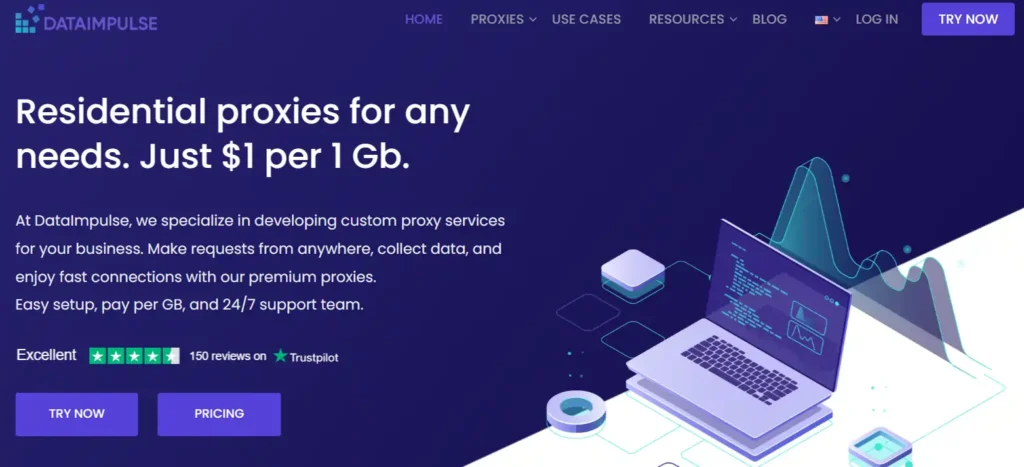
DataImpulse is the value baseline for shell scraping: $1 per GB residential, authenticated SOCKS5 alongside HTTP and HTTPS, and targeting written right into the username so one endpoint covers country, city, or ASN in a single cURL line. The 90 million first-party residential pool posts a published 99.51 percent success rate, traffic never expires, and a $5 minimum keeps test runs cheap. You trade managed unblocking tools for the lowest true cost per successful request.
| Parameter | Detail |
|---|---|
| Proxy types | Residential, datacenter, mobile |
| Protocols | HTTP, HTTPS, authenticated SOCKS5 |
| Authentication | Username/password (targeting in username) |
| Geo-targeting | Country included; city and ASN available |
| Pricing | Residential $1/GB; datacenter $0.50/GB; mobile $2/GB |
| Coupon | No code needed ($5 minimum, non-expiring) |
| Free trial | $5 minimum top-up (5 GB) |
Pros
Cons
9. Proxy-Seller (Best Multi-Type and Cheapest IPv6)

Proxy-Seller earns its place by covering every proxy class from one account, which is rare and handy when a cURL workflow mixes tasks.
You get IPv4 and IPv6 datacenter, ISP static residential, rotating residential, and 4G/5G mobile, all supporting HTTP(S) and SOCKS5 with either username-password or IP-whitelist authentication. Its standout is IPv6 datacenter from just $0.08 per IP, the cheapest credible bulk option for IPv6-friendly targets like Google and Reddit. A REST API in five languages, GDPR and ISO 27001 compliance, and a $1.99 trial round it out.

| Parameter | Detail |
|---|---|
| Proxy types | IPv4, IPv6, ISP, rotating residential, mobile |
| Protocols | HTTP(S), SOCKS5 |
| Authentication | Username/password and IP whitelist |
| Geo-targeting | 220+ countries; residential country, city, ISP |
| Pricing | IPv6 from $0.08/IP; IPv4 from $0.70/IP; residential from $0.70 to $3.50/GB |
| Coupon | AFFINCO (15% off IPv4, IPv6, ISP) |
| Free trial | $1.99 3-day trial |
Pros
Cons
How to Choose the Right cURL Proxy

Match the proxy to the job rather than the price tag. To test cURL through a proxy for free, start on Webshare.
For balanced mid-scale rotating scrapes with clean documentation, Decodo fits. For the lowest block rate on sensitive targets, NodeMaven's clean-IP filter leads. For SLA-grade SOCKS5 at scale, Oxylabs is the safe default, provided you plan around its port limit. For unmetered high-volume loops, Shifter's unlimited-bandwidth ports remove the per-GB math, and for fast scraping of unprotected targets, Rayobyte's unlimited-bandwidth datacenter from $1 per IP is the value pick.
For long stateful scripts, IPRoyal's seven-day sticky sessions hold steady; for the cheapest per-GB residential, DataImpulse wins; and for a mixed workflow or dirt-cheap IPv6 bulk, Proxy-Seller covers every type from one account.
Whatever you pick, run a small for loop against httpbin.org/ip first to confirm rotation before pointing it at a real target.
How to Test and Debug cURL Proxies
Before scaling, verify the proxy is doing its job. The canonical check is to confirm that a request returns the proxy IP, not yours:
curl -x "http://user:pass@host:port" https://httpbin.org/ipIf the returned address is not the proxy's, the request is not being routed. Add -v (verbose) to see the connection handshake and headers, which exposes whether cURL reached the proxy at all.
Three errors recur in command-line scraping. A 407 Proxy Authentication Required means your credentials are wrong or missing, so check the -U value or the user:pass in the URL. A 429 Too Many Requests means you are hitting the target too fast from too few IPs, which calls for faster rotation or a short delay between calls.
A 403 Forbidden or a CAPTCHA usually means the target detected a datacenter IP, so switching to residential or ISP resolves it. For flaky targets, add resilience with –retry 3 –retry-delay 2, and slow an aggressive loop with –limit-rate or a sleep between iterations. This is the same disciplined testing loop we apply across every data-collection build.
Final Word
cURL plus the right proxy is the most direct path to reliable command-line data collection, and the best choice comes down to your workload. Start free on Webshare, step up to Decodo for balanced rotating scrapes, lean on NodeMaven when block rates matter, and scale production SOCKS5 jobs on Oxylabs.
Shifter's unlimited-bandwidth ports suit heavy unmetered loops, Rayobyte's datacenter IPs handle fast easy targets, IPRoyal holds long stateful sessions, DataImpulse wins on raw cost, and Proxy-Seller covers every proxy type plus the cheapest IPv6 in the market.
Whichever you choose, wire it into -x, confirm the IP against httpbin.org/ip, and only then point your loop at a real target.
For more on the infrastructure behind scraping, see our guides to the best rotating proxies, the top MyPrivateProxy alternatives, and the best antidetect browsers for when your workflow moves from the shell to a full browser


Ali
Ali is a digital marketing expert with 7+ years of experience in SEO-optimized blogging. Skilled in reviewing SaaS tools, social media marketing, and email campaigns, we craft content that ranks well and engages audiences. Known for providing genuine information, Ali is a reliable source for businesses seeking to boost their online presence effectively.