

CRM software is no longer a luxury. It is a must-have for businesses of every size. In 2026, CRM market revenue is set to cross $109 billion globally.
Over 91% of companies with more than 10 employees already rely on CRM systems to manage sales pipelines, customer data, and marketing automation.
For every $1 spent, businesses earn back $8.71 in returns. These CRM statistics prove why smart marketers are doubling down on customer relationship management tools right now. Here are 50+ updated stats for 2026 to shape your next move. 📊
🌎Global CRM Market Size and Revenue in 2026
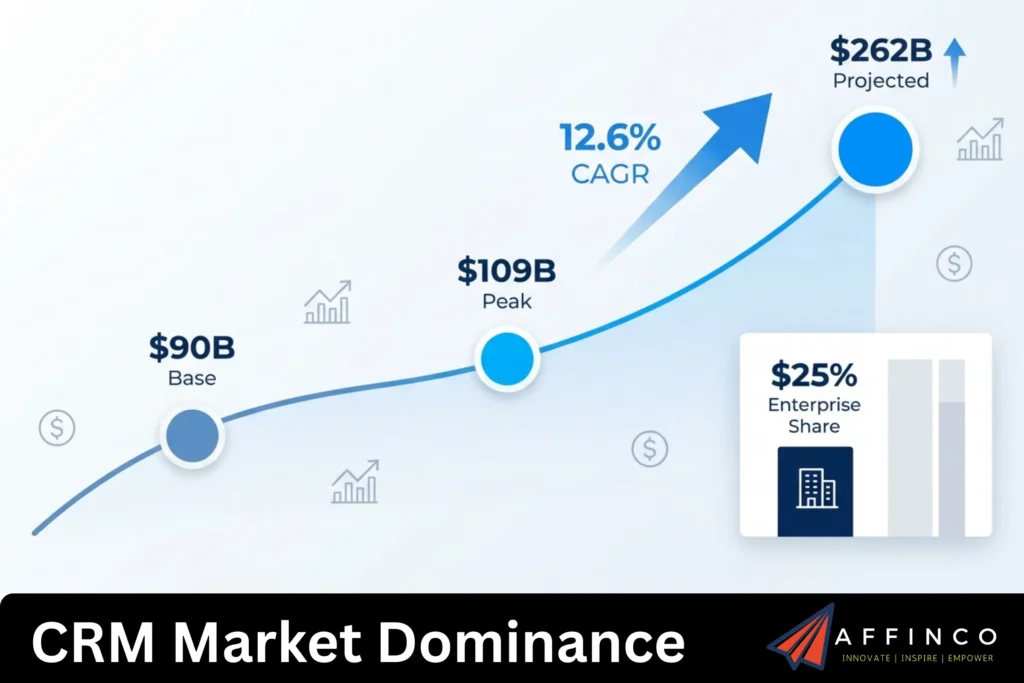
The global CRM market has grown into one of the largest segments of enterprise software. In 2026, CRM software revenue is projected to reach $109.07 billion worldwide.
Growth is steady. CRM revenue was $90.10 billion in 2025. It is expected to hit $262.74 billion by 2032, growing at a CAGR of 12.6%.
Here is a year-by-year breakdown of CRM market size:
| Year | Global CRM Market Size (USD Billion) | Annual Growth Rate |
|---|---|---|
| 2024 | $101.41 | 11.3% |
| 2025 | $112.91 | 11.3% |
| 2026 | $109.07 to $126.17 | 10% to 12% |
| 2028 | $131.9 | 10.2% |
| 2030 | $157.53 | 9.8% |
| 2032 | $262.74 | 12.6% |
CRM software now makes up nearly 25% of all enterprise software spending. That is a massive share. No other single software category comes close in terms of business adoption and revenue combined.
📈CRM Adoption Rates Across Business Sizes
Adoption is nearly universal among mid-sized and large firms. 91% of companies with more than 11 employees use a CRM system. Among small businesses, 71% have adopted CRM software solutions.
Companies looking for CRM tools are not just enterprises. 84% of organisations searching for CRM software have under 1,000 employees. That tells you something important. Small and mid-sized businesses are driving fresh demand.
Here is how CRM adoption breaks down by company size:
Industry-wise, service businesses lead CRM demand at 32%. IT and manufacturing follow at 13% each. Retail is expected to contribute 21% of total CRM market share by 2034.
🏆CRM Market Share by Vendor: Who Leads in 2026?
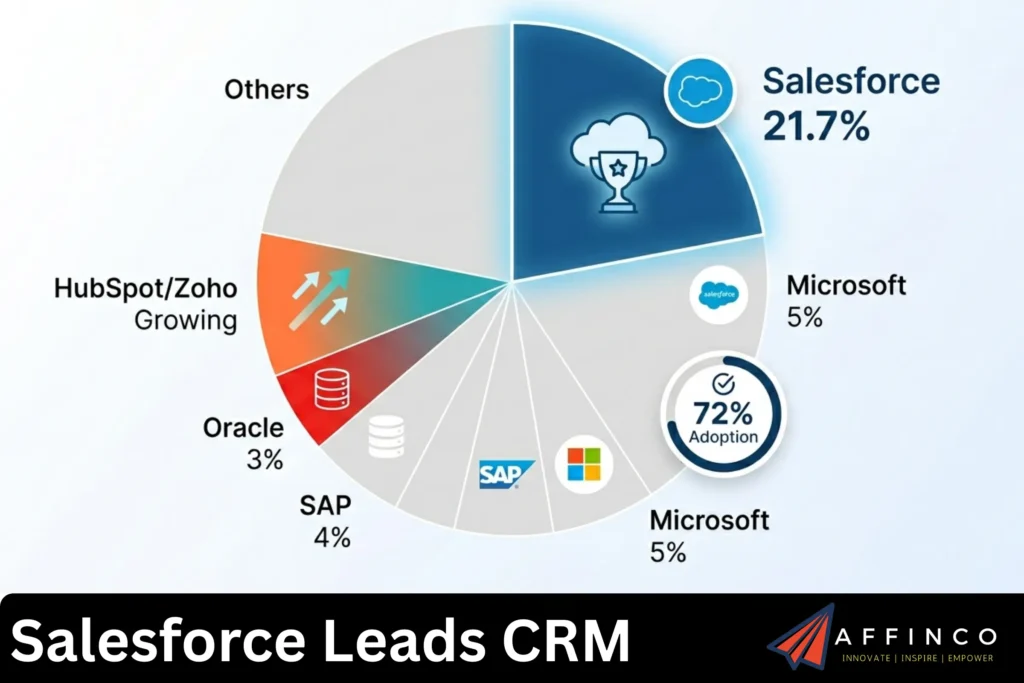
Salesforce continues to dominate. It holds a 21.7% share of the global CRM applications market. Salesforce has been the market leader for 12 consecutive years. For fiscal 2026, Salesforce is guiding revenue of $41.45 to $41.55 billion.
No other vendor comes close. Salesforce's market share is larger than Oracle, SAP, and Microsoft combined.
| CRM Vendor | Market Share | Key Strength |
|---|---|---|
| Salesforce | 21.7% | Largest ecosystem, AI integration |
| Microsoft Dynamics | ~5% | Office 365 integration |
| SAP | ~4% | Enterprise ERP bundling |
| Oracle | ~3% | Database and cloud synergy |
| HubSpot | Growing fast | Free tier, SMB-friendly |
| Zoho CRM | Growing fast | Affordable, global reach |
Salesforce Sales Cloud holds the highest average CRM adoption rate at 72%. HubSpot Sales Hub and ActiveCampaign follow at 71% each. Zoho and Monday CRM sit at 70%.
83% of Fortune 500 companies use at least one Salesforce app. Over 150,000 companies worldwide rely on Salesforce. Among CRM buyers, Salesforce, Zoho, and HubSpot lead in total installations.
💰CRM ROI Statistics: What Returns Can You Expect?
CRM delivers some of the highest returns in all of marketing technology. For every $1 invested in CRM, businesses earn back $8.71 on average. That is an ROI of 771%.
Here is what CRM does for revenue and conversions:
These are not small gains. A 300% conversion lift means a business closing 10 deals a month could jump to 40. That kind of growth changes everything for a marketing team.
Sales forecasting accuracy increases by 42% with proper CRM implementation. Automating lead management alone can result in a 10% revenue increase within 6 to 9 months. Data-driven organisations using CRM are 23 times more likely to acquire new customers.
📈Customer Retention and Satisfaction Stats
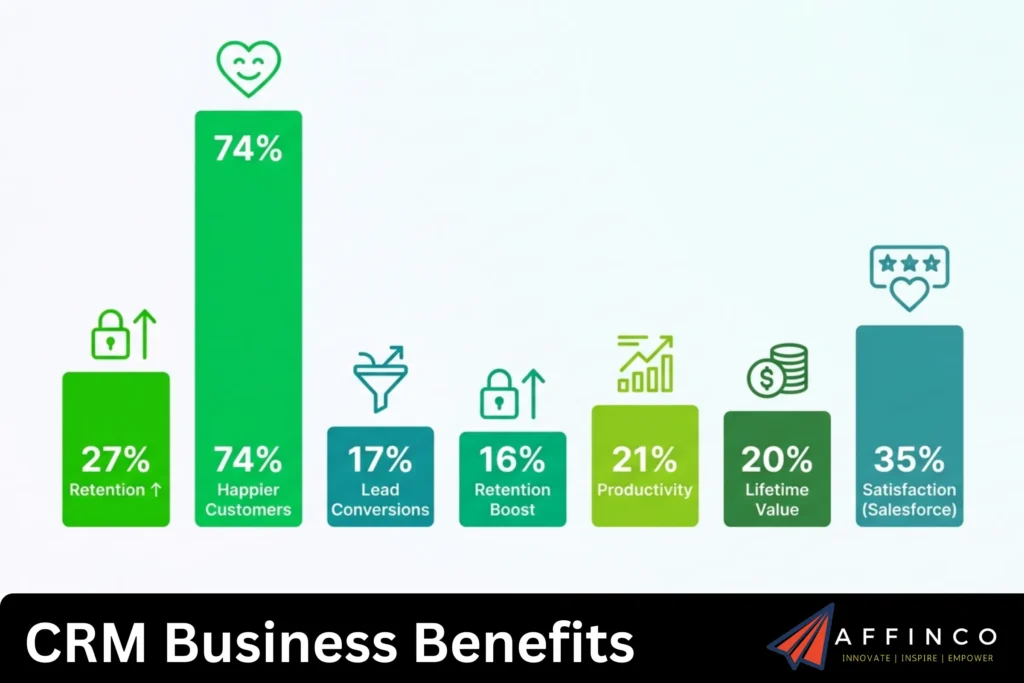
Keeping customers costs far less than acquiring new ones. CRM helps with that. 47% of businesses report higher customer retention rates after adopting CRM software. CRM usage increases customer retention by as much as 27%.
More retention and satisfaction stats:
Salesforce customers specifically report a 35% increase in customer satisfaction. A 44% increase in sales pipeline is another benefit tied to Salesforce implementations.
☁️Cloud CRM vs On-Premise: Where Is the Market Heading?
Cloud has won. 87% of CRM deployments are now cloud-based. On-premise CRM is shrinking fast, with only 13% of businesses still running local installations.
SaaS CRM is growing at an estimated CAGR of 13.43% between 2022 and 2027. Cloud CRM occupies 75% of total CRM market value.
| Deployment Model | Market Share | Growth Rate | Best For |
|---|---|---|---|
| Cloud-based CRM | 75% to 87% | 13.43% CAGR | SMBs, remote teams, global firms |
| On-premise CRM | 13% to 25% | Declining | Highly regulated industries |
Small and medium-sized enterprises in particular prefer cloud-based CRM solutions because of lower upfront costs and easier scalability. Remote work trends have accelerated this shift further.
📱Mobile CRM Statistics for 2026
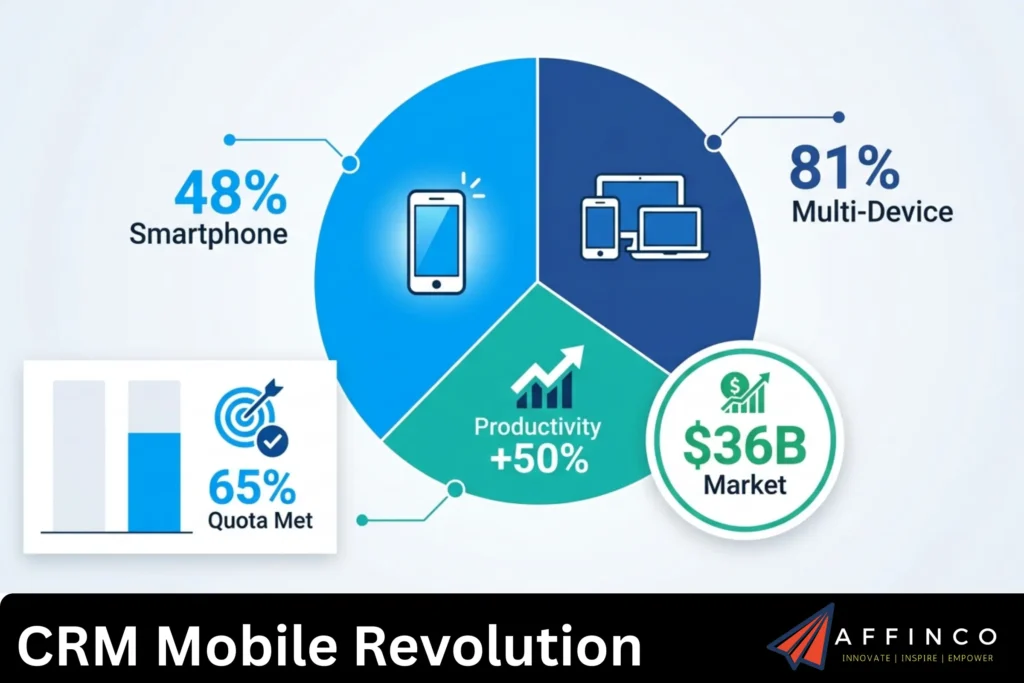
Mobile access is now standard. 81% of CRM users access systems from multiple devices, including smartphones and tablets. 50% of teams improved productivity using a mobile CRM.
Mobile CRM software market is valued at $36.24 billion in 2026, up from $31.36 billion in 2025, at a CAGR of 15.6%. Mobile CRM is expected to grow by 13% annually going forward.
Key mobile CRM stats:
For marketers managing teams in the field or working across time zones, mobile CRM access is no longer a nice-to-have. It is essential for hitting targets.
🤖AI in CRM: The Fastest Growing Segment
Artificial intelligence is reshaping how CRM platforms work. The global AI in CRM market was valued at $4.1 billion in 2023 and is expected to reach $48.4 billion by 2033. That is nearly 12x growth in a decade.
Organisations integrating AI into CRM report a 44% increase in lead generation. 61% of businesses plan to add AI features to CRM by 2028. By 2025, over 70% of CRM tools already include AI features like chatbots and predictive analytics.
AI-powered CRM capabilities include:
Salesforce processed 19 trillion tokens all-time and delivered 2.4 billion agentic work units in fiscal 2026. That shows how deeply AI is embedded in modern CRM operations.
⚙️CRM by Industry: Who Uses It Most?
CRM adoption varies by sector. Some industries are further ahead than others.
| Industry | CRM Adoption Rate | Key Use Case |
|---|---|---|
| Technology | 97% | Sales pipeline, customer success |
| Financial Services | 91% | Compliance, client management |
| Healthcare | 89% | Patient management, outreach |
| Education | 93% | Student engagement, enrolment |
| Retail | 88% | Loyalty programmes, e-commerce |
The finance and insurance sectors spend the most on CRM software. Public administration and professional services follow. Retail alone is expected to contribute 21% of total CRM market share by 2034.
73.8% of all CRM spending comes from companies with more than 1,000 employees. But small business CRM adoption grew by 45% in the past two years. That gap is closing quickly.
🏪Regional CRM Market Breakdown
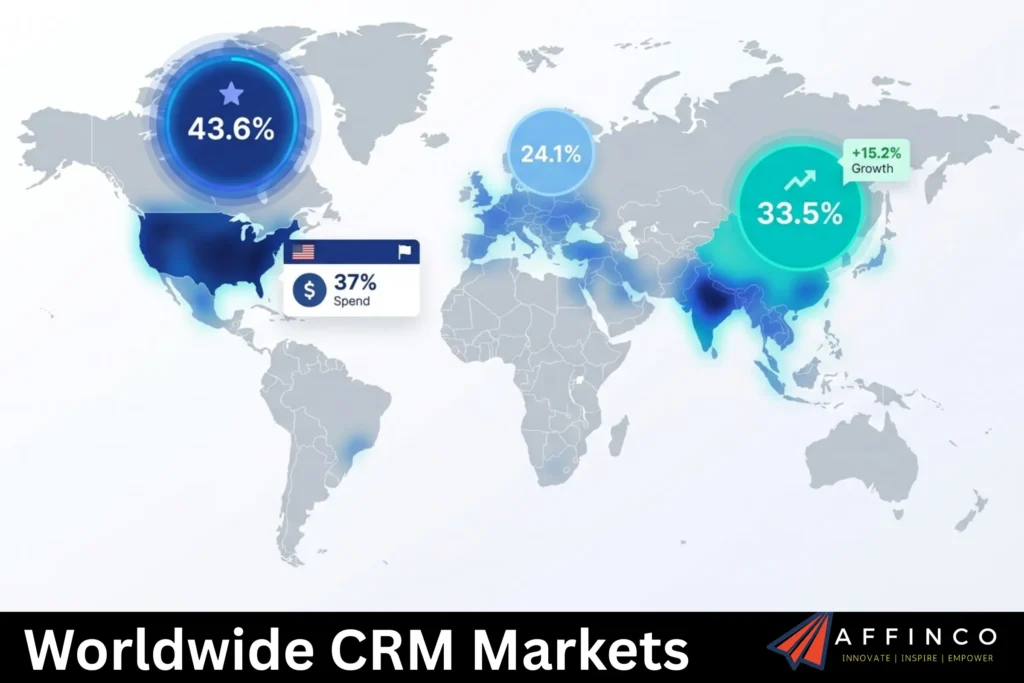
North America dominates CRM spending. Over 60% of businesses in North America use CRM systems. The US alone accounted for around $49.57 billion in CRM software revenue in 2025. North America is forecast to hold approximately 24.6% of the global CRM market by 2034.
Regional highlights:
For marketers expanding internationally, Asia Pacific offers the highest growth potential. Lower CRM penetration combined with rapid digital adoption makes it a prime region for new customer acquisition strategies.
🎯CRM Challenges Marketers Still Face
CRM is powerful, but adoption is not always smooth. Here are common pain points reported by businesses:
45% of companies say automation is the main feature they want in a CRM tool. Integration ranks second at 36%, followed by mobile access at 20%, ease of use at 15%, and customisation at 8%.
Training and onboarding remain critical. Businesses that invest in CRM training see 2x faster adoption and higher user satisfaction. Picking a CRM with built-in tutorials and responsive support teams reduces friction significantly.
🏷️CRM and Sales Automation: Key Performance Stats
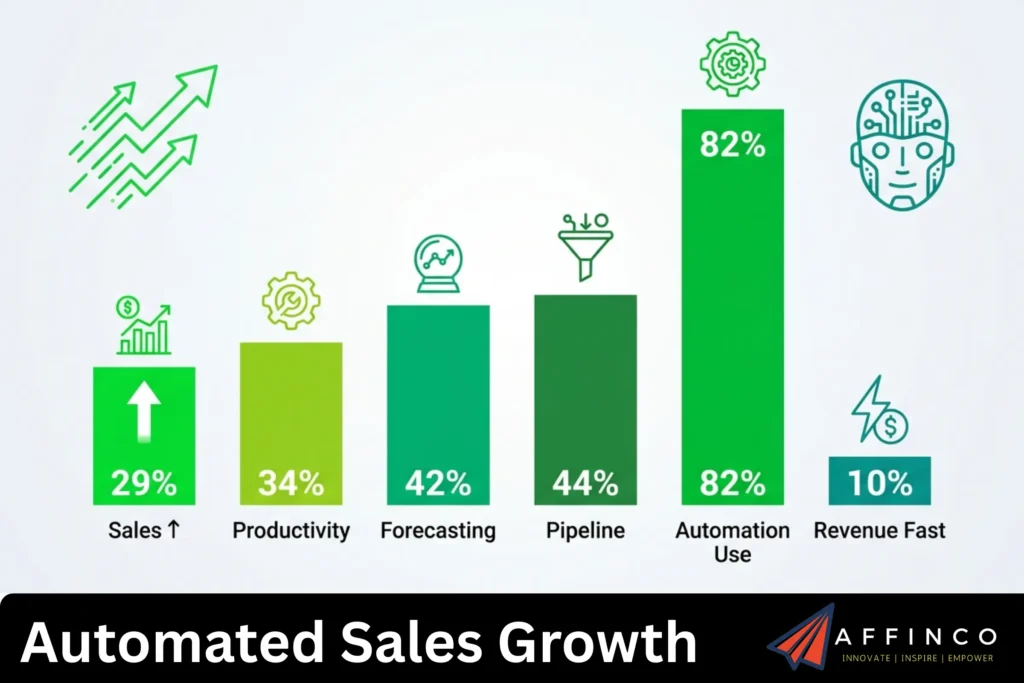
Sales automation is where CRM delivers some of its biggest wins. 82% of organisations rely on CRM for sales reporting and automation.
Performance improvements from CRM sales automation:
CRM-powered automation handles repetitive tasks like follow-up emails, lead assignment, and reporting. That frees sales teams to focus on closing deals rather than data entry. For marketers running performance-based campaigns, CRM automation is the backbone of efficient pipeline management.
🔥What These CRM Stats Mean for Your 2026 Strategy
CRM is a $109 billion industry in 2026 and growing at double-digit rates. 91% of mid-to-large businesses already use it. Cloud CRM dominates at 87% market share. AI integration is accelerating at 12x pace. And for every dollar invested, businesses get back nearly nine.
If you are not using CRM yet, you are behind 91% of your competitors. If you are already using one, the opportunity lies in AI features, mobile access, and better automation. The stats make it clear.
CRM software adoption is not slowing down. Smart marketers who act on these numbers will capture more leads, close more deals, and retain more customers in 2026 and beyond. 🚀

Ali
Ali is a digital marketing expert with 7+ years of experience in SEO-optimized blogging. Skilled in reviewing SaaS tools, social media marketing, and email campaigns, we craft content that ranks well and engages audiences. Known for providing genuine information, Ali is a reliable source for businesses seeking to boost their online presence effectively.