

MCP started as an Anthropic side project in 2024 and became shared plumbing for almost every major AI platform by 2026. Monthly SDK downloads now sit near 97 million. Public server counts cleared 10,000.
Around 45% of software companies run MCP in some form of production, yet roughly four in ten internet-facing servers still ship with zero authentication.
We have been wiring agents into client marketing stacks since the protocol was young. So we pulled the credible numbers together, binned the inflated ones, and added our own estimates where public data goes quiet.
That gap between hype and shipped reality is the whole story of MCP adoption statistics 2026. Plenty of teams talk about it. Fewer run it in production. Even fewer run it safely.
MCP Adoption Statistics 2026: The Headline Numbers Marketers Keep Asking Us For
We get asked about MCP on almost every strategy call now. Usually the question sounds like “is this real, or is it another acronym that dies by next year?” Fair question. Plenty of agent standards have arrived loudly and gone quietly.
So we pulled the primary numbers rather than the recycled ones. What follows leans on Anthropic's own ecosystem reporting, the official MCP registry, GitHub's public API, and a named enterprise survey with a known sample size. Where a figure comes from our own modelling, we label it plainly.
| Metric | 2024 (Launch Year) | 2025 | 2026 (Current) | What Our Team Reads Into It |
|---|---|---|---|---|
| Monthly SDK downloads (Python and TypeScript) | Around 100,000 in first month | 97 million | More than 400 million | Roughly 4,000x growth across two years. Download volume now rivals mature web libraries. |
| Active public MCP servers | Around 50 reference servers | More than 10,000 | 9,652 latest records in official registry | Registry counts trail real ecosystem size because private enterprise servers never appear. |
| GitHub repositories tagged mcp-server | Negligible | Roughly 7,800 by community counts | 15,926 | Developer supply is doubling faster than curated registry listings. |
| Reference servers repository stars | Early single-digit thousands | Tens of thousands | 86,148 stars, 10,799 forks | Forking activity signals teams building private variants, not just reading docs. |
| Enterprise software teams in production | Effectively zero | Early pilots only | 45% of software cohort surveyed | Production means limited plus broad rollout combined. Broad rollout alone sits at 19%. |
| Governance model | Single vendor (Anthropic) | Donated to Agentic AI Foundation | Linux Foundation stewardship | Neutral governance removed the biggest enterprise objection we heard through 2025. |
| Servers in Claude connectors directory | Not available | Early directory build-out | More than 950 | Curated directories matter more than raw counts once buyers start vetting suppliers. |
AFFiNCO Read: Download counts get quoted most because they look impressive. We watch fork counts and registry records instead. Forks tell us how many teams are shipping something private, and private deployment is where agency budgets actually land.
From 100,000 Downloads To 400 Million: Charting The Growth Curve
Growth stories usually flatten once you plot them, but MCP has not followed that rule. The curve keeps steepening, which is unusual at this stage of a protocol's life.
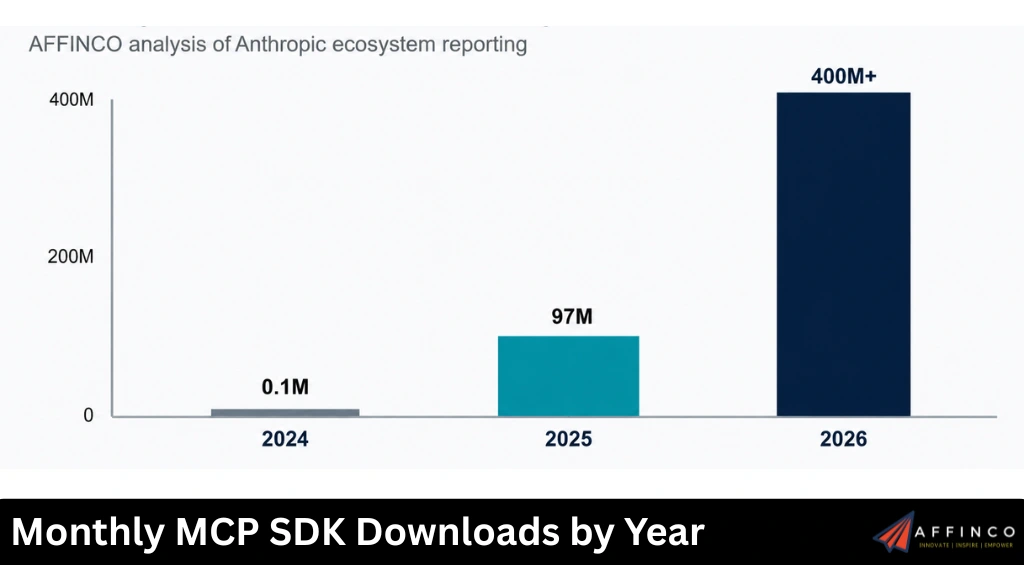
A useful comparison helps here. React took roughly three years to reach 100 million monthly npm downloads. MCP passed a comparable scale in about 16 months, then quadrupled again.
Speed like that usually means one of two things. Either the standard solved a problem people were already hacking around, or vendors pushed it hard. With MCP, both applied at once.
The Adoption Timeline: How A Vendor Protocol Became Shared Infrastructure
We find the year-by-year view more useful than raw totals. Adoption of an integration standard follows a predictable order: developers first, tooling vendors second, enterprises third, governance last.
MCP compressed all four stages into two years, which explains why so many marketing teams feel behind. Most of them are not actually behind at all. They arrived at a perfectly normal pace on an abnormal timeline.
Client support arrived from ChatGPT, Cursor, Gemini, Microsoft Copilot, Visual Studio Code and GitHub. Governance then moved to the Agentic AI Foundation, which mattered more than any download milestone.
The 2026 enterprise year is where adoption became a procurement conversation rather than a developer one. The stateless specification revision shipped with hardened authorisation, and named companies started publishing production commitments.
Figma, Intuit, Netlify, Zoom, Xero and PostHog all built against the new revision before release. Cloudflare, AWS Bedrock and Vercel documented deployment paths of their own.
Our read on 2027 follows a different pattern. Supply growth slows while trust infrastructure takes over as the deciding factor.
What we project: Our model puts monthly SDK downloads between 750 million and 900 million by the close of 2026. Growth is decelerating in percentage terms while accelerating in absolute volume, which is exactly what late-stage standard adoption looks like.
Why 2026 Became The Year MCP Stopped Being Optional
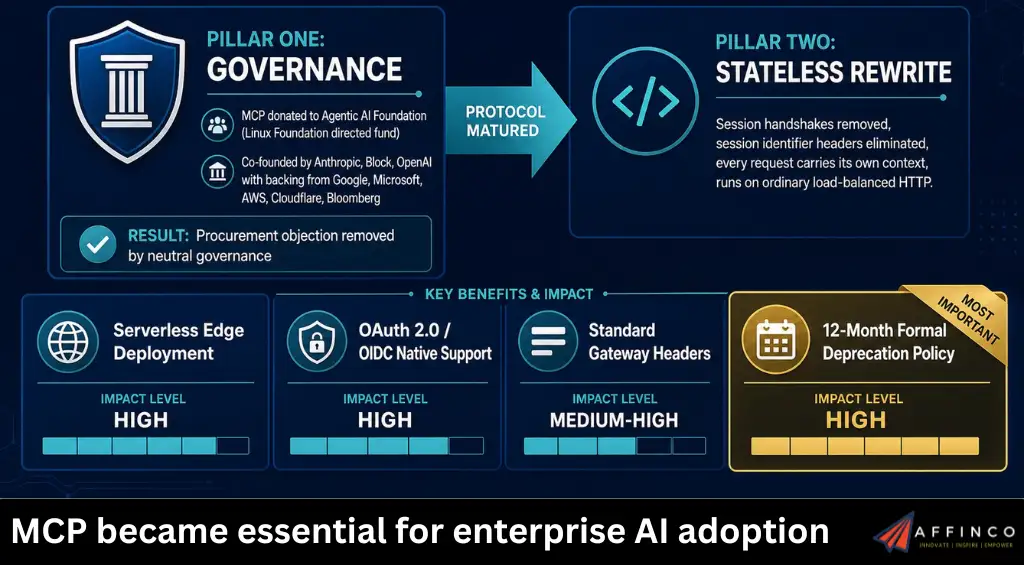
Two things changed the calculation for enterprises, and neither was a download number.
Governance came first. Anthropic donated MCP to the Agentic AI Foundation, a directed fund under the Linux Foundation. Anthropic, Block and OpenAI co-founded it, with backing from Google, Microsoft, AWS, Cloudflare and Bloomberg.
That single move killed the objection we heard most often on client calls. Procurement teams stop worrying about vendor capture once a neutral body holds the specification.
Second came the engineering rewrite. The 2026 specification revision made the protocol stateless at its core. Session handshakes and session identifier headers were removed entirely.
Before that change, running a remote MCP server meant shared session stores or gateway packet inspection. Both added latency and cost. Now every request carries its own context, so servers run on ordinary load-balanced HTTP infrastructure.
For agencies like ours, that last point matters most. Client stacks live for years. A protocol with no deprecation policy is a protocol you cannot responsibly recommend to a client on a three-year contract.
How Many MCP Servers Exist Right Now, And Why The Counts Disagree
Ask three sources how many MCP servers exist and you get three answers. None of them are lying, they simply count different things.
We treat server counts as four separate measurements, because conflating them produces nonsense figures that get quoted for months afterwards.
Notice the gap between 90,000 catalogued and 10,000 runnable. Roughly nine in ten listed servers fail basic execution checks in large-scale sweeps.
We hit similar ratios internally. When our team evaluated candidate servers for client reporting workflows, most failed on authentication handling, stale dependencies or missing error responses.
Numbers we trust: Treat any headline above 20,000 servers as ecosystem noise unless the source states its verification method. Our working figure for genuinely production-grade public servers sits between 2,500 and 4,000.
Enterprise Production Adoption: Who Has Actually Shipped Something
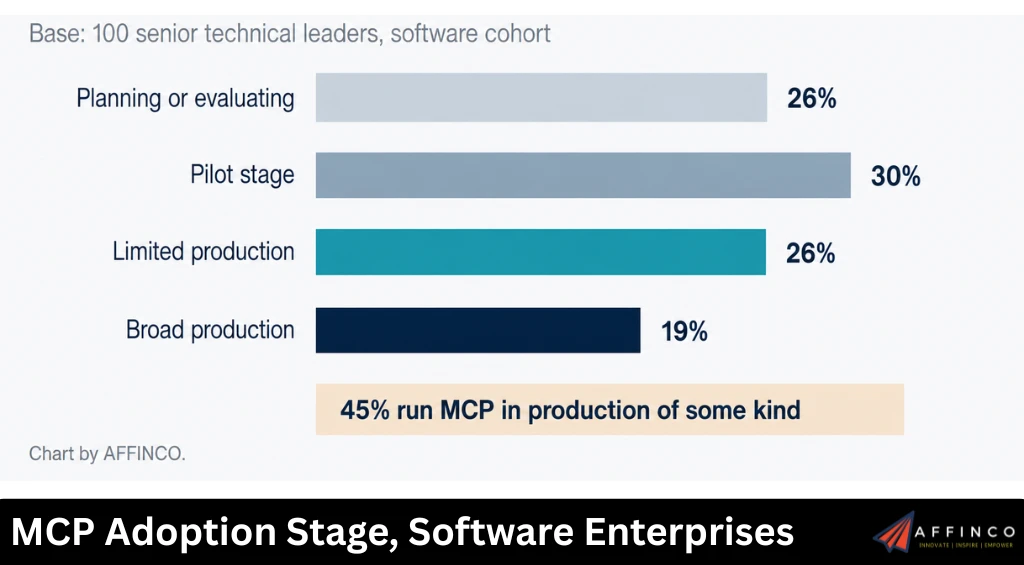
Survey data on MCP has been messy. A widely repeated claim put enterprise production adoption at 78%, with no traceable sample behind it. That figure has since been withdrawn by several publishers.
The strongest named source we found surveyed 300 senior technical leaders across large enterprises, split evenly across software, financial services and retail. Nearly 60% of respondents worked at organisations with more than 5,000 employees.
Respondent titles skewed to CTO, Principal Engineer and Director of AI Platform. All held real ownership over AI investment decisions, which matters when you are measuring production readiness rather than opinion.
| Adoption Stage | All Industries Surveyed | Software Cohort | What Sits Behind The Number | Our Practitioner Note |
|---|---|---|---|---|
| Planning or evaluating options | 29% | 26% | Business case written, nothing built yet | Most stall here on security sign-off rather than budget |
| Pilot | 30% | 30% | One team, one use case, usually read-only | Pilots that stay read-only convert to production far more often |
| Limited production | 29% | 26% | Live workloads, restricted user group | Typical shape is developer tooling before business workflows |
| Broad production use | 12% | 19% | Multiple teams, multiple connected systems | Software firms lead retail and financial services clearly here |
| Combined production total | 41% | 45% | Limited plus broad rollout added together | Strong for a two-year-old protocol, far below the retired 78% claim |
| Ranked as a top-five company priority | Varies by sector | 49% | Critical plus high priority responses | Highest of any industry measured in the study |
Retail told a similar story, with more than 40% reporting production use. Financial services trailed, which surprised nobody who has sat through a bank's vendor review process.
One detail in that study deserves closer attention. Only 11% of respondents described themselves as building or using MCP servers in production personally, while 50% were experimenting.
That gap between organisational adoption and individual hands-on experience explains a lot of failed rollouts. Companies buy the capability faster than their people build the muscle.
What Enterprises Are Actually Plugging Into Their AI Agents
Connection targets tell you more about maturity than adoption percentages do. Teams connect low-risk systems first, then work outward as confidence grows.
The ordering below matches what we see on client engagements almost exactly. Version control and documentation go first because both are read-heavy and low-consequence.
| Our Practitioner Note | Share Connecting It | Typical Access Pattern | Marketing Stack Equivalent | Risk Level We Assign |
|---|---|---|---|---|
| Version control (GitHub, GitLab, Bitbucket) | 63% | Read plus pull request creation | Content repositories and campaign asset stores | Low to moderate |
| Documentation systems (Confluence, Notion, wikis) | 62% | Read only | Brand guidelines, positioning docs, campaign briefs | Low |
| Issue tracking (Jira, Linear, Asana) | 54% | Read plus ticket creation | Campaign production boards and creative queues | Moderate |
| Cloud infrastructure (AWS, GCP, Azure) | 53% | Read plus scoped actions | Data warehouses feeding attribution models | High |
| Code quality and security scanning | 49% | Read only | Site audit and technical SEO crawlers | Low |
| Monitoring and observability (Datadog, New Relic) | 46% | Read only | Analytics platforms and ad account dashboards | Low to moderate |
| Team communication (Slack, Teams) | 37% | Read plus message posting | Client channels and internal approval threads | High on write access |
| Container registries and orchestration | 35% | Read plus deployment triggers | Publishing pipelines and CMS deployment | High |
We hold write access behind explicit approval on every client account we manage. Our AI agents can draft a budget reallocation and flag it, but a strategist confirms before spend moves. Read-first rollouts have never caused us an incident. Write-first rollouts elsewhere have caused plenty.
The Use Cases Winning Budget Approval Right Now
Software teams reported a clear cluster of priorities, and every one of them shares a trait. Each removes repetitive work rather than replacing judgement.
User profiles reinforce the pattern. Software developers are primary users at 80%, followed by data analysts and scientists at 68%.
Knowledge workers reach 47% and management sits at 32%. Marketing does not yet appear as a named category in enterprise MCP surveys, which is exactly the opportunity we keep pointing clients toward.
Security Remains The Single Biggest Blocker, And Rightly So
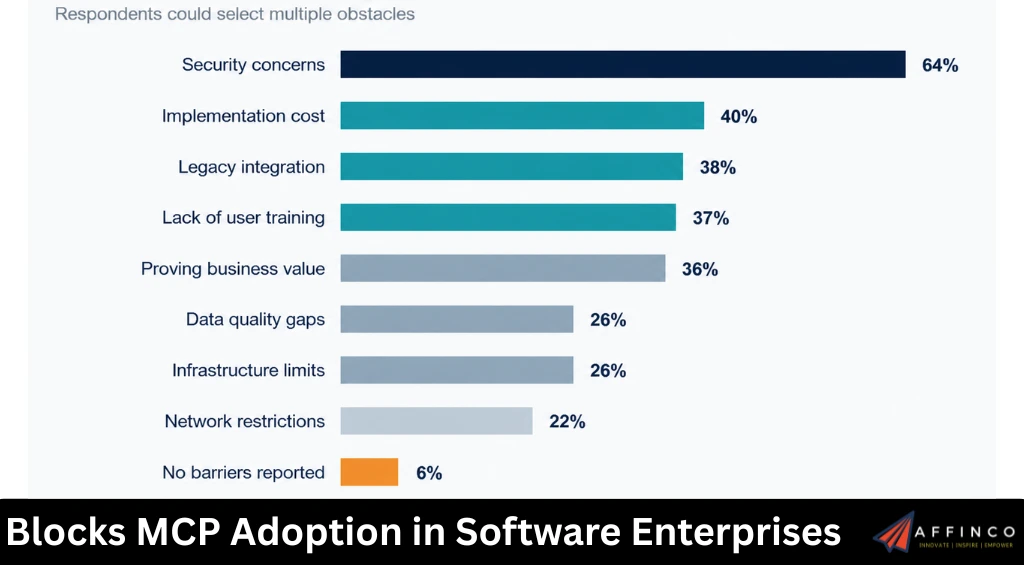
Security concerns topped the obstacle list at 64% among software respondents. Higher, notably, than among financial services or retail peers despite tighter regulation in those sectors.
Software teams understand the attack surface better, so they worry more. We consider that a healthy signal rather than a warning.
Credential handling across the public server population is where things get uncomfortable. An audit covering more than 5,200 servers found 88% require credentials of some kind.
Of those, 53% rely on static API keys or personal access tokens. Only 8.5% use OAuth, while around 79% pass keys through environment variables.
Static keys in environment variables is a pattern we retired from client work years ago. Seeing it dominate a brand-new ecosystem was genuinely sobering.
| Security Finding | Measured Value | Sample Or Scope | Practical Consequence | Control We Recommend |
|---|---|---|---|---|
| Servers requiring credentials | 88% | Audit of 5,200+ public servers | Nearly every server holds an access secret | Scoped service accounts, never personal tokens |
| Reliance on static API keys or PATs | 53% | Same credential audit | No rotation, no expiry, no revocation trail | Short-lived tokens with automated rotation |
| OAuth adoption across public servers | 8.5% | Same credential audit | Most servers cannot bind to enterprise identity | Require OAuth or OIDC before procurement approval |
| Open-source servers with general vulnerabilities | 7.2% | Academic study of 1,899 servers | Roughly one in fourteen carries a known flaw | Dependency scanning before any install |
| Servers carrying tool poisoning risk | 5.5% | Same academic study | Hidden instructions inside tool descriptions | Signed manifests and metadata review |
| Added attack susceptibility versus direct integrations | 23% to 41% higher | 847 attack scenarios across 5 servers | Protocol convenience carries a measurable cost | Tool allowlisting plus human approval gates |
| Role-based permissions in place | 67% | Software enterprise survey | Majority already applying access control | Extend to per-tool rather than per-server scope |
| Audit logging and monitoring in place | 60% | Software enterprise survey | Four in ten still cannot reconstruct agent actions | Log every tool call with user attribution |
Our call on risk: Tool poisoning is the attack class we brief clients on first. A poisoned tool description runs on every single invocation, silently, for every user, until somebody notices. Traditional prompt injection needs repeated delivery. This one ships once and keeps working.
Where Enterprises Host MCP, And Who They Trust To Build It
Hosting choices split more evenly than we expected. No single model dominates, which suggests teams are still working out what good looks like.
Build strategy shows far more consensus. Roughly 69% of software organisations plan to build their MCP platform in-house using open-source components.
Around 35% use proprietary solutions in-house, 37% build alongside a third-party expert, and only 9% outsource entirely. Preference for open source runs strong, with 35% expressing a firm preference.
Accountability sits mostly with security teams at 37%, then AI or data platform teams at 32%, then engineering at 23%. Line-of-business ownership sits at just 4%.
That final number is the one we flag to marketing directors. If your team owns the workflow but not the security posture, you will wait on someone else's queue for every change.
What MCP Adoption Statistics Mean For Marketing And Agency Teams
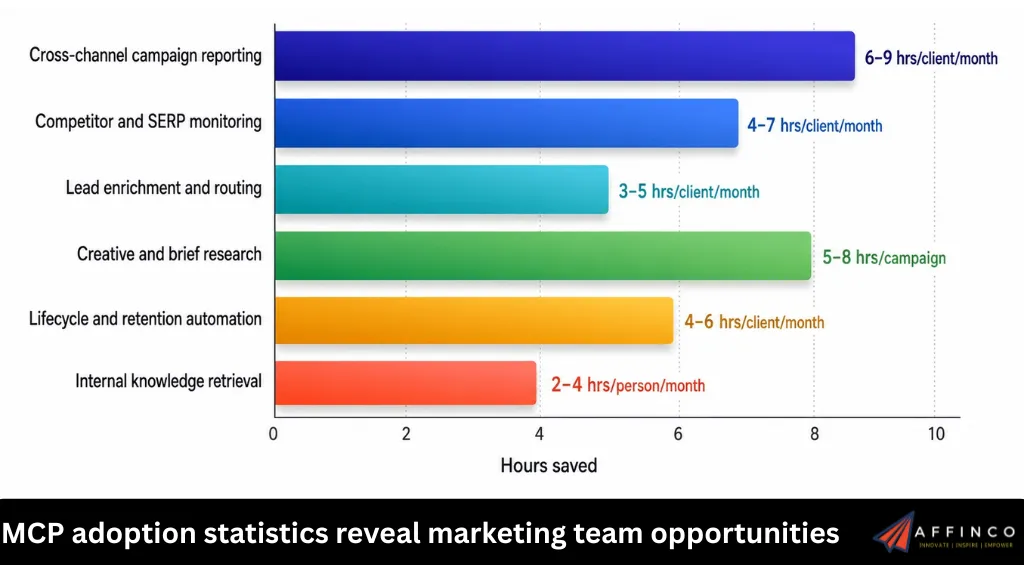
Enterprise MCP research is dominated by engineering use cases. Marketing barely registers as a category yet, and public deployment counts for CRM or ad platform servers remain unverified.
We think that absence is temporary and worth acting on early. Marketing operations carries more tool boundaries than almost any other function.
Consider a normal campaign week. CRM, ad platforms, web analytics, lifecycle email, customer data platforms, docs, messaging, support systems and project boards all hold a piece of the answer.
Every boundary between those systems is a place where somebody copies a number into a spreadsheet. MCP removes the copying, not the thinking.
That distinction shapes how we scope agent work for clients. An agent that assembles a performance summary saves hours without touching a single decision.
An agent that changes bids without review saves nothing, because a strategist ends up auditing the change anyway. Automation only pays when it removes work nobody wanted to do.
There is a second reason we push clients toward MCP earlier than most agencies do. Integration debt compounds quietly, and marketing stacks carry more of it than most.
Build a custom connector between your analytics platform and one AI tool, and you own that connector forever. Swap the AI tool next year and the work restarts.
Build a server once and every compliant client can call it. Given how quickly model vendors trade places, portability now carries real commercial value.
| Marketing Workflow | How MCP Applies | Access We Grant | Risk To Control | Our Estimated Time Saved |
|---|---|---|---|---|
| Cross-channel campaign reporting | Agent pulls analytics, CRM and ad data into one summary | Read only | Row-level access leakage, attribution assumptions | 6 to 9 hours per client each month |
| Competitor and SERP monitoring | Web data servers crawl and structure competitor pages on demand | Read only, external sources | Rate limits, stale caching, blocked targets | 4 to 7 hours per client each month |
| Lead enrichment and routing | Agent connects CRM, firmographic data and sales routing | Read plus gated write | Duplicate records, consent boundaries | 3 to 5 hours per client each month |
| Creative and brief research | Agent queries prior campaigns, brand docs and audience notes | Read only | Brand rule drift, unapproved claims | 5 to 8 hours per campaign |
| Lifecycle and retention automation | Agent combines segments, event data and template libraries | Draft only, human send | Wrong-segment sends, frequency breaches | 4 to 6 hours per client each month |
| Internal knowledge retrieval | Agent searches playbooks, positioning docs and campaign history | Read only | Stale docs, missing ownership metadata | 2 to 4 hours per person each month |
Time-saved figures above come from our own account operations across client engagements, not from published research. We share ranges rather than single numbers because account complexity varies enormously. Treat them as planning inputs, not guarantees.
The Web Data Servers We Actually Run In Client Workflows
Most marketing MCP value starts with one capability: getting clean web data into an agent without building a scraper.
Two servers cover the majority of what our team needs, and they solve different problems.

Firecrawl converts any URL into clean, model-ready markdown. Its MCP server exposes scraping, crawling, site mapping and search as callable tools.
The efficiency gain is real. Firecrawl reports returning roughly 93% fewer tokens than raw HTML by pre-processing pages properly.
Token reduction sounds like a developer concern. It is actually a margin concern, because token spend on a large crawl compounds fast across a client roster.
Firecrawl also carries genuine developer traction, with more than 40,000 GitHub stars and a reported 1.25 million active developers. Its newer skills approach cuts context overhead further for teams that want web access without running a full server.
Apify solves a different problem. Its MCP server exposes more than 30,000 Actors as tools, covering structured platform data that generic crawlers handle poorly.
We reach for Apify when a client needs marketplace listings, map results or profile data at scale. Full proxy control, country selection and session management matter enormously on protected targets.
Market Size And The Money Moving Into Agent Infrastructure
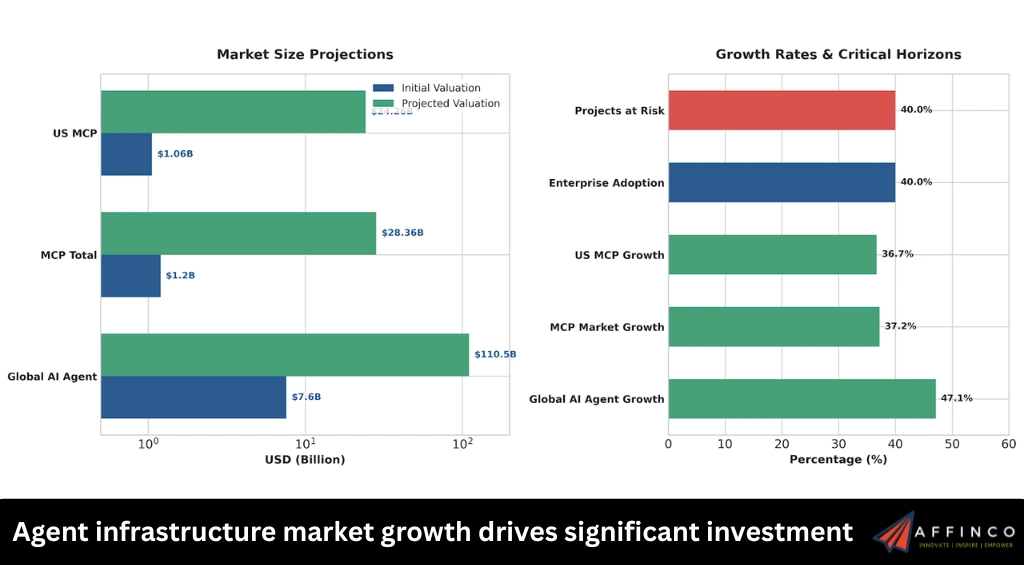
Forecasts deserve scepticism, so we present them as forecasts rather than facts. Directionally, though, the money story supports what adoption data already shows.
| Market Measure | 2025 Value | 2026 Value | Forecast Horizon | Growth Rate | Confidence We Assign |
|---|---|---|---|---|---|
| Model Context Protocol market | USD 1.20 billion | Not separately published | USD 28.36 billion by 2035 | 37.22% compound annual growth | Moderate, single analyst house |
| United States MCP market | USD 1.06 billion | Not separately published | USD 24.26 billion by 2035 | 36.72% compound annual growth | Moderate |
| Global AI agent market | USD 7.6 billion | USD 10.9 billion | USD 110.5 billion by 2032 | 47.13% compound annual growth | Moderate to high |
| Enterprise apps with task-specific agents | Under 5% | 40% forecast by year end | Continued expansion | Eightfold increase in one year | High, major analyst forecast |
| Agentic AI projects at cancellation risk | Not measured | Not measured | More than 40% by end of 2027 | Attributed to weak returns and governance gaps | High, and worth planning around |
| Marketing-specific MCP servers (AFFiNCO estimate) | Under 4% of registry | Roughly 7% to 9% of registry | We model 15% to 18% by 2028 | Our own modelling, not published research | Directional only |
That cancellation forecast deserves more attention than it gets. More than 40% of agentic AI projects may be scrapped by the end of 2027.
Weak returns and governance gaps drive most of those failures. Neither problem is a protocol problem, which is exactly why MCP adoption alone guarantees nothing.
Our estimate: Across agencies specifically, we put current MCP usage at roughly one in six shops running at least one server in live client workflows. We model that reaching one in three during 2027, with reporting and research workflows leading rather than campaign execution.
Client Adoption: Which AI Platforms Support MCP Today
Platform support is the best-evidenced part of the whole MCP story. Every major vendor documents it publicly.
- Claude and Claude Desktop offer original client support plus a connectors directory carrying more than 950 servers
- ChatGPT supports connectors and remote servers through its tool surface
- Google Gemini supports MCP tools with automatic tool-calling loops in its SDK
- Microsoft Copilot Studio connects agents to existing servers over streamable transport
- GitHub ships an official server, and Vercel, Netlify and Cloudflare all document deployment paths
- AWS Bedrock AgentCore runs MCP alongside agent-to-agent protocols as complementary defaults
Cross-vendor support is what separates a standard from a vendor feature. Competing platforms rarely agree on anything, so agreement here carries real weight.
Mistakes We Keep Watching Teams Make With MCP Rollouts
We have now reviewed enough agent deployments to see patterns. Most failures repeat a small number of avoidable errors.
The tool count mistake surprises people most, because adding more tools feels like adding more capability. In practice, agents pick worse tools as the option set grows.
We cap connected tools per workflow and split agents by function instead. One agent handles reporting, another handles research, and neither sees the other's toolset.
Governance failures follow a predictable shape too. Somebody runs a successful pilot, leadership asks to scale it, and nobody revisits the permissions granted during testing.
Pilot credentials are almost always too broad, because restricting them slows the pilot down. Scaling that same setup across an organisation carries the loose permissions along with it.
Our rule on client accounts is simple enough to enforce. Every promotion from pilot to production triggers a fresh permission review, with the previous scope treated as void.

AFFiNCO Projections: Where These Numbers Land Next
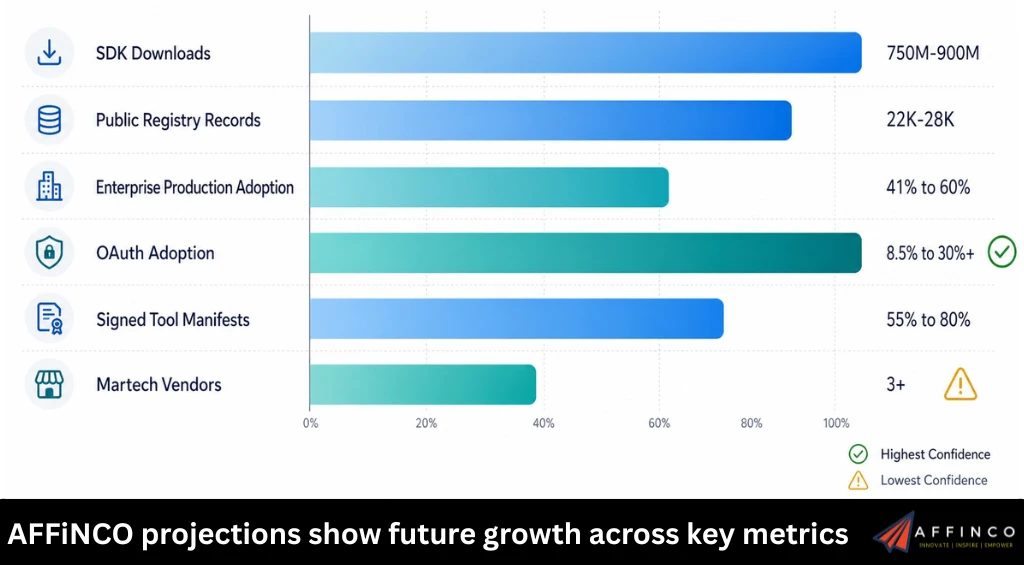
Time to put our own stake in the ground. These are estimates built on client deployments, partner conversations and the growth rates above, not sourced figures.
We hold the OAuth projection with the most confidence. Authorisation now aligns with production identity systems, so the main technical excuse for static keys has gone.
Our least confident call is the martech timing. Marketing platforms have historically been slow to open programmatic surfaces, and nothing suggests urgency yet.
How We Compiled These MCP Adoption Statistics
Method matters when a topic attracts this much recycled data. We applied a simple hierarchy while assembling this piece.
Any percentage without a named source, sample and denominator was excluded. That rule alone removed several widely circulated figures, including the retired 78% production claim.
Our own numbers appear only inside labelled callouts and clearly marked table rows. We would rather show our working than have a reader mistake our modelling for measured research.
The Bottom Line On MCP Adoption In 2026
MCP has crossed from interesting protocol into ordinary infrastructure. Four hundred million monthly downloads, neutral governance, cross-vendor support and 45% enterprise production adoption make that conclusion hard to argue with.
What has not been solved is the operational layer. Credential hygiene across public servers remains poor, tool poisoning has no widely deployed defence, and marketing platforms have barely started shipping first-party servers.
Our advice to clients has stayed consistent through every revision of these MCP adoption statistics. Start with read-only connections to systems you already trust. Log everything. Gate writes behind a human.
Teams doing that are already saving real hours each month. Teams skipping it are building an incident they have not had yet.

Sources And Further Reading
- Anthropic: Donating the Model Context Protocol and establishing the Agentic AI Foundation
- Anthropic: Bringing the 2026 MCP specification to Claude
- Model Context Protocol: The 2026 specification release
- Model Context Protocol: Official specification
- Stacklok: State of Model Context Protocol in Software 2026
- Stacklok: State of Model Context Protocol in Retail 2026
- Linux Foundation: Formation of the Agentic AI Foundation
- Google Developers: Scaling AI agent infrastructure with stateless MCP
- Cloudflare: The next generation of MCP
- Microsoft: Official MCP C# SDK version 2.0
- Practical DevSecOps: MCP security statistics 2026
- Cloud Security Alliance: MCP tool poisoning and auto-execution research note
- Journal of Cybersecurity and Privacy: MCP threat modelling and tool poisoning analysis
- arXiv: Model Context Protocol threat modelling research

Ali
Ali is a digital marketing expert with 7+ years of experience in SEO-optimized blogging. Skilled in reviewing SaaS tools, social media marketing, and email campaigns, we craft content that ranks well and engages audiences. Known for providing genuine information, Ali is a reliable source for businesses seeking to boost their online presence effectively.