
Email Marketing Statistics reveal that businesses generate $36 to $40 for every dollar spent in 2026, making it the highest ROI digital channel available. With 4.73 billion email users and 392 billion daily emails, the inbox remains where real revenue happens.
We've gathered the latest email marketing data covering open rates, automation, personalization, conversion benchmarks, and AI-powered campaigns.
These numbers expose what actually drives subscriber engagement and why your email strategy can outperform every other marketing channel.
Let's check out the stats that separate winning campaigns from wasted budget.
Global Email Marketing Market Overview (2026)
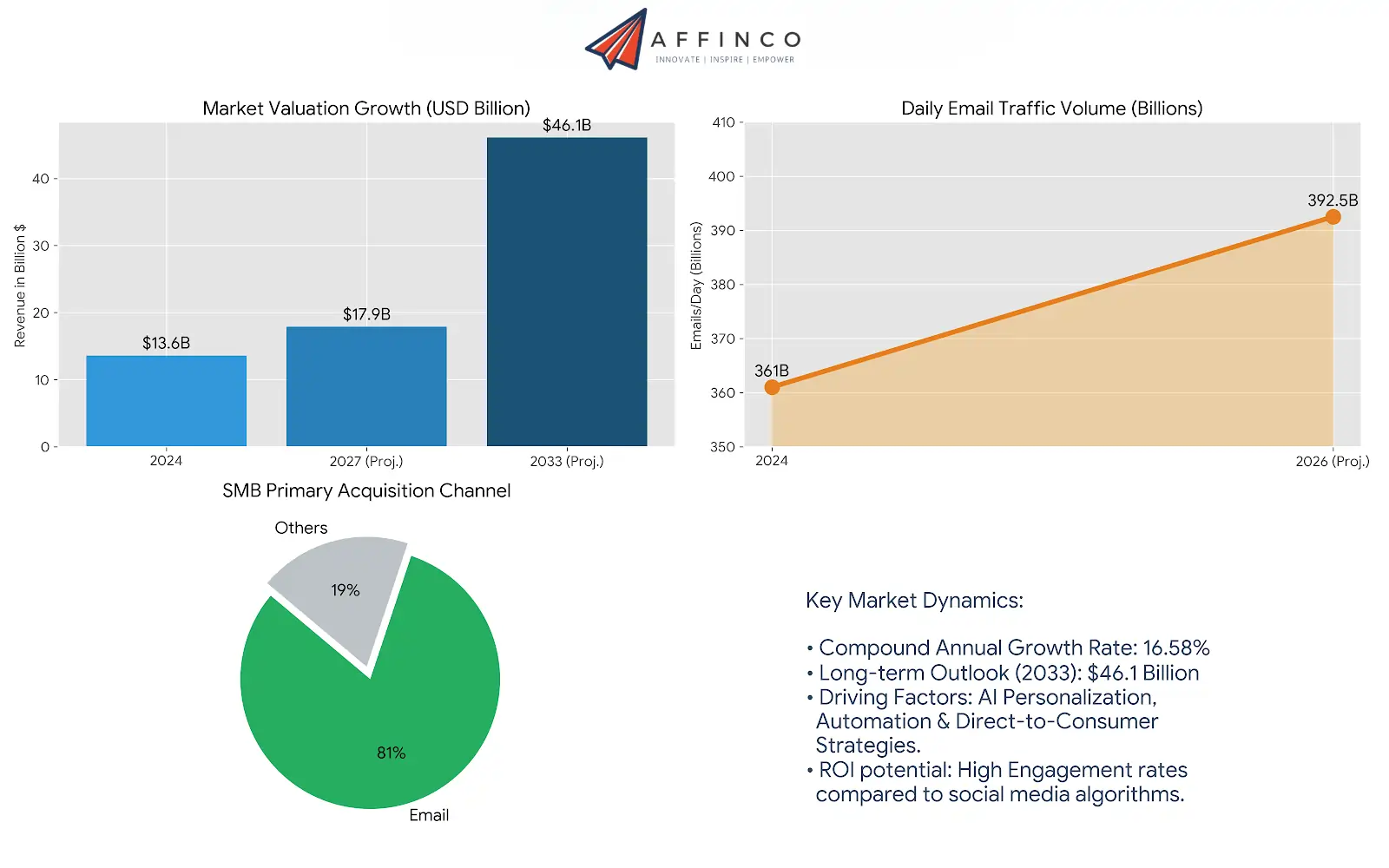
The email marketing industry continues to expand at a robust pace, driven by cost-effectiveness and high engagement rates. Analysts project significant revenue growth as businesses double down on direct-to-consumer channels to bypass algorithm volatility on social platforms.
The sheer volume of daily emails suggests that while competition in the inbox is fierce, the opportunity for reach is unparalleled. Marketers must focus on quality over quantity to stand out in this crowded digital space.
Email User Growth and Penetration 2026
Email usage is near-universal among digital consumers, with penetration rates climbing in developing markets. The total user base is expanding steadily, driven by mobile adoption and the necessity of email for digital identity verification.
With nearly 5 billion active users, email offers a direct line to a massive global audience that no other platform can match. The data confirms that email is not dying; it is becoming more entrenched in daily digital behavior.
2026 ROI and Revenue Metrics
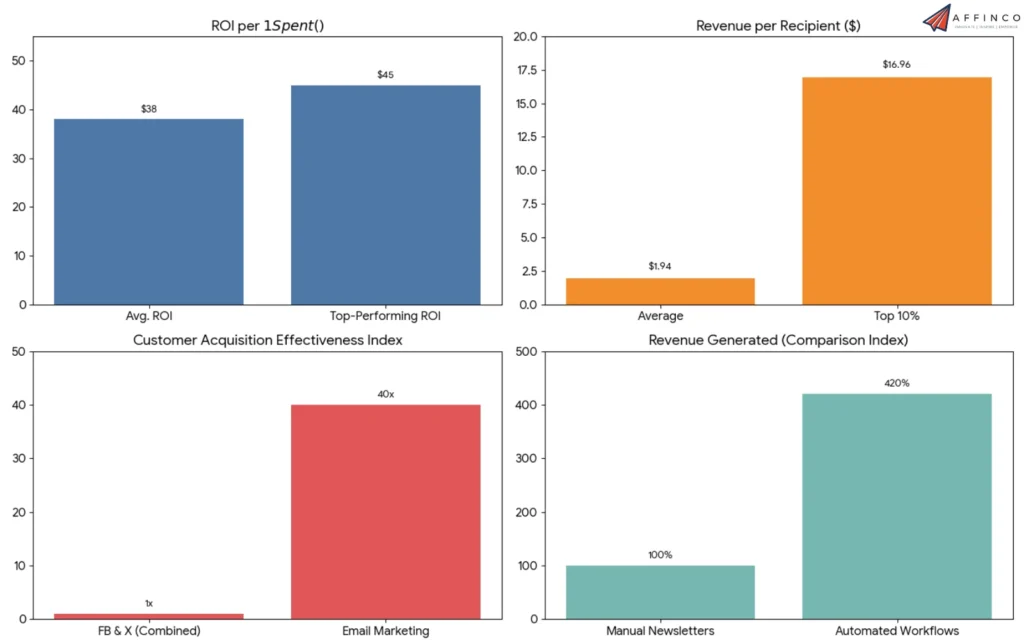
Return on Investment (ROI) is the primary reason brands continue to prioritize email budgets. In 2026, email marketing remains the most efficient channel for generating revenue, offering returns that dwarf those of paid search and social media.
These figures illustrate that email is a revenue-generating engine, not just a communication tool. Companies that optimize their campaigns for conversion are seeing exponential returns on their marketing spend.
AI in Email Marketing Statistics (2026 Trend)
Artificial Intelligence has moved from a buzzword to a core operational necessity in 2026. Marketers are using generative AI to craft copy, predict send times, and automate complex segmentation logic with unprecedented speed.
The integration of predictive analytics and machine learning is creating a divide between high-performing brands and those lagging behind. Adopting AI tools is no longer optional for those seeking to maximize campaign performance.
Mobile Email Usage and Optimization
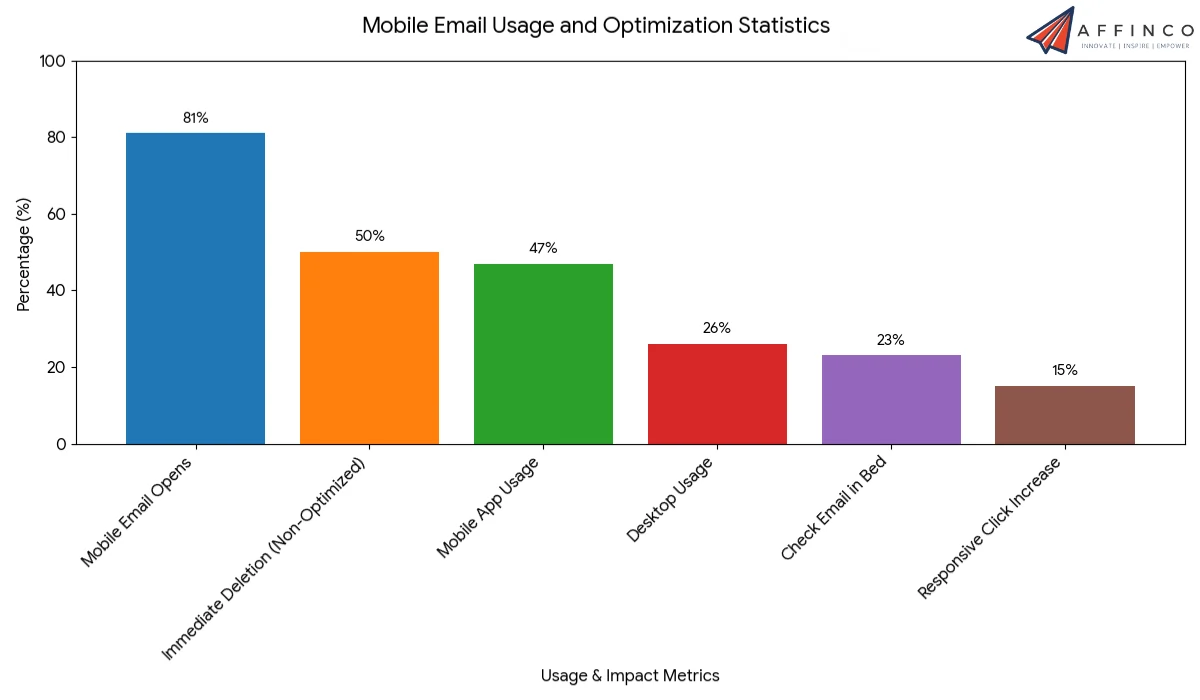
The majority of emails are now opened on mobile devices, making mobile-first design a non-negotiable standard. In 2026, failing to optimize for smaller screens results in immediate deletion and lost revenue opportunities.
Marketers must prioritize responsive coding and short, scannable content to cater to the mobile-first user. A poor mobile experience is the fastest way to increase unsubscribe rates in 2026.
Email Open Rates by Industry (2026 Benchmarks)
Understanding industry benchmarks is vital for setting realistic goals and evaluating campaign performance. Open rates vary significantly depending on the sector, with non-profits and government entities typically seeing higher engagement.
| Industry | Avg. Open Rate | Avg. Click Rate (CTR) |
|---|---|---|
| Non-Profit | 46.49% | 2.66% |
| Government | 28.77% | 3.99% |
| Retail | 38.58% | 1.34% |
| SaaS / Tech | 38.14% | 1.19% |
| Travel & Hospitality | 45.21% | 2.43% |
| Insurance | 44.40% | 2.33% |
| Education | 28.50% | 4.40% |
Comparing your metrics against these specific verticals allows for a more accurate health check of your email program. If you are in retail and hitting 40% opens, you are performing well above the average.
Click-Through Rate (CTR) and Engagement
While open rates indicate interest, click-through rates measure intent and action. In 2026, CTR is the metric that matters most for gauging the effectiveness of content and call-to-actions (CTAs).
Engagement metrics confirm that users respond best to interactive, visually appealing, and highly relevant content. Static, text-heavy emails are losing ground to dynamic and rich-media formats.
Personalization and Segmentation Statistics
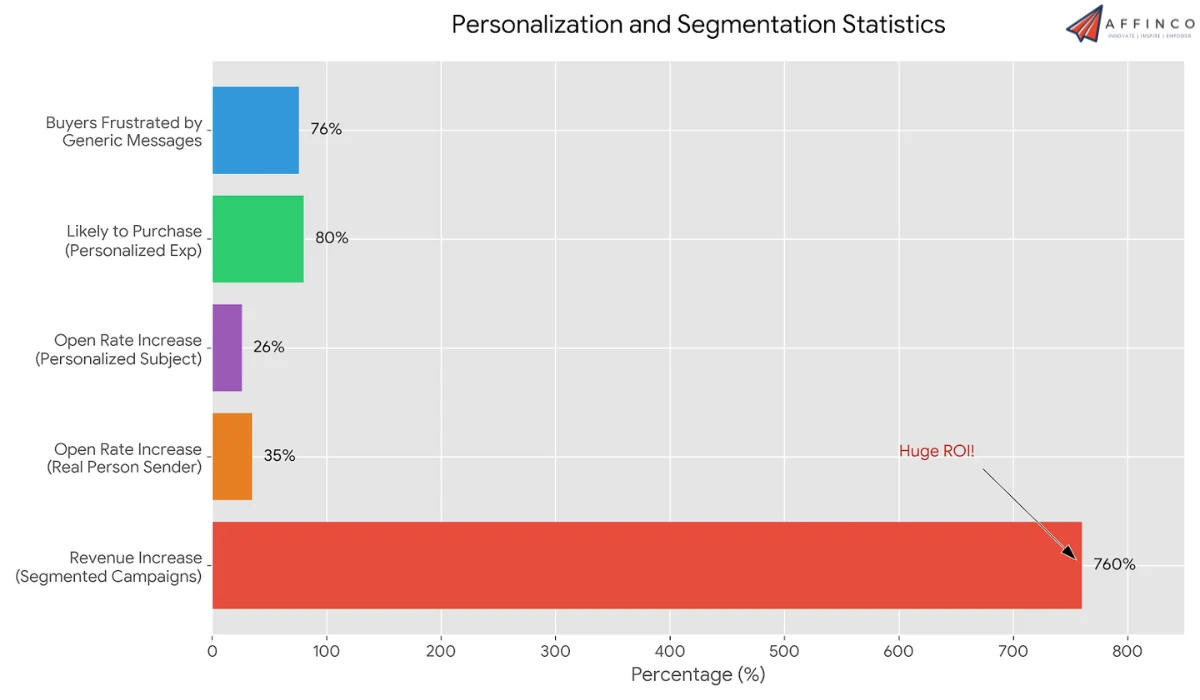
Generic “batch and blast” emails are obsolete in the modern marketing era. Consumers expect hyper-relevant content tailored to their behaviors, preferences, and past purchases.
The data clearly shows that segmentation is the key to unlocking higher revenue per subscriber. Brands that invest in cleaner data to fuel personalization will win the inbox battle in 2026.
Automation and Workflow Efficiency
Automation is the secret weapon for scaling email marketing without increasing headcount. Triggered emails sent based on user behavior consistently outperform scheduled newsletters.
Setting up robust automated flows allows businesses to generate revenue while they sleep. It ensures that every customer interaction is met with a timely and relevant response.
B2B vs. B2C Email Marketing Stats

B2B and B2C audiences behave differently, with B2B buyers valuing logic and information, while B2C consumers often respond to emotion and urgency. Understanding these nuances is vital for strategy.
While the tactics may differ, email remains the backbone of both B2B and B2C sales funnels. B2B marketers should focus on educational value, while B2C campaigns thrive on visual appeal and quick wins.
Deliverability and Spam Statistics
Reaching the inbox is half the battle; avoiding the spam folder is the other. With stricter regulations from providers like Google and Yahoo, maintaining sender reputation is critical in 2026.
Deliverability is a technical aspect that has a massive impact on revenue. Marketers must rigorously monitor their domain health and clean their lists to avoid being blacklisted.
Subject Line and Content Length Stats
The art of the subject line determines whether an email gets read or ignored. Short, punchy, and emoji-enhanced subject lines tend to perform best in the crowded mobile inbox.
- Subject lines with 6 to 10 words generate the highest open rates, averaging 21%.
- Emails with emojis in the subject line have a 56% higher open rate than text-only subject lines.
- Interactive content in the body of the email increases click-to-open rates by 73%.
- The ideal length for email copy is between 50 and 125 words, yielding response rates exceeding 50%.
- Using the word “Video” in a subject line boosts open rates by 19% and click-through rates by 65%.
Brevity and visual interest are key drivers of engagement. Consumers scan rather than read, so getting to the point quickly is essential for success.
Timing and Frequency Statistics

Knowing when to send is almost as important as what to send. While there is no universal “perfect time,” aggregate data points to specific windows of high engagement.
Testing send times for your specific audience is the only way to be sure, but these benchmarks provide a solid starting point. Respecting user frequency preferences is crucial for long-term retention.
Interactive and AMP Email Trends
Interactive emails transform the inbox from a static reading pane into a dynamic web-like experience. This technology, known as AMP for Email, is seeing wider adoption in 2026.
Moving beyond static text and images creates a memorable experience that drives action. The future of email is functional, allowing users to complete tasks without ever clicking through to a landing page.
Privacy and Data Security Stats
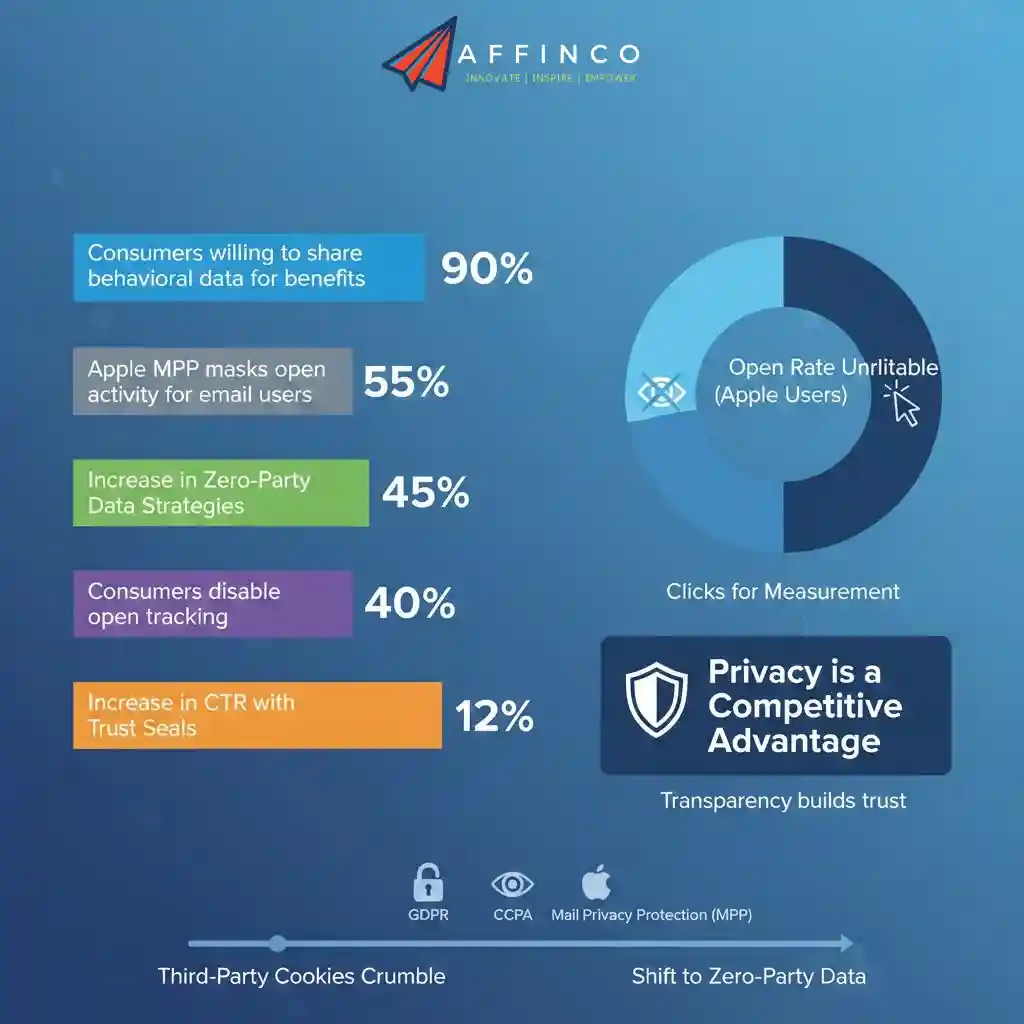
With privacy laws like GDPR and CCPA tightening, and Apple's Mail Privacy Protection (MPP) masking data, marketers are shifting focus to zero-party data.
- 90% of consumers are willing to share behavioral data if it means a cheaper and easier shopping experience.
- Apple's MPP masks open activity for over 55% of email users, making “Open Rate” a less reliable metric for Apple users.
- Zero-party data (data users intentionally share) collection strategies have increased by 45% as third-party cookies crumble.
- 40% of consumers will disable open tracking if given the explicit choice, forcing marketers to rely on clicks for measurement.
- Trust seals and clear privacy policies in footers increase click-through rates by 12%.
Privacy is now a competitive advantage. Transparency about data usage builds trust, which is the foundation of any successful email marketing relationship.
Conclusion: The State of Email in 2026
Email marketing is growing, and becoming more intelligent. With 4.73 billion users and an ROI of $36:1, it remains the most profitable digital channel available.
Success in 2026 hinges on three pillars: AI-driven personalization, mobile-first experiences, and respect for user privacy.
Marketers who adopt these strategies will not only survive the changing landscape but thrive in it, turning their email lists into their most valuable business asset.
Actionable Takeaway: Audit your current strategy against these benchmarks. If you aren't using automation or segmenting your list, you are leaving substantial revenue on the table. Start small, test often, and let the data guide your decisions.


Ali
Ali is a digital marketing expert with 7+ years of experience in SEO-optimized blogging. Skilled in reviewing SaaS tools, social media marketing, and email campaigns, we craft content that ranks well and engages audiences. Known for providing genuine information, Ali is a reliable source for businesses seeking to boost their online presence effectively.