
Media buying has entered a new era. Global advertising spend is set to cross $1.2 trillion in 2026, with digital channels claiming nearly 76% of every dollar spent.
Brands are moving faster than ever towards programmatic advertising, AI-powered targeting, and mobile-first campaigns.
For marketers, knowing where budgets are flowing and what actually delivers ROI is not just helpful, it is essential. These media buying statistics for 2026 break down spending, platforms, formats, and returns so you can allocate every pound and dollar with confidence.
💰How Big Is Global Advertising Spend in 2026?
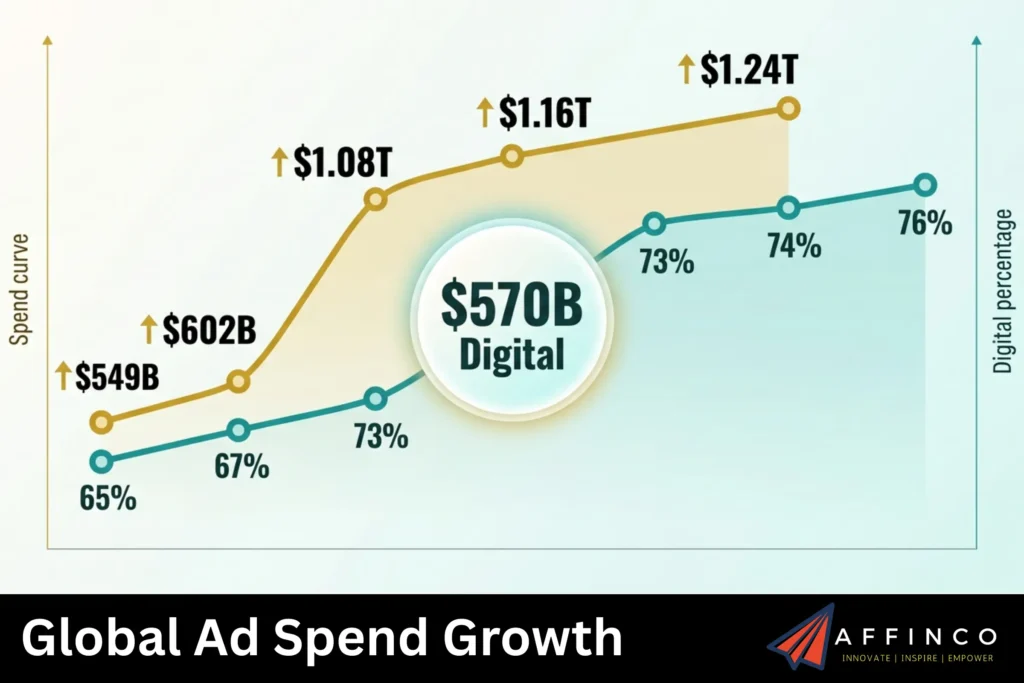
Global advertising spend continues its upward climb. In 2025, marketers worldwide spent $1.16 trillion on advertising across all channels. That figure is projected to grow by 6% to 8% in 2026, pushing total spend past $1.2 trillion.
Digital channels now dominate. In 2025, digital accounted for 74.4% of total ad spend. By 2026, that share is expected to reach 76%, leaving traditional media with an ever-shrinking slice.
Here is a quick look at how global ad spend has grown:
| Year | Global Ad Spend | Digital Share |
|---|---|---|
| 2022 | $549 billion | 65% |
| 2023 | $602 billion | 67% |
| 2024 | $1.08 trillion | 72.7% |
| 2025 | $1.16 trillion | 74.4% |
| 2026 | $1.24 trillion (est.) | 76% |
Digital ad spend alone is projected to surpass $570 billion in 2026, up from $513 billion in 2025. By 2027, that number is forecast to exceed $616 billion.
🌍Regional Ad Spend Breakdown for 2026
North America leads global media buying by a wide margin. Asia Pacific is catching up fast. Europe holds steady in third position.
| Region | Ad Spend (USD) | Growth Rate |
|---|---|---|
| North America | $370 billion+ | 8.5% |
| Asia Pacific | $290 billion+ | 9.2% |
| Europe | $175 billion+ | 5.1% |
| Latin America | $35 billion+ | 6.5% |
| Middle East and Africa | $14 billion+ | 5.0% |
In the United States alone, digital advertising spending is forecast to reach $380 billion in 2026 across all formats. China remains a powerhouse, with digital ad spend surpassing $180 billion annually.
India is showing rapid growth too. Digital media buying in India is expected to capture 61% of total marketing spend by 2026, up from 49% in 2024. That is a massive shift from television dominance to digital-first budgets in just two years.
🤖Programmatic Advertising Is Running the Show
Programmatic buying now powers the vast majority of digital display advertising. In 2024, global programmatic ad spend reached an estimated $595 billion. By 2026, that figure is valued at $720 billion.
A few numbers that show how dominant programmatic media buying has become:
By 2027, programmatic formats are projected to drive nearly 89% of total digital advertising revenue. By 2033, the programmatic market could reach $975 billion at a CAGR of 19.9%.
Private marketplaces (PMPs) are growing fastest within programmatic, offering brands premium inventory with better brand safety and controlled auction environments.
📱Social Media Ad Spend Reaches Record Highs
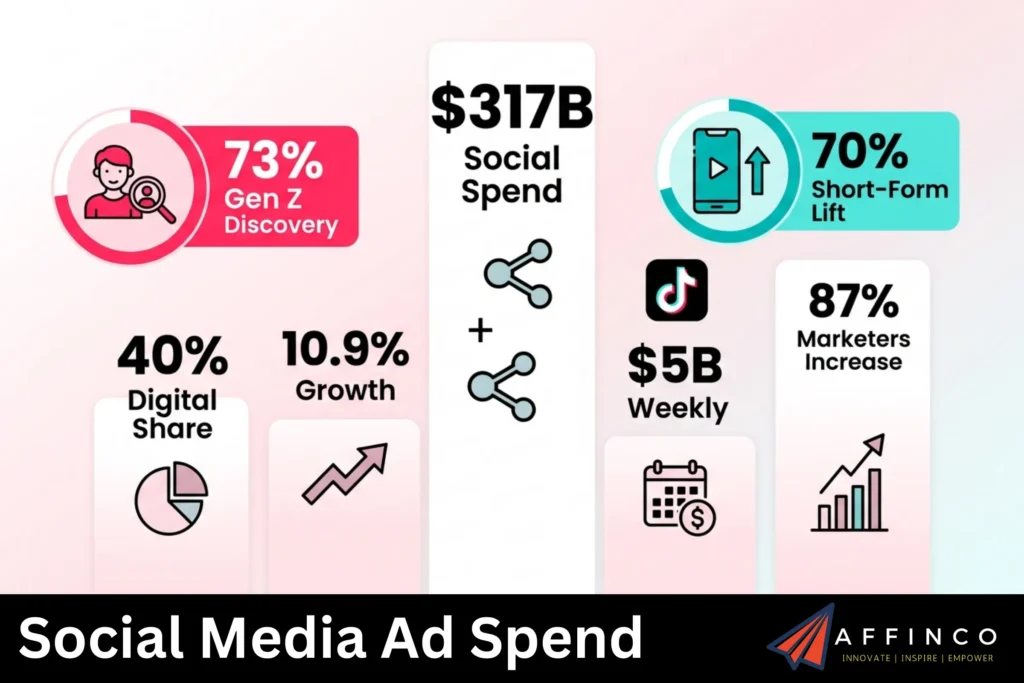
Social media is now one of the most powerful channels for paid media buying. Total spend on social media advertising is projected to reach $317.33 billion in 2026.
That figure is staggering. Marketers now spend more than $5 billion per week on social media ads. Social media ads account for roughly $3 in every $10 spent on digital advertising.
Key social media ad buying statistics:
Short-form video ads on TikTok, Instagram Reels, and YouTube Shorts are driving 70% higher engagement rates than traditional video ads. If you are not already buying media on short-form platforms, you are missing where attention actually lives.
🎬Video Advertising Is the Fastest-Growing Format
Video is eating the advertising world. The global digital video advertising market is expected to grow from $140.28 billion in 2025 to $188.76 billion in 2026. That is a 34.5% jump in a single year.
Video ads outperform other formats by 120% in engagement. Short-form video delivers the highest ROI among all video formats at 41%.
Here is how video ad spend stacks up against other formats:
| Ad Format | Projected 2026 Spend | Growth Trend |
|---|---|---|
| Video Advertising | $188.76 billion | 34.5% YoY |
| Social Media Ads | $317.33 billion | 10.9% YoY |
| Search Advertising | $220 billion+ | 8.2% YoY |
| Retail Media | $130 billion+ | 22% YoY |
| Connected TV (CTV) | $45 billion+ | 18% YoY |
Connected TV advertising is a standout growth area. CTV ad spending is projected to hit $45 billion by 2026, with some projections placing it even higher at $37 billion in the US market alone. Viewers are abandoning traditional cable in favour of streaming platforms, and advertising budgets are following suit.
94% of organisations say influencer marketing outperforms traditional digital advertising, often delivering 2x to 3x returns.
🔍Search Advertising Still Dominates Budgets
Search remains the single biggest category in digital media buying. Search advertising makes up nearly 40% of all digital ad budgets.
In 2025, search was the top choice for advertisers globally. Combined spend across online search and social media equated to roughly 54% of global advertising spend across all channels.
Google, Bing, and Amazon search collectively drive the majority of paid search advertising revenue. AI-powered search features are now changing how ads appear in results, with Google's AI Overviews and Bing's Copilot reshaping click patterns and cost-per-click rates.
For B2B marketers, search remains especially critical. US B2B digital advertising spending is projected to reach $23 billion by 2026, with much of that budget flowing into search and LinkedIn.
📲Mobile Advertising Takes Over
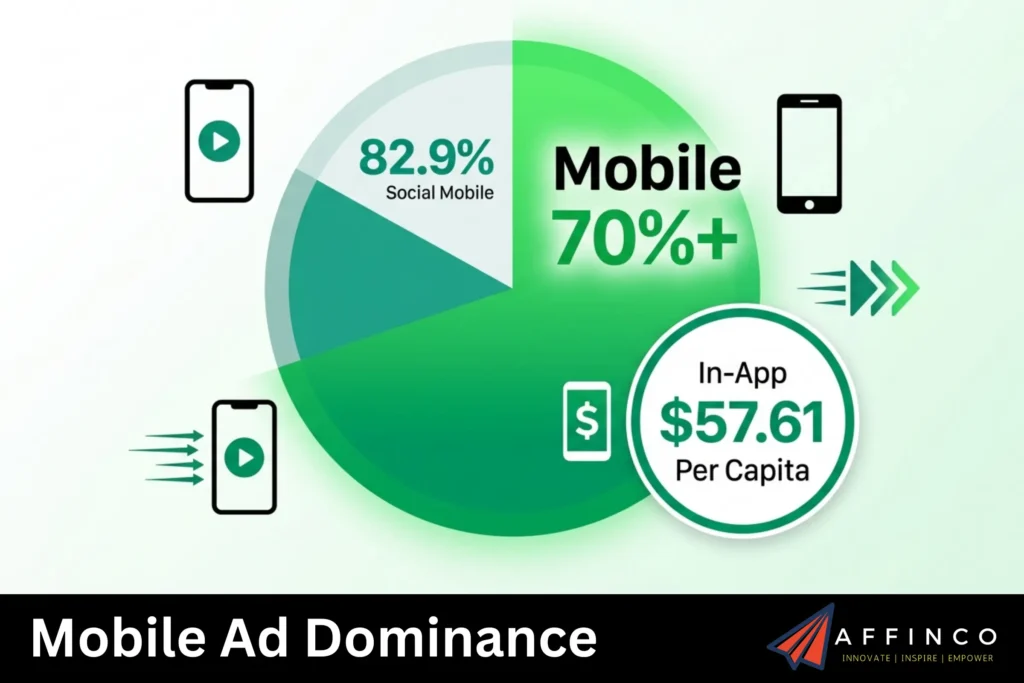
Mobile is no longer a secondary channel. Mobile advertising makes up over 70% of total digital ad revenue in 2026. By 2030, 82.9% of total social media ad spending will be generated through mobile.
Marketers who still design campaigns desktop-first are missing the majority of impressions and conversions. Mobile-first creative, fast-loading landing pages, and vertical video formats are now non-negotiable for any serious media buying strategy.
In-app advertising is also booming. Average ad spending per capita in the in-app advertising market is expected to be $57.61 in 2026. Apps are becoming one of the most effective environments for reaching consumers during high-intent moments.
🛒Retail Media Is the Breakout Channel of 2026
Retail media is growing faster than any other advertising channel. Spending on retail media advertising is projected to hit $130 billion by 2026.
In 2025, marketers spent $204 billion on ads on online retail platforms, considerably more than the $146 billion spent on traditional TV advertising. That gap is only widening in 2026.
Retail media enjoyed 22% year-on-year growth in 2025, making it the channel with the highest annual increase in advertising spending worldwide. Amazon, Walmart, and other major retailers now operate sophisticated ad platforms that rival Google and Meta in targeting capability.
Why marketers love retail media:
Retail and ecommerce brands account for 24% of all programmatic ad spending in 2026, making them the largest single end-user segment.
🧠AI and Automation Are Reshaping Media Buying
AI is no longer a buzzword in media planning and buying. It is the engine running most modern campaigns. 80% of marketers currently use AI for content creation, and 75% use it for media production.
In 2026, the smartest brands focus on:
AI-driven ad spend optimisation is expected to grow by 25% year-over-year. Brands using AI for campaign management report significant reductions in cost per acquisition and improvements in ROAS.
A net 61% of marketers plan to increase investment in creator content in 2026, with AI tools helping to scale and personalise creator collaborations.
🔒Privacy Changes Are Forcing New Media Buying Strategies
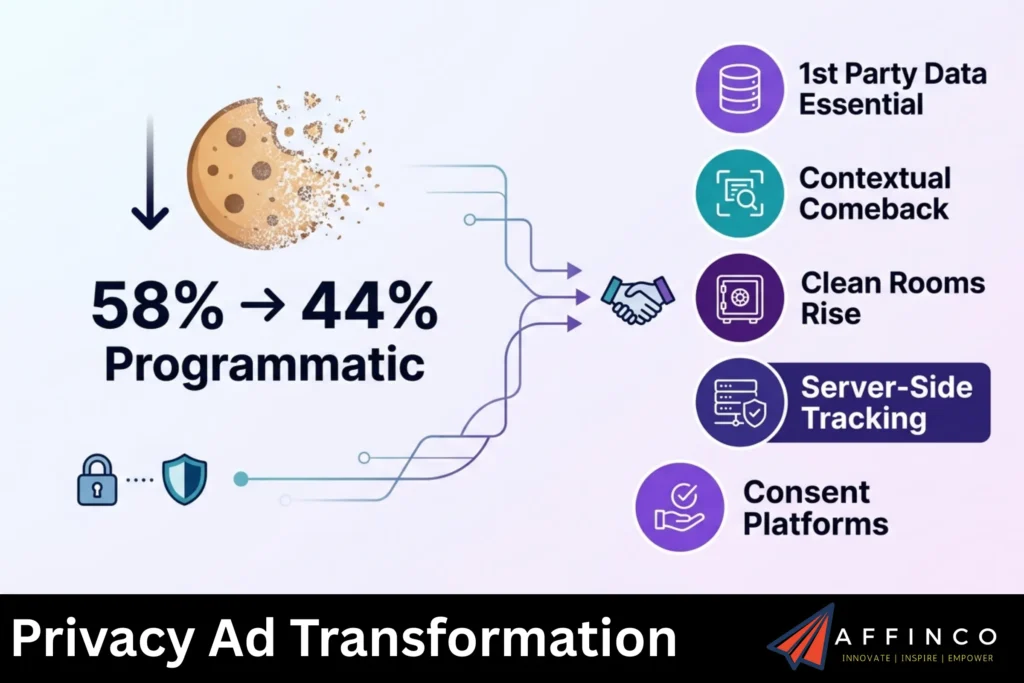
Privacy regulations are reshaping how marketers approach audience targeting and media buying. Third-party cookies are being phased out across major browsers. GDPR, CCPA, and newer regulations in Asia Pacific are tightening data collection rules.
India's programmatic market illustrates the shift well. In 2024, 58% of digital ad spend went to direct media purchases. By 2026, programmatic's share is expected to reach 44%, driven by advertisers seeking more flexibility and control.
Key privacy-related shifts in media buying:
Brands that adapt to privacy-first advertising will have a clear edge over competitors still relying on deprecated tracking methods.
📺Traditional Media Is Shrinking but Not Dead
Traditional media still commands a portion of global advertising budgets, but that share keeps declining. TV ad spending has fallen below 22% of total ad spend in 2025.
Print and out-of-home media each hold about 5.7% of global spend. Out-of-home advertising is expected to reach $40 billion in 2026, showing a post-pandemic rebound.
Podcast advertising is a bright spot in traditional-adjacent media. Annual podcast ad revenue now surpasses $4 billion. Audio ads offer high engagement rates and reach audiences during moments when screens are not an option, like commuting or exercising.
The real story is convergence. Connected TV and OTT advertising blur the line between traditional TV and digital. CTV gives marketers the targeting precision of digital with the big-screen impact of television. That is why CTV budgets are growing at 18% year-over-year while linear TV keeps losing share.
👀Ad Engagement and Consumer Behaviour Stats
Understanding how consumers interact with ads is crucial for any media buying professional. The average person sees over 6,000 ads daily. Standing out in that clutter requires smart creative and precise placement.
Key consumer behaviour stats for media buyers:
Email marketing still delivers one of the best returns in digital media buying, averaging $42 for every $1 spent. For direct response campaigns, email remains hard to beat.
💼B2B Media Buying Is Growing Fast
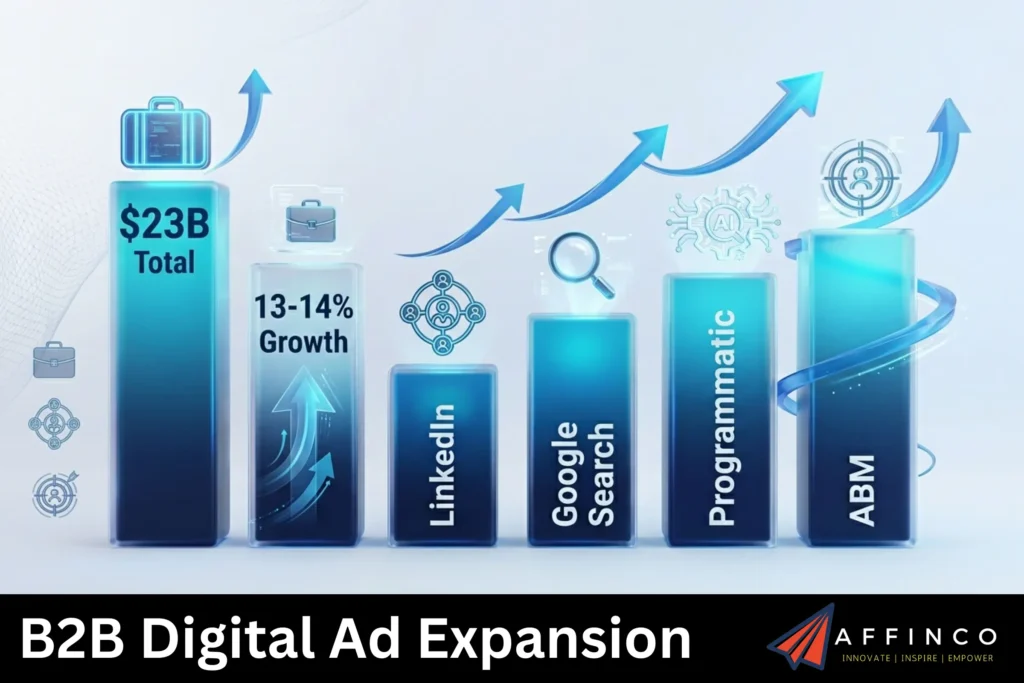
B2B brands are ramping up digital advertising budgets at an impressive rate. US B2B digital ad spending reached $18.3 billion in 2024 and is projected to hit $23 billion by 2026.
Global B2B digital ad spend growth was roughly 13% in 2025. In the US specifically, growth hit 14% in 2025. Growth rates are expected to remain in double digits through 2026, though they may slow slightly.
LinkedIn, Google Search, and programmatic display are the top channels for B2B media buying. Account-based marketing (ABM) strategies are increasingly integrated into media plans, with distinct audience segments built around engagement depth, purchasing habits, and intent signals.
What Smart Marketers Should Take Away
Every number in these media buying statistics points in one direction. Digital is dominant, programmatic is the default, and AI is the accelerator.
Budgets are flowing towards video, social, and retail media at the expense of traditional channels. Mobile accounts for over 70% of digital ad revenue. Programmatic buying handles 90% of display advertising. Privacy regulations are forcing a shift to first-party data and contextual targeting.
For any marketer planning media buying budgets in 2026, the playbook is clear. Go digital-first, invest in video and social, embrace programmatic, and build a first-party data strategy before it is too late. Brands that follow the data will outperform those that rely on gut instinct.

Ali
Ali is a digital marketing expert with 7+ years of experience in SEO-optimized blogging. Skilled in reviewing SaaS tools, social media marketing, and email campaigns, we craft content that ranks well and engages audiences. Known for providing genuine information, Ali is a reliable source for businesses seeking to boost their online presence effectively.