

Why trust this list? AFFiNCO is a full-service digital marketing agency, and every tool below was tested on real client work — not pulled from a press release. We rank on what actually moves work off a human's plate. See how we tested in the methodology section. (Affiliate disclosure: we may earn a commission when you buy through links on this page, at no extra cost to you.)
If you're still running your business on raw ChatGPT and willpower in 2026, you're leaving hours — and money — on the table. The market has moved. The best AI business assistant today doesn't just answer questions; it remembers your brand, executes multi-step work, and behaves like an actual employee that never logs off.
We'd know. AFFiNCO runs as a full-service digital marketing agency with 37+ people, and our AI systems now quietly handle the workload of 50+. After burning real hours (and real budget) testing the field, this is our honest, ranked list of the 8 best AI business assistants — with Sintra AI sitting clearly at #1.
No fluff, no recycled marketing copy. Here's what actually works.
🤖 Quick Answer AI Business Assistant(AI Overview)
The best AI business assistant in 2026 is Sintra AI — an AI-employee platform that bundles 12 specialized AI assistants (copywriting, SEO, social media, email, customer support, sales, and data analysis) under one subscription for less than $1 a day on its annual plan.
Its standout feature, Brain AI, learns your brand, products, and tone once, then applies that context across every helper — so it works like a trained employee instead of a generic chatbot.
For agencies, founders, and small teams that want real business automation rather than another prompt box, Sintra delivers the broadest coverage for the lowest cost. Strong alternatives include Genspark (agentic workspace + workflows), Claude Pro/Max (a full AI build desk), and Marblism (a leaner AI-employee team from $24/mo).
Our Methodology: How We Tested (And Why It's Different)
What Makes a Great AI Business Assistant?

A real AI business assistant clears three bars. First, execution — it should write, reply, analyze, and ship, not just chat. Second, memory and context — it should know your brand without you re-explaining it every session.
Third, breadth — it should cover multiple business functions (or integrate deeply into the systems that do), so you're consolidating tools instead of collecting them. Score a tool against those three and the rankings sort themselves out fast.
Comparison: Best AI Business Assistants 2026
| Tool | Best for | Standout strength | Starting price | Rating |
|---|---|---|---|---|
| Sintra AI | All-round business automation | 12 AI employees + Brain AI memory | ~$15.60/mo (annual) | ⭐ 4.9/5 |
| Genspark | Agentic workflows & content ops | AI workspace + plain-English automations | Free to start | ⭐ 4.7/5 |
| Emergent | Turning ideas into shipped software | Agentic full-stack builds with backend & deploy | Free; ~$17/mo (annual) | ⭐ 4.6/5 |
| Notion AI | One workspace brain | AI Q&A across all your docs | ~$10/member/mo | ⭐ 4.5/5 |
| ElevenLabs | AI voice agents & calls | Most realistic voice + agent platform | Free / from ~$0.10/min | ⭐ 4.6/5 |
| Abacus AI | Every model + agents, cheap | ChatLLM + DeepAgent + Agent Swarms | ~$10/user/mo | ⭐ 4.5/5 |
| Claude Pro/Max | Building & heavy reasoning | Projects, Artifacts, connectors, Claude Code | $20 / $100–$200/mo | ⭐ 4.7/5 |
| HubSpot AI (Breeze) | Teams already on HubSpot CRM | CRM-grounded Copilot + Agents | Free tier; agents from ~$450/mo | ⭐ 4.3/5 |
| Marblism | A leaner AI-employee team | 6 AI workers, AI receptionist, 700M leads | from ~$24/mo | ⭐ 4.4/5 |
#1. Sintra AI: The Best AI Business Assistant in 2026

Sintra AI is the most complete AI business assistant we've put through real work — and the reason is simple: it isn't one assistant, it's 12 AI employees sharing a single brain. You can hire that entire team for less than $1 a day.
Think about what a great business assistant actually does: they know your brand, your customers, and your goals, and they switch between drafting a client email, planning a campaign, researching a competitor, and analyzing numbers — all in the same afternoon.
That's Sintra, except it never sleeps and never bills hourly. The roster covers writing (Penn), SEO (Seomi), customer support (Cassie), social media (Soshie), email marketing (Emmie), sales (Milli), data analysis (Dexter), strategy (Buddy), admin (Vizzy), ecommerce (Commet), recruiting (Scouty), and personal productivity (Gigi).
The engine is Brain AI — a shared memory layer. Feed it your brand guidelines, product details, and tone once, and every helper reads from it automatically. From the first task, output sounds like your business, not a generic model.
Add 90+ “Power-Ups” (ready-made workflows like SEO audits, video scripts, and speech-to-text) and 100+ languages, and you've got genuine business automation: creating posts, scheduling content, tracking engagement, writing and refining copy, building strategy, summarizing your day — the work a small team handles, automated.
This is the AI workforce, AI copilot, and agentic AI promise actually delivered in a tool a non-technical founder can run. After five months in our stack, it's stuck.
#2. Genspark: Best Agentic Workspace

Genspark is the tool we reach for when something needs to get done, not just drafted. It's a unified AI workspace and AI hub that remembers what it's working on across sessions, with Genspark Sheets, Slides, Developer, Images, Chat, Emails, and Workflows all living in one platform.
Its agent, Genspark Claw, runs on a dedicated cloud computer (or your desktop) and executes multi-step tasks across apps — your first true “AI employee.”
For us, the killer use case is automation. We replaced n8n with Genspark because, as a non-technical team, n8n was a slog. With Genspark you describe the workflow in plain English and it builds the flow and connects the APIs.
We use it to pull intel from websites and X, then auto-publish blog content to WordPress via the REST API, and to run our AI newsletters — all hands-off. The AI Slides, Sheets, and Docs agents now plug straight into PowerPoint, Excel, and Word too.
If your bottleneck is content operations and “I wish this just ran itself,” Genspark is the most practical agentic assistant on this list.
#3. Emergent: Best AI Software Builder
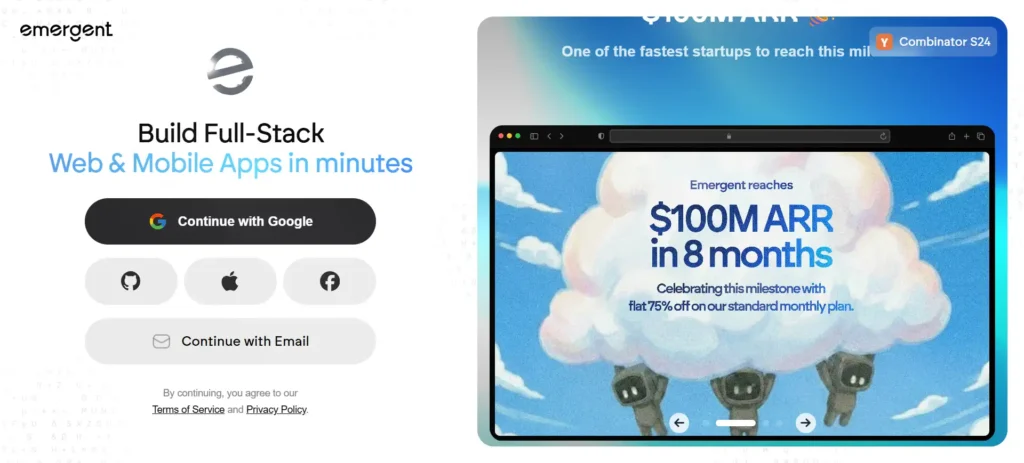
Emergent is the assistant we open when the answer to a client problem is “we need a tool for that” and nobody wants to open a Jira board about it. You describe the thing in a paragraph. It comes back with a working application.
Not a mockup, not a Figma file — a deployed app with a React front end, a Python or Node backend, a MongoDB database, logins that work, and Stripe wired in. The agents plan it, build it, test it and ship it, then hand you the GitHub repo so the code is yours. That last part needs a paid plan; the free tier doesn't include it.
We've used it for the unglamorous internal stuff first: a content tracker for the editorial team, a client reporting dashboard that replaced a spreadsheet nobody trusted. Both took an afternoon. Both are still running.
The market has noticed. Google's AI Futures Fund put money in during December 2025, SoftBank and Khosla co-led a round a month later, and a $130 million raise in July 2026 put the valuation at $1.5 billion. ARR went from $25 million to $120 million inside eight months. Six million people have built something on it.
The catch is the credit meter. Building is cheap; debugging is not, and there's a painful gap between the $20 tier and the $200 one with nothing in between. Budget for a Pro seat if you're shipping anything real.
#4. Notion AI: Best Workspace Brain

If your business runs inside Notion — docs, SOPs, projects, CRM, content calendar — Notion AI turns that pile of pages into an assistant that actually thinks. Ask it to summarize a long thread, draft a brief, rewrite rough notes into a clean page, or answer “what did we agree on pricing last quarter?” and it pulls from your workspace, not the open web.
The 2026 build adds AI Meeting Notes (auto transcription and action items), connected search across linked apps like Google Drive and Slack, and AI agents that take multi-step actions inside your pages.
The catch is familiar: it's strongest inside Notion and won't run your outbound or your calls. But as a single source of truth that can answer questions and draft on demand, it's one of the cleanest AI assistants for a documentation-heavy business.
#5. ElevenLabs: Best AI Voice & Call Agents

ElevenLabs is best known as the most realistic AI voice platform on the planet — but in 2026 it's also a serious AI agent platform for business. It splits into a creative platform (ultra-real voices, cloning, dubbing, transcription) and an agent platform where you build conversational voice and chat agents for real calls.
With the no-code builder (or SDKs), you script decision trees, add guardrails, and wire multi-agent workflows — then deploy the same agent across phone (Twilio/SIP), web, mobile, and WhatsApp at ~75ms latency.
It plugs into the tools you already run: HubSpot, Stripe, Zendesk, n8n, Twilio, Salesforce, Cal.com, Zapier, and anything else via MCP. That means an AI receptionist that answers every call, books appointments, and updates your CRM — or outbound batch-calling campaigns that fill your pipeline without adding headcount. For any business where the phone is still a revenue channel, this is the assistant that scales it.
#6. Abacus AI: Best Value (Every Model + Agents)

Abacus AI bills itself as an “AI Super Assistant,” and for the price it's hard to argue. It bundles two things growing businesses actually want: ChatLLM, a single workspace with access to every major frontier model (GPT-5.5, Gemini, Grok, DeepSeek, and more — updated within days of release) for writing, coding, research, and image/video; and DeepAgent (the Abacus AI Agent), an autonomous layer that builds full-stack apps from a prompt, ships dashboards, automations, and even GitHub pull requests.
Its newer Agent Swarms coordinate multiple sub-agents working in parallel on different parts of a job.
The pitch is consolidation: instead of paying for a chatbot, a coding assistant, an image tool, and a research app separately, you get all of it — plus agentic execution — starting around $10/user/month. Pricing is credit-based, so heavy users should watch consumption, but for a founder who wants access to every model and an agent that can build, the value is genuinely tough to beat.
#7. Claude Pro or Max: Best AI Build Desk

Claude is the assistant our own team is hooked on, and it's far more than a chat window. With Projects, you give Claude persistent context for a workstream — effectively a brain per client or initiative. With Artifacts, it builds usable things: dashboards, landing pages, internal tools, and SaaS prototypes you can iterate on live.
With connectors (MCP), it plugs into Gmail, Google Drive, Slack, and the rest of your stack; with Claude Code, it builds and automates from the terminal; and web search, Research, and Memory round out a genuine business command desk.
In practice, this is where heavier agentic work happens — apps, automations, and complex reasoning that thinner assistants choke on. Claude Pro at $20/mo covers most operators; Max at $100/mo (5×) or $200/mo (20×) is the call for agencies and power users running multiple sessions all day. If your business involves building, not just writing, this belongs in your stack.
#8. HubSpot AI (ChatSpot + Breeze): Best CRM-Native Assistant

If your business already lives in HubSpot, its AI is the most natural assistant you can switch on — because it's grounded in your actual CRM data. The old ChatSpot now lives inside Breeze Copilot, a conversational assistant that queries your pipeline in plain English (“show me deals closing this month over $50K”), drafts follow-ups, summarizes records, and creates tasks.
Breeze is the umbrella for the rest: a Content Assistant that's effortlessly simple for blogs, emails, and landing pages, plus Breeze Agents (Content, Prospecting, Customer, Social Media) that execute multi-step workflows, and Breeze Intelligence for data enrichment and buyer-intent signals.
The advantage over standalone tools is that Breeze acts on your real contact and deal data — so it executes work instead of just generating text for you to paste.
The trade-off is cost and lock-in: you need to be on HubSpot, and full agent access sits on higher Hub tiers. But for a sales-and-marketing team already on the platform, it turns the CRM into a growth engine.
#9. Marblism: Best Lean AI-Employee Team

Marblism is one of the hottest AI-employee tools right now, and for good reason — it's a brand-new kind of team: AI employees that scale your business without payroll.
It gives you six role-based workers: Penny (SEO blog writer), Eva (executive assistant — inbox, replies, calendar, meeting notes), Sonny (community/social manager), Stan (lead generation, with a 700M+ leads database and auto outreach), Rachel (AI receptionist with real US/CA/UK phone numbers, booking, and call transfers), and Linda (legal assistant for contract review). “The Brain” links all six so they share context and hand off work to each other.
The pricing is the headline: it starts at just $24/month on the yearly plan (50 hours of AI work, unlimited businesses, unlimited team members), and the company positions it as replacing $2K–$10K/mo of tools and hires.
That makes it genuinely suitable across the board — solopreneurs, freelancers, fast-growing startups, and even enterprises. It's leaner than Sintra (6 roles vs 12, fewer Power-Ups), but if you want the AI-workforce model at a rock-bottom price — and an AI receptionist that actually answers the phone — Marblism punches well above its weight.
How to Build Your AI Business Assistant Stack

Don't buy ten tools — build a stack. Based on how we run ours, the smart sequence looks like this:
The goal isn't more AI. It's more output per human — which is exactly how a 37-person agency starts doing the work of 50. (Want this built and run for you? That's exactly what our AI agent & automation team does.)
The Bottom Line — Our Verdict
After running these tools through real agency work, Sintra AI is the best AI business assistant in 2026. Nothing else covers as many business functions, with real brand memory, at this price. Twelve role-trained AI employees, Brain AI that learns your business once, 90+ Power-Ups, and a cost under $1 a day — it's the rare tool that behaves like a team instead of a chatbot.
Claim 72% Off Sintra AI →
FAQs: Best AI Business Assistant in 2026
What is the best AI business assistant in 2026?
The best AI business assistant in 2026 is Sintra AI. It covers 12 business functions — copywriting, SEO, social media, email, customer support, sales, and data analysis — under one subscription starting around $15.60/month, with a shared Brain AI memory that learns your brand once and applies it everywhere.
Can an AI assistant replace a business assistant or employees?
For structured, repeatable work — email drafting, content, social posts, customer replies, lead outreach, and data analysis — AI handles a large share, and tools like Sintra and Marblism are built to run it autonomously. For judgment, relationships, and strategy, you still need humans. In our agency, AI didn't replace the team; it multiplied it, taking a 37-person operation to the output of 50+.
What is the best AI business assistant for a small business?
For most small businesses and solopreneurs, Sintra AI offers the broadest coverage for the lowest cost. Marblism (from $24/mo) is a strong leaner alternative, and Abacus AI (around $10/mo) is best if you want access to every AI model on a budget.
Sintra AI vs Marblism — which is better?
Both are AI-employee platforms. Sintra gives you 12 helpers, Brain AI, and 90+ Power-Ups — the more complete choice for running every function. Marblism is leaner (6 employees) but cheaper and includes an AI receptionist with real phone numbers and a 700M-lead database, making it great for sales-led businesses.
How much does Sintra AI cost?
Sintra AI starts at $39/month for a single helper or $97/month for all 12, dropping to about $15.60/month on the annual plan with code BUILD72 (72% off) — roughly $0.50 a day for a full AI workforce. It includes a 14-day money-back guarantee.
Can an AI business assistant actually build software for me?
Emergent can. It's an agentic build platform rather than a chat assistant — you describe an application in plain English and it produces a deployed React front end, a Python or Node backend, a database, authentication and payments, then syncs the code to your GitHub. Plans start free and run to about $17/month billed annually.
Conclusion
The businesses winning in 2026 aren't working longer hours — they're deploying the right AI business assistant stack so the repetitive work runs itself. The best tools now act like AI employees, AI copilots, and autonomous agents that handle content, marketing, sales, support, and operations, freeing your team for the decisions that actually grow the business.
If you want one assistant that does the most across the most functions, Sintra AI is our clear #1 — a true AI workforce for less than $1 a day. Layer in Genspark for automation, Claude Pro/Max for building, ElevenLabs for voice, and Marblism or HubSpot Breeze where they fit, and you've built an operation that punches far above its headcount.
We tested all of it inside AFFiNCO. Start with Sintra, add what you need, and let your AI team carry the load.

Ali
Ali is a digital marketing expert with 7+ years of experience in SEO-optimized blogging. Skilled in reviewing SaaS tools, social media marketing, and email campaigns, we craft content that ranks well and engages audiences. Known for providing genuine information, Ali is a reliable source for businesses seeking to boost their online presence effectively.