
Ranking in Google is no longer only about getting a page into position one, three, or five.
A page can perform well in normal organic results and still be absent from an AI Overview. Another page may get surfaced as a supporting source because one specific section answers a question Google needs while building its response.
That changes how I think about Google AI Overview SEO.
I do not treat it as a separate SEO discipline with a secret checklist. I treat it as an additional retrieval layer sitting on top of the same Search index we have been optimizing for years.
The practical job is to make your content:
That last point matters.
Getting quoted inside an AI-generated answer is nice. Getting the right visitor from that answer and turning that visit into a signup, lead, sale, demo, or affiliate conversion is much better.
This guide explains how to rank in Google AI Overviews, how source selection works, what actually affects AI visibility, what wastes time, and how I would audit a page that is failing to appear in AI Overview results.
Quick Answer: Google AI Overview Visibility Starts With Search Eligibility and Retrieval Relevance
To increase your chances of appearing in Google AI Overviews, make sure your page can be crawled, indexed, and displayed normally in Search. Then improve the page so it answers the main intent plus the supporting questions Google may retrieve while constructing its response.
In practical terms, focus on:
- Technical Search eligibility
- Accurate intent matching
- Original information
- Clear answer blocks
- Strong subtopic coverage
- First-hand evidence
- Internal topic connections
- Useful images, charts, screenshots, and tables
- Accurate structured data where relevant
- AI visibility measurement
There is no separate form where you submit a URL for AI Overviews.
There is no guaranteed markup that activates inclusion.
There is no magic keyword density that makes Google quote a paragraph.

AI Overview optimization is still SEO, but the unit you are optimizing is increasingly the useful answer, supporting passage, entity, fact, comparison, and evidence inside the page.

How Google AI Overviews Select Supporting Sources From the Search Index
Before changing content, it helps to understand the retrieval process.
A simplified version looks like this:
User query → Search retrieval → related query retrieval → supporting documents → relevant passages → generated response → supporting linksIt is more complex internally, but this model is useful for SEO because it explains why ranking for the exact typed keyword is only one part of the problem.
Search Index Eligibility Comes Before AI Overview Eligibility
A page generally needs to be eligible for ordinary Google Search before it can become a supporting link in Google's generative Search features.
That means your Google AI Overview SEO audit should still begin with boring technical questions:
- Can Googlebot crawl the URL?
- Is the URL indexed?
- Is the canonical correct?
- Is a noindex directive blocking it?
- Can Google render the important content?
- Is important information hidden behind interactions?
- Can the page show a normal Search snippet?
- Are duplicated URLs wasting crawl activity?
- Can Google reach the page through internal links?
If these fail, rewriting your introduction for AI is mostly wasted effort.
I always fix retrieval access before content formatting.
Retrieval-Augmented Generation Connects AI Responses to Web Sources
Google describes the use of retrieval-augmented generation, commonly shortened to RAG. In plain English, the system can retrieve information from indexed web pages and use those sources while producing an AI response.
For publishers, that creates an important distinction.
You are not simply trying to make Google understand what the whole article is about.
You also want individual sections to contain information that is useful when Google needs support for a particular part of an answer.
A 4,000-word article about CRM software, for example, might contain sections useful for:
The complete page has one primary subject, but several sections may satisfy different retrieval needs.
Query Fan-Out Expands One Search Into Multiple Information Needs
This is one of the most important concepts in AI Overview optimization.
Google can generate related searches around the original query and retrieve information from several subtopics.
Take this query:
best CRM for a small real estate agency
The system may need information related to:
A page does not necessarily need to rank first for the original phrase to contain useful information for one of those supporting retrievals.
A Practical Query Fan-Out Map I Use for Content Planning
For most informational and commercial queries, I map possible branches across eight buckets:
| Retrieval Branch | Question to Answer |
|---|---|
| Definition | What is it? |
| Mechanism | How does it work? |
| Requirement | What is needed? |
| Comparison | How does it differ from alternatives? |
| Problem | Why might it fail? |
| Evidence | What proves the claim? |
| Cost or value | What does it cost or produce? |
| Action | What should the reader do next? |
This is much more useful than dumping 100 related keywords into an article.
AI Overview Citation Visibility Is Not the Same as Ranking for the Head Keyword
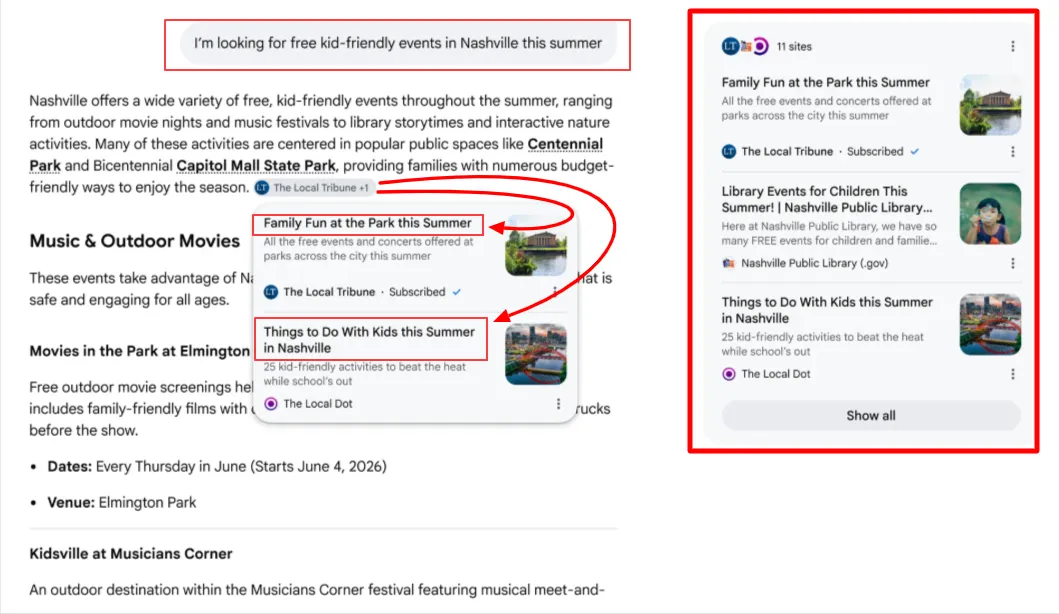
This explains a problem I see in AI visibility audits.
A team checks its primary keyword, sees position three, and assumes the page should automatically appear in the AI Overview.
That assumption is too simple.
Traditional rank tracking asks:
Where does my URL rank for this query?
AI visibility analysis also needs to ask:
Which information need is Google trying to support, and which page best supplies that information?
Those are different questions.
This is why Google AI citation SEO should look at passage relevance, supporting topics, information quality, and evidence, not only keyword position.
Google AI Overview Ranking Factors: 10 Areas I Would Audit First
Google does not provide a fixed list called “AI Overview ranking factors.”
So I would not trust anyone selling a secret list of 200 AI citation factors.
What we can audit are the requirements Google documents, established SEO principles, and observable areas that influence how useful a page is for retrieval.
1. Technical Search Eligibility Controls the Entry Point
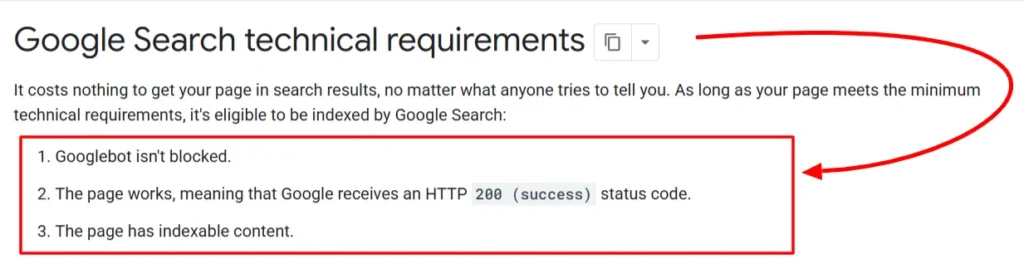
Start with the technical layer.
Check:
For large websites, also inspect crawl waste.
You do not want thousands of parameter pages, duplicate filters, internal search pages, or near-identical archives consuming attention while priority URLs remain poorly connected.
If Google struggles to process the page, AI Overview formatting tricks will not rescue it.
2. Search Intent Must Be Modeled Beyond the Primary Keyword
I rarely optimize an important page around one keyword alone.
For how to rank in AI Overviews, I would also answer:
These are not keywords to stuff.
They are questions the searcher may logically have before, during, and after the primary query.
3. Non-Commodity Information Gives Google a Reason to Retrieve You
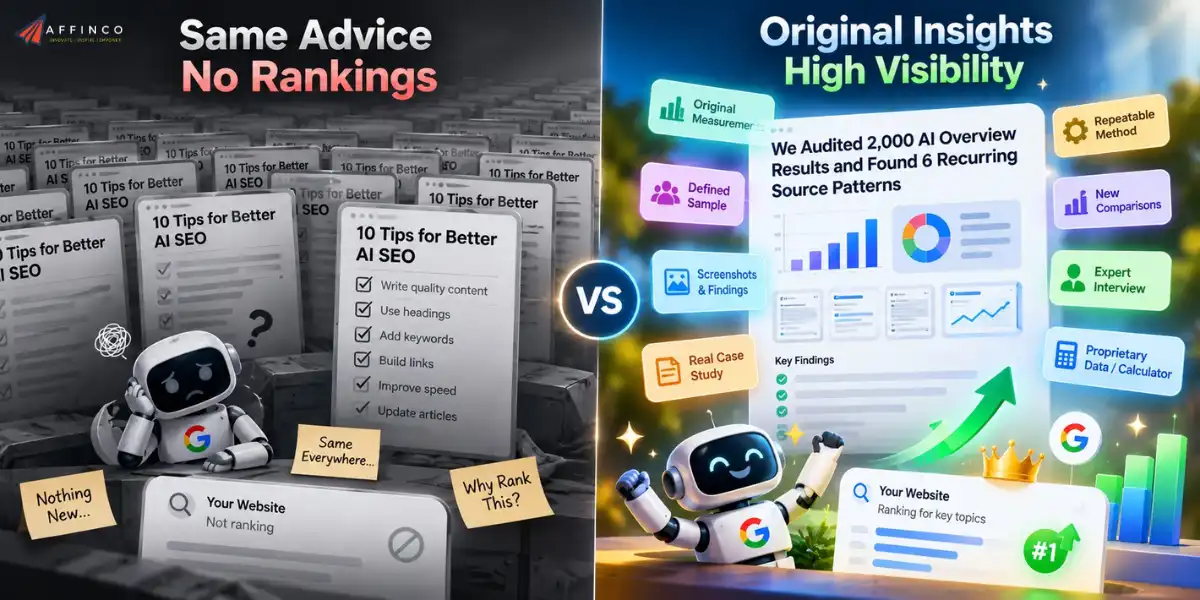
This is where a lot of SEO content falls apart.
Imagine 50 websites publishing:
10 Tips for Better AI SEO
Every article repeats:
What new information is Google getting from page number 51?
Very little.
Now compare that with the other one:
We Audited 2,000 AI Overview Results and Found 6 Recurring Source Patterns
The second page can contain something scarce:
Your content does not need a massive study every time.
Even smaller assets can create information gain:
If an AI system could produce nearly the same article without seeing your page, you probably have not added enough original value yet.
4. Important Answers Should Be Easy to Locate
Good information buried inside bad structure is still hard to use.
Place important answers where readers expect them.
A strong section often looks like this:
Question → direct answer → explanation → evidence → example → next implicationFor example:
Does Schema Help With AI Overviews?
Schema can help Google understand page entities and qualify content for supported Search features, but there is no special AI Overview schema that guarantees inclusion.
Then expand the answer.
That first paragraph can stand on its own, while the following content gives context. Do not confuse this with forcing every paragraph into a fixed word count. There is no requirement that every answer must contain 40, 100, or 150 words.
Write as much as the answer needs.
5. Supporting Questions Increase Retrieval Coverage
Think of your primary topic as a parent node.
Under it sit several supporting nodes:
Primary Topic
↓

Definition
Requirements
Process
Comparison
Mistakes
Evidence
Tools
Cost
Implementation
Cover the branches that genuinely help the reader.
You do not need separate pages for every tiny query variation.
In fact, publishing dozens of thin pages targeting near-identical searches can create more problems than it solves.
6. First-Hand Experience Makes Generic Topics Harder to Replace
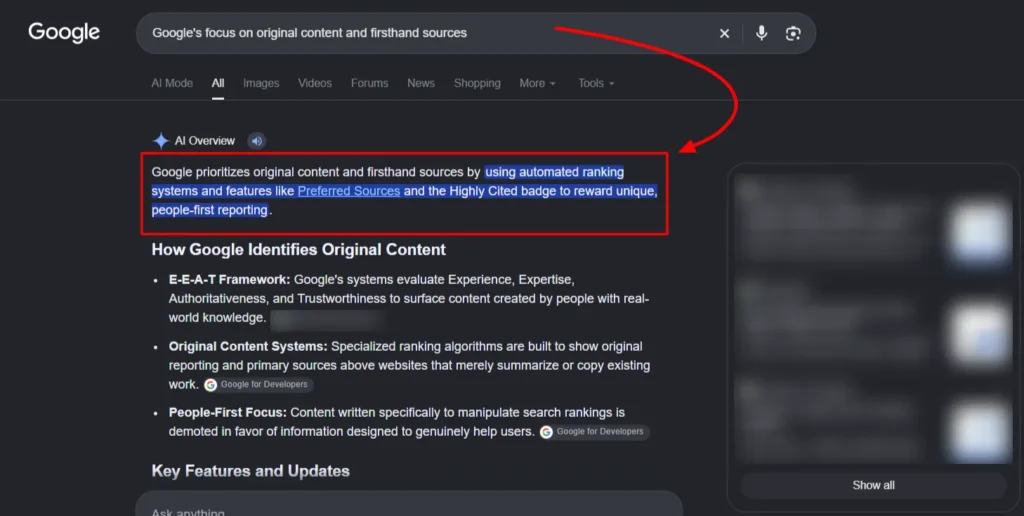
This is especially important for:
Show what actually happened.
Useful experience signals can include:
Do not fake first-hand use.
A screenshot copied from a vendor and a sentence saying “we tested it” is not meaningful evidence.
7. Claims Need Enough Context to Be Reused Safely
Compare these two statements:
Weak:
AI Overviews reduce traffic.
Better:
In a defined sample of informational queries, click-through rate declined after AI Overviews appeared, while branded queries showed a smaller change.
The second statement tells the reader more.
When publishing numbers, add context such as:
This matters for users first, but it also makes facts easier to interpret correctly.
8. Information Freshness Should Match Query Sensitivity
Not every query needs constant updating.
A tutorial about basic HTML heading structure may remain useful for a long time.
A page about:
- Software pricing
- Search features
- Tax rules
- Product specifications
- API limits
- Regulations
- AI tools
may need updates much more often.
Do not change a publication date just to make a page look fresh.
Update something meaningful.
9. Internal Topic Connections Help Google and Users Reach Supporting Pages
A strong AI Search cluster might look like this:
Google AI Overviews Guide
Then connect those pages contextually.
Avoid dropping 20 exact-match internal links into an article because an SEO plugin turned a score red.
Internal links should help the next question.
10. Multimedia Can Add Information Text Cannot Carry Well
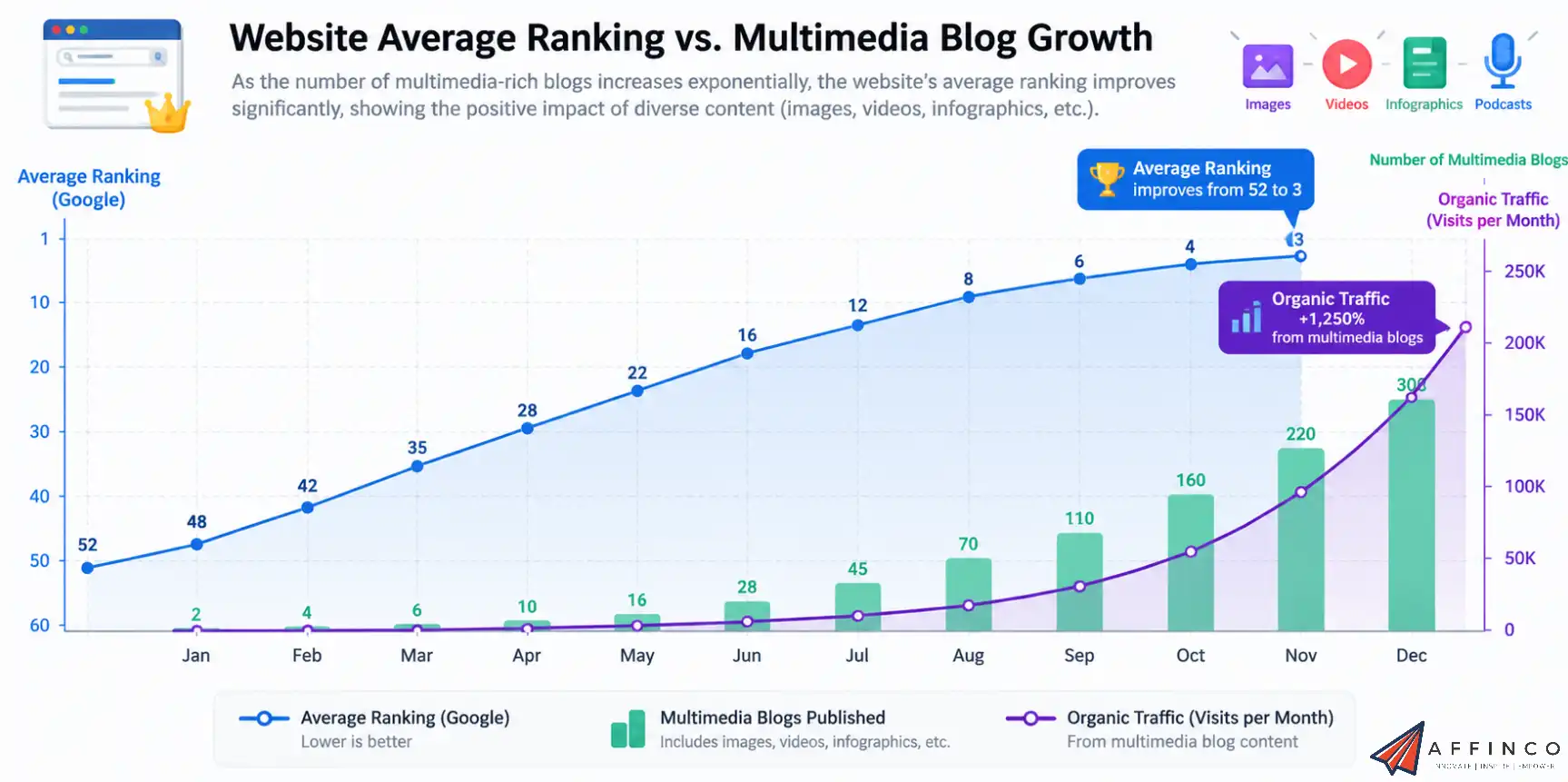
Use visuals when they explain something better.
Good options include:
For technical topics, I especially like diagrams because they can turn an abstract retrieval process into something readers understand in seconds.
How to Optimize for Google AI Overview Step by Step
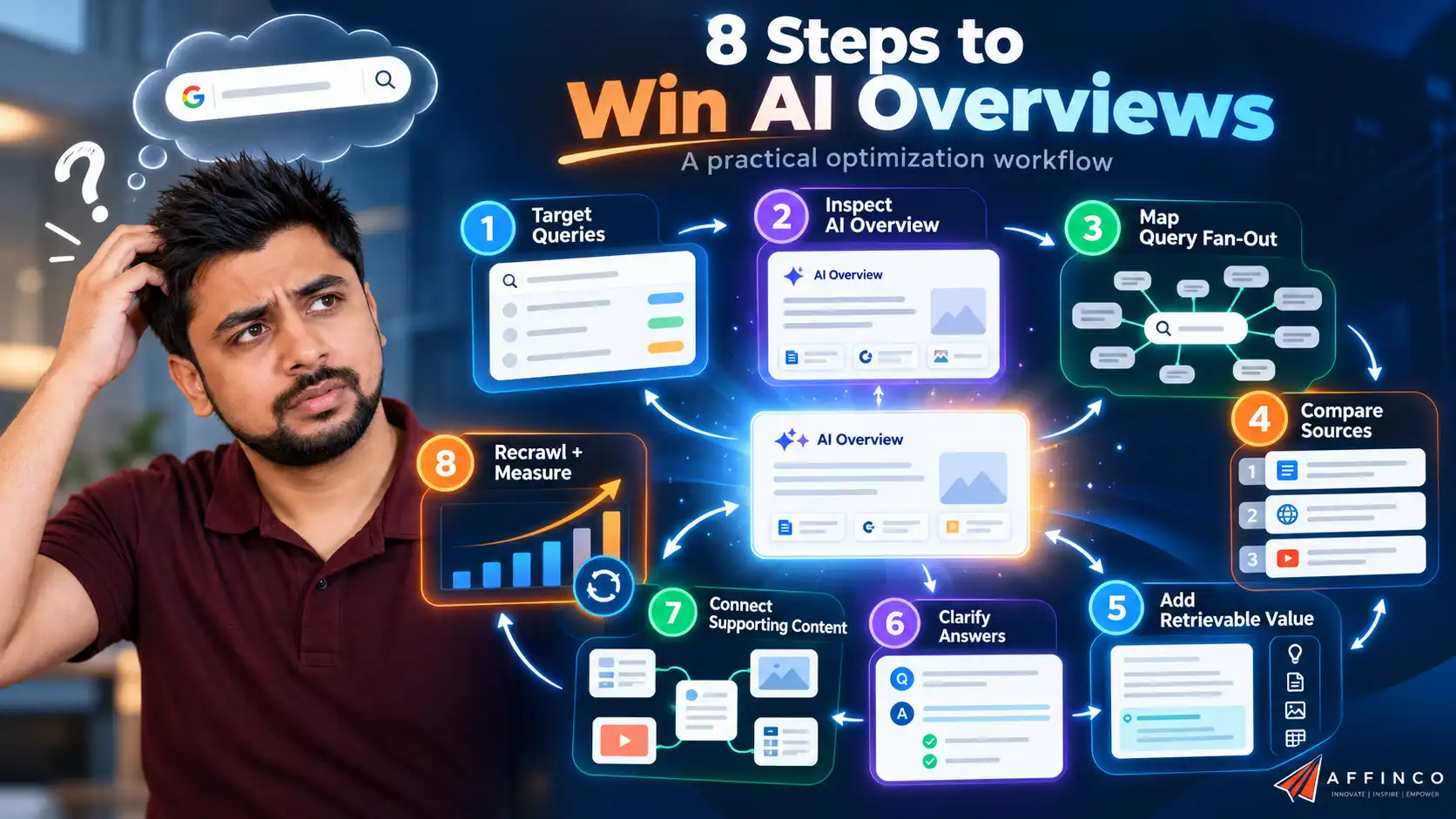
Here is the workflow I would use on an existing website.
Step 1: Build a Target Query Set From Existing Search Demand
Start in Search Console.
Look for:
Do not start by optimizing the entire site.
Pick pages where improved AI visibility could actually matter commercially.
Step 2: Inspect the AI Overview as a Research Document
Search your target query and record:
You are looking for retrieval patterns, not something to copy.
Step 3: Reverse-Engineer Possible Query Fan-Out
Take the primary query and map its likely information needs.
For example:
AI Overview SEO tool
Could branch into:
This tells you what the searcher may need to evaluate before buying a tool.
Step 4: Compare Your Page Against Existing Supporting Sources
Use a sheet like this:
| Element | Your Page | Existing Sources | Action |
|---|---|---|---|
| Direct answer | Weak | Strong | Rewrite opening answer |
| Original data | None | Some | Add test data |
| First-hand evidence | Low | High | Add screenshots |
| Topic coverage | Partial | Strong | Add missing sections |
| Supporting evidence | Weak | Strong | Add primary evidence |
| Visuals | None | Several | Add diagram |
| Fresh information | Mixed | Current | Recheck facts |
| Internal links | Weak | Strong | Add supporting pages |
This turns AI optimization into an audit instead of guesswork.
Step 5: Add Information Worth Retrieving
Look for opportunities to add:
Do not add extra words just to make the article longer.
More text is not the goal. More useful information is.
Step 6: Rewrite Key Sections for Answer Clarity
For each important H2 or H3, ask:
Can a reader understand my answer from the opening two or three sentences?
If not, tighten it.
Then support it below.
A structure I use frequently is:
Direct answer → reason → evidence → example → caveat → actionIt reads naturally and makes important information easier to locate.
Step 7: Connect the Page to Supporting Content
If your article mentions AI Overview tracking in three places, you probably need a deeper page about tracking.
If it repeatedly mentions tools, you may need an AI Overview SEO tool comparison.
If readers need implementation help, you may need an AI Overview optimization service page.
This creates a useful route from informational intent into commercial intent without forcing a sales pitch into every section.
Step 8: Get the Updated Page Recrawled and Measure the Result
After a substantial change:
Do not judge the result from one manual search.
AI responses and supporting links can vary.
Google AI Citation SEO: How to Make Individual Claims Worth Reusing
Being “good content” is too vague to audit.
I prefer asking:
What sentence, table, number, definition, or finding on this page deserves to be referenced?Write Claims That Can Stand on Their Own
Bad:
This one performed much better.
Better:
Page A loaded 41% faster than Page B across the same 20 mobile URLs in our test.
The second statement tells the reader:
Keep Evidence Close to the Claim
Do not publish a statistic near the top and explain its source 12 paragraphs later.
Keep the number, context, and explanation close together.
Give Measurements Enough Context
A metric becomes much more useful when you include:
“Conversion rate increased 18%” sounds impressive.
“Conversion rate increased from 2.2% to 2.6% across 18,400 sessions after the checkout change” is far more informative.
Separate Observed Facts From Author Judgement
I like using clear wording:
Observed: what the data or test showed.
My interpretation: what I think explains it.
That separation increases reader trust and stops opinions from being presented as measured facts.
Create Assets Other Sites Could Reference
Some of the strongest assets for Google AI citation SEO are:
These assets give the page a job beyond ranking for a keyword.
How to Get Your Website in Google AI Overview: Technical Checklist
Use this before rewriting anything.
| Check | What to Verify |
|---|---|
| Crawlable | Googlebot can access the page |
| Indexed | URL is present in Google's index |
| Snippet eligible | Page can appear normally in Search |
| Correct canonical | Preferred URL is clear |
| Renderable | Core content can be processed |
| Query relevance | Page answers the main intent |
| Supporting relevance | Page answers related information needs |
| Original information | Page adds something beyond generic summaries |
| Clear answer | Important information is easy to locate |
| Evidence | Claims have enough support and context |
| Internal links | Related pages are connected |
| Fresh facts | Time-sensitive details are accurate |
| Conversion route | Reader has a useful next step |
| Measurement | AI and organic visibility are tracked |
If several of these fail, do not look for a secret AI trick.
Fix the page.
What Does Not Help You Rank in AI Overviews?
A lot of AI SEO work has turned into ritual. Teams add things because another SEO said an LLM likes them.
That is not a strategy.
Creating llms.txt Specifically for Google Rankings
You can maintain an llms.txt file for systems that use it. But creating one is not a Google AI Overview ranking shortcut.
Do not let it replace indexation, good content, internal linking, technical SEO, or original information.
Adding an “AI Overview Schema”
There is no special AI Overview schema that guarantees inclusion. Use supported structured data because it accurately describes your visible content and helps Google understand eligible Search features.
Do not invent properties such as:
“aiOverviewReady”: true
Google is not waiting for that flag.
Stuffing Every Long-Tail Variation Into One Article
You do not need:
repeated throughout the page.
Use natural language.
Cover the topic properly.
Publishing Hundreds of Near-Identical GEO Pages
Query fan-out does not mean:
One query variation = one page.
A site that creates hundreds of nearly identical pages around tiny wording changes can create duplication, weak content, and scaled-content issues.
Build pages around meaningful search intent.
Artificially Breaking Every Paragraph Into Tiny “AI Chunks”
Short paragraphs can improve readability. That does not mean Google requires every paragraph to contain a fixed number of words.
Use sections because they help humans navigate the content.
Buying Fake Brand Mentions
Do not confuse visibility with manufactured noise.
Low-quality forum posts, fake discussions, spammy mentions, and fabricated recommendations are not a substitute for:
Does Schema Markup Help With Google AI Overviews?
Structured data can still help Google understand page content and qualify URLs for supported Search features, but there is no special structured data type that guarantees AI Overview inclusion.
Use schema that genuinely matches the page.
Common examples include:
If your page contains a product, describe the product accurately.
If it is an article, article markup may help clarify article information.
If it contains video, use supported video markup when appropriate.
Do not add schema for content users cannot see.
And do not assume adding FAQ markup gives an article an AI Overview advantage.
Do Backlinks Help You Rank in Google AI Overviews?
Backlinks still matter within the wider SEO system, but there is no documented backlink number that activates an AI Overview source.
Think of links as part of the site's larger search strength.
They can help with:
- Page discovery
- Authority
- Competitive organic ranking
- Brand visibility
- Referral traffic
But retrieval still needs relevance.
A very strong domain does not automatically have the best passage for every question.
That is why I would not run an AI Overview campaign as:
“Buy 50 links and wait for citations.”
Build pages that deserve links and also answer retrieval needs precisely.
Can a Page Appear in AI Overview Without Ranking #1?
Yes, you should not treat position one as a required threshold for AI Overview visibility.
The original query may cause Google to retrieve related information across several supporting searches. That creates opportunities for URLs relevant to specific subtopics, comparisons, examples, or facts. This is also why traditional position tracking is incomplete for AI Search.
You need to know both:
- Where do I rank?
and:
- Where am I being used as a supporting source?
How to Track Google AI Overview Rankings and Source Visibility
This is where SEO teams need better reporting.
At minimum, track:
Search Console should remain part of the reporting stack, but many teams will also use an AI Overview tracking tool, Google AI Overview checker, or AI citation tracking tool to monitor query-level changes.
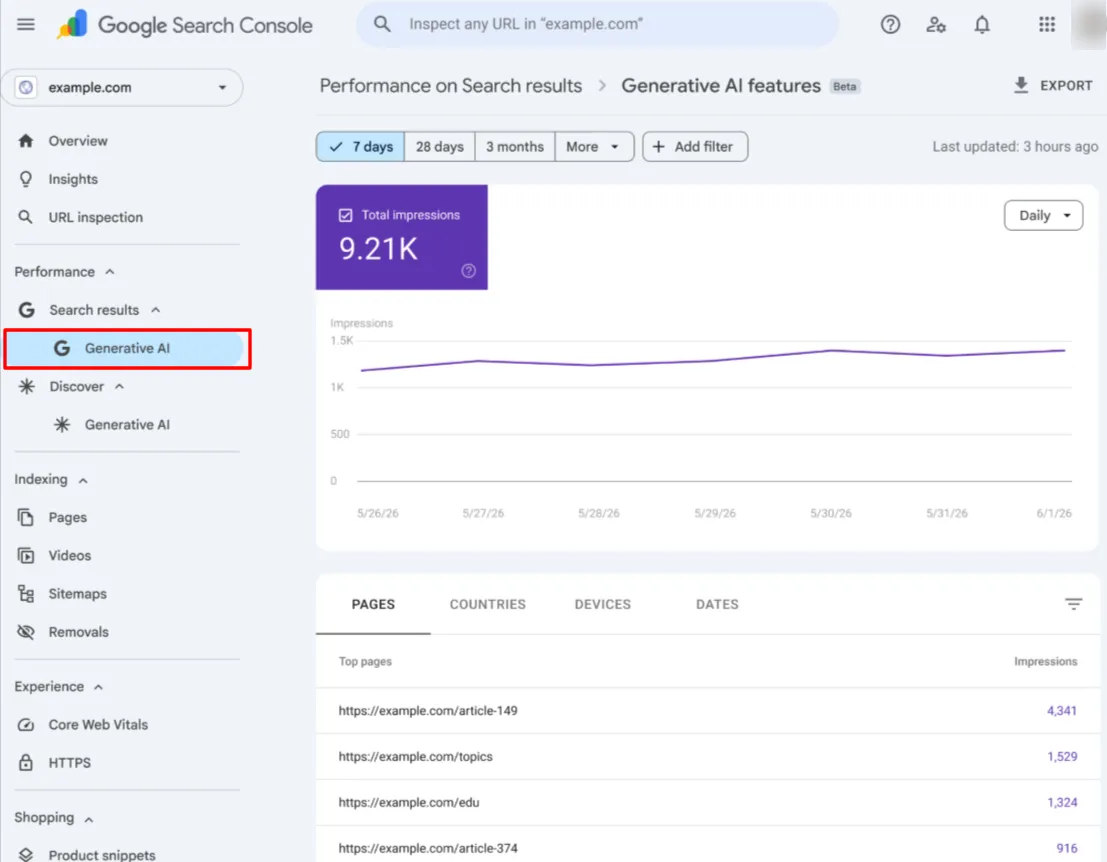
Do not stop at visibility.
A source link producing qualified leads is more valuable than 100 informational mentions that never influence revenue.
What to Look for in an AI Overview SEO Tool
The AI SEO software market is crowded, so ignore feature count and look at the reporting you actually need.
A useful AI search visibility tool should ideally support:
For agencies, multi-project reporting also matters.
For publishers, URL-level source history may matter more.
For SaaS teams, competitor mentions and conversion attribution may become higher priorities.
That is why generative engine optimization tools should be evaluated against your business model, not against the longest feature page.
Semrush AI Visibility: Track Citations, Competitors and Prompt Gaps
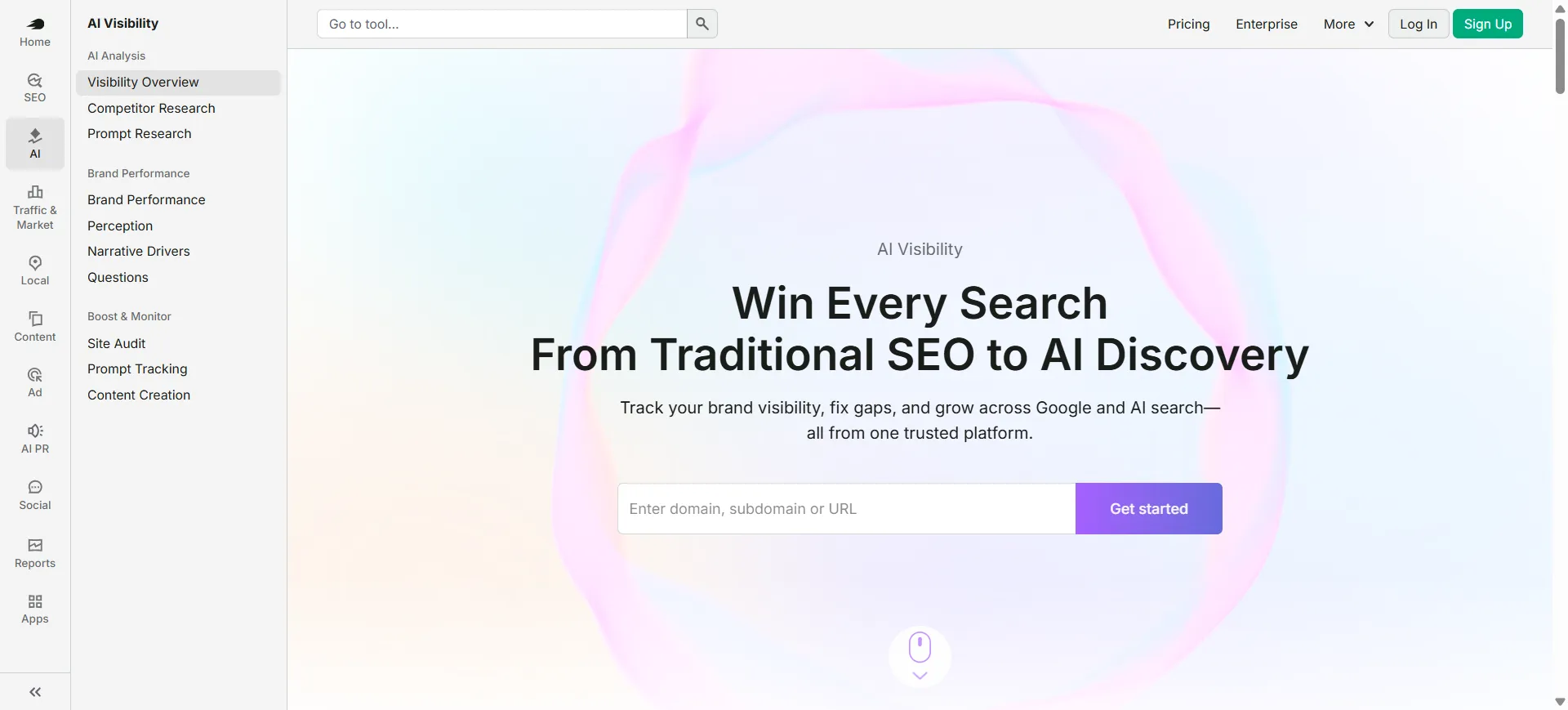
If you want to move beyond manually checking AI Overviews, Semrush AI Visibility gives you a much clearer view of where your brand is actually showing up.
You can monitor Google AI Overviews, AI Mode, ChatGPT and Gemini, see which pages earn citations, compare your visibility against competitors, and find prompts where competing brands appear but yours does not.
That last part is especially useful. Instead of guessing what content to update next, you can identify actual AI visibility gaps and work backwards from the prompts, topics and cited pages already getting exposure.
For SEO teams already using Semrush for rankings, backlinks and competitor research, having traditional SEO and AI visibility data in the same platform also makes reporting much easier.

Want to test it before paying?
Through our link, you can get an extended 14-day Semrush free trial, giving you two weeks to test the AI visibility features against your own website and competitors.
When an AI SEO Agency or AI Overview Optimization Service Makes Sense
You probably do not need an agency to add a direct answer below an H2.
External help starts making more sense when the problem includes several systems at once.
Examples:
A credible AI SEO agency, GEO agency, or Google AI Overview SEO service should be able to explain how it handles:
Technical SEO + content quality + original information + site architecture + measurementBe cautious if the entire offer revolves around:
There is no reason to buy mystery.
AI Overview SEO vs Traditional SEO vs GEO vs AEO
These terms overlap, but they are useful for describing different operational goals.
| Area | Main Goal | Typical Work |
|---|---|---|
| Traditional SEO | Improve Search visibility | Technical SEO, content, links, architecture |
| AEO | Provide clear answers | Direct responses, definitions, question coverage |
| GEO | Increase visibility in generative answers | Retrieval relevance, evidence, entity clarity |
| AI Overview SEO | Appear as a supporting source in Google's AI results | SEO, original information, retrieval coverage, measurement |
For Google specifically, I would not build four separate teams for these.
The underlying work overlaps heavily.
The labels are useful for reporting and planning.
The website still needs one connected search strategy.
Four-Week Google AI Overview Optimization Plan
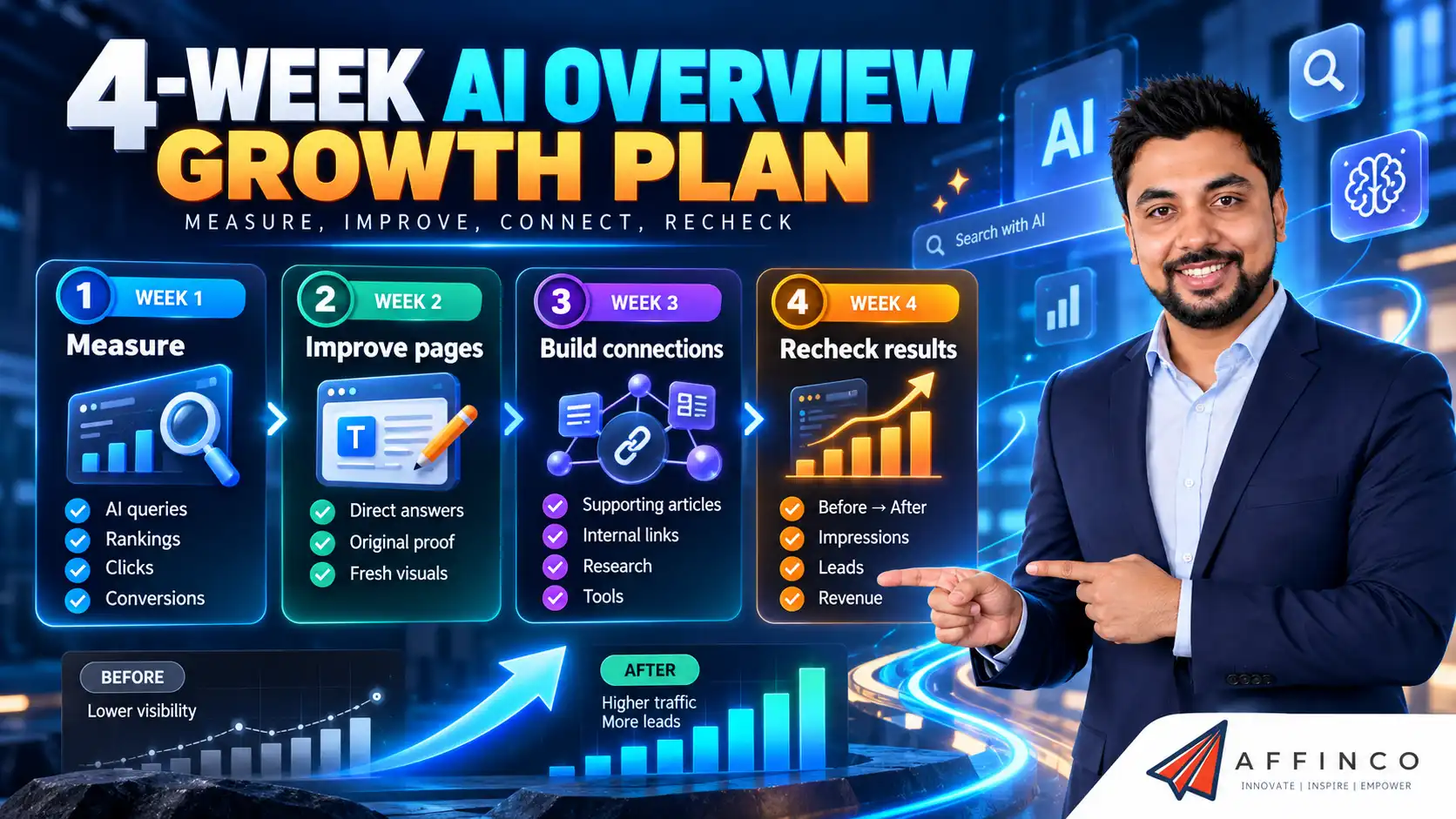
If I had to improve an established site without creating chaos, I would run the work in four stages.
Week 1: Measure Retrieval and Visibility
Identify:
Create the baseline before editing pages.
Week 2: Improve Priority Content
For the highest-value URLs:
Do not rewrite 200 URLs at once.
You need clean before-and-after data.
Week 3: Build Supporting Topic Connections
Add or improve:
The goal is to make the topic easier to navigate for both users and Search.
Week 4: Recheck Performance
Compare:
Before → After
Measure:
Then decide what deserves another update.
Google AI Overview SEO Checklist
Before publishing or refreshing a priority URL, run this list:
- URL is crawlable
- URL is indexed
- Canonical is correct
- Main content renders correctly
- Search intent is clear
- Main question receives a direct answer
- Important supporting questions are covered
- Content contains original information
- First-hand evidence is included where relevant
- Statistics have enough context
- Important claims can stand alone
- H2 and H3 headings describe real subtopics
- Internal links connect related pages
- Images or video add useful information
- Structured data matches visible content
- Time-sensitive details are current
- Mobile page experience is usable
- Page gives users a reason to click
- Conversion path is clear
- Organic performance is measured
- AI visibility is measured
That is the checklist I would trust before any supposed AI SEO hack.
Frequently Asked Questions About Ranking in Google AI Overviews
How do I rank in Google AI Overviews?
Make the page crawlable and indexable, answer the search intent clearly, cover relevant supporting questions, publish original information, support important claims, and strengthen the page with good internal links and useful evidence.
How does Google choose AI Overview sources?
Google can retrieve relevant information from its Search index for the original query and related queries. Pages and passages useful for supporting parts of the generated response may then appear as supporting links.
Does a page need to rank first to appear in an AI Overview?
No fixed number-one requirement exists. AI systems may retrieve sources related to supporting questions as well as the user's original query.
Does schema help with Google AI Overviews?
Structured data can help Google understand content and support normal Search features, but there is no special AI Overview schema that guarantees inclusion.
Does llms.txt improve Google AI Overview rankings?
No. Maintaining llms.txt may be useful for other systems that support it, but it is not a ranking requirement for Google's generative Search features.
Do backlinks affect AI Overview visibility?
Links remain part of wider SEO, but there is no documented backlink threshold for AI Overview inclusion. Page relevance, retrieval eligibility, quality, and usefulness still matter.
How can I track Google AI Overview visibility?
Track AI Overview appearances, cited URLs, competitors, organic positions, Search Console performance, conversions, and source gains or losses. An AI visibility monitoring tool can add query-level history and competitor tracking.
AFFiNCO Recommends More Guides to Check:

Stop Optimizing for the Box and Start Optimizing for Retrieval
The biggest mistake in Google AI Overview SEO is treating the AI Overview like a separate search engine that requires a different version of your website.
It does not.
The stronger approach is to build pages Google can retrieve when it needs reliable information.
That means improving:
Retrievability + relevance + originality + evidence + usability + measurementDo the technical SEO first.
Answer the real question. Cover the supporting questions. Add information competitors cannot cheaply reproduce. Make your strongest claims easy to understand.
Measure where the page appears and what those appearances produce. Do that consistently and AI Overview optimization stops being a collection of hacks.
It becomes what it should have been from the start:

Ali
Ali is a digital marketing expert with 7+ years of experience in SEO-optimized blogging. Skilled in reviewing SaaS tools, social media marketing, and email campaigns, we craft content that ranks well and engages audiences. Known for providing genuine information, Ali is a reliable source for businesses seeking to boost their online presence effectively.